Clemente-Periván Sayuri Itzel, Gómez-Gómez Yazmín, Leyva-Vázquez Marco Antonio, Lagunas-Martínez Alfredo, Organista-Nava Jorge, Illades-Aguiar Berenice
Laboratorio de Biomedicina Molecular, Facultad de Ciencias Químico Biológicas, Universidad Autónoma de Guerrero, Chilpancingo, Mexico.
Centro de Investigación sobre Enfermedades Infecciosas, Instituto Nacional de Salud Pública, Cuernavaca, Mexico.
Front Oncol. 2020 Mar 11;10:247. doi: 10.3389/fonc.2020.00247. eCollection 2020.
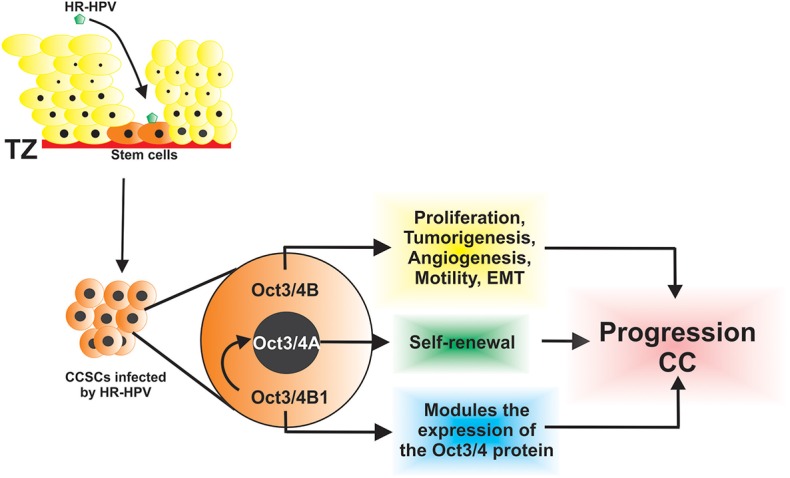
Cervical cancer (CC) is the fourth most common type of cancer that affects women. Compared to other types of cancer, CC has a high mortality rate in women worldwide. Several factors contribute to the development of CC, but persistent high-risk human papillomavirus infection is the main etiologic agent associated with the development of CC. Moreover, several studies reported that alterations in the expression of transcription factors present in a small subpopulation of cells within tumors called cancer stem cells (CSCs), which contribute to the development of CC by promoting tumorigenicity and metastasis. These transcription factors affect self-renewal and maintenance of pluripotency and differentiation in stem cells. belongs to the family of transcription factors with the POU domain. It consists of five exons and can be edited by alternative splicing into three main transcripts: OCT3/4A, OCT3/4B, and OCT3/4B1. The OCT3/4 expression in CSCs promotes carcinogenesis and the development of malignant tumors, and the loss of expression leads to the loss of self-renewal and proliferation and favors apoptosis. This review describes the main roles of OCT3/4 in CC and its importance in several biological processes that contribute to the development of CC and may serve as molecular targets to improve prognosis of CC.
宫颈癌(CC)是影响女性的第四大常见癌症类型。与其他类型的癌症相比,CC在全球女性中具有较高的死亡率。多种因素促成了CC的发生,但持续性高危型人乳头瘤病毒感染是与CC发生相关的主要病因。此外,多项研究报道,肿瘤中一小部分细胞即癌症干细胞(CSCs)中存在的转录因子表达改变,这些转录因子通过促进致瘤性和转移促成了CC的发生。这些转录因子影响干细胞的自我更新、多能性维持及分化。 属于具有POU结构域的转录因子家族。它由五个外显子组成,可通过可变剪接编辑成三种主要转录本:OCT3/4A、OCT3/4B和OCT3/4B1。CSCs中OCT3/4的表达促进癌变和恶性肿瘤的发展,而表达缺失会导致自我更新和增殖能力丧失并促进细胞凋亡。本综述描述了OCT3/4在CC中的主要作用及其在促成CC发生的多个生物学过程中的重要性,并可能作为改善CC预后的分子靶点。