Leibniz-Forschungsinstitut für Molekulare Pharmakologie, im Forschungsverbund Berlin e.V. (FMP), Campus Berlin-Buch, Robert-Rössle-Str. 10, 13125, Berlin, Germany.
Department of Musculoskeletal Biology, Institute of Ageing & Chronic Disease, William Henry Duncan Building, University of Liverpool, Liverpool, L7 8TX, UK.
Angew Chem Int Ed Engl. 2020 Jul 13;59(29):11937-11942. doi: 10.1002/anie.202000618. Epub 2020 May 14.
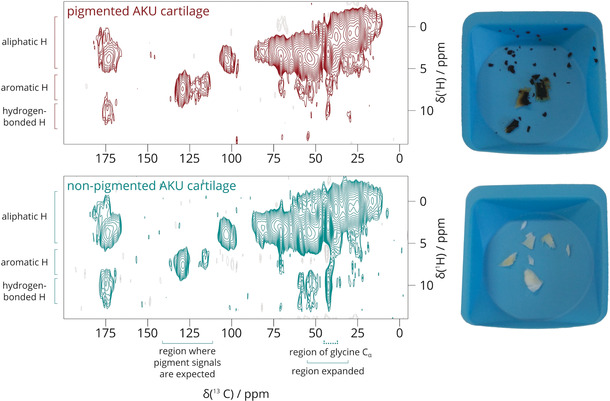
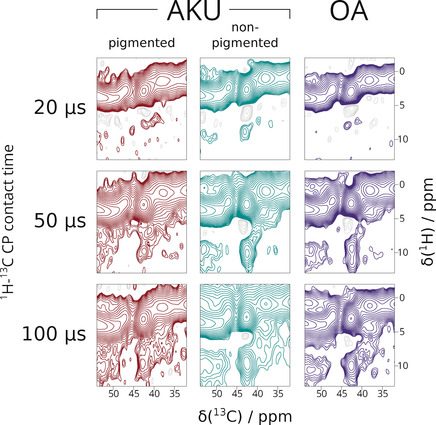
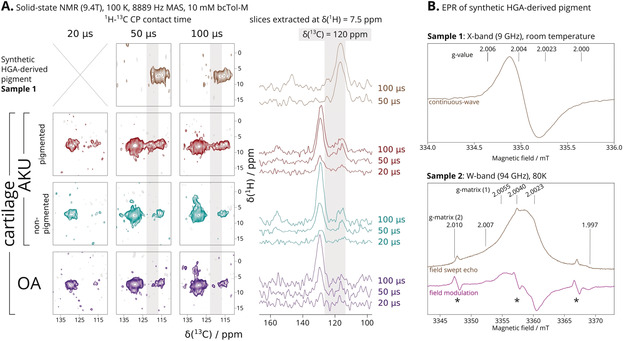
Alkaptonuria (AKU) is a rare disease characterized by high levels of homogentisic acid (HGA); patients suffer from tissue ochronosis: dark brown pigmentation, especially of joint cartilage, leading to severe early osteoarthropathy. No molecular mechanism links elevated HGA to ochronosis; the pigment's chemical identity is still not known, nor how it induces joint cartilage degradation. Here we give key insight on HGA-derived pigment composition and collagen disruption in AKU cartilage. Synthetic pigment and pigmented human cartilage tissue both showed hydroquinone-resembling NMR signals. EPR spectroscopy showed that the synthetic pigment contains radicals. Moreover, we observed intrastrand disruption of collagen triple helix in pigmented AKU human cartilage, and in cartilage from patients with osteoarthritis. We propose that collagen degradation can occur via transient glycyl radicals, the formation of which is enhanced in AKU due to the redox environment generated by pigmentation.
尿黑酸尿症(AKU)是一种罕见的疾病,其特征是高浓度的高香草酸(HGA);患者患有组织褐黄病:深褐色色素沉着,特别是关节软骨,导致严重的早期骨关节炎。目前还没有分子机制将升高的 HGA 与褐黄病联系起来;色素的化学性质仍不清楚,也不知道它如何诱导关节软骨降解。在这里,我们提供了有关 AKU 软骨中 HGA 衍生色素组成和胶原蛋白破坏的关键见解。合成色素和色素沉着的人软骨组织均显示出类似对苯二酚的 NMR 信号。电子顺磁共振波谱法显示合成色素含有自由基。此外,我们观察到色素沉着 AKU 人软骨和骨关节炎患者的软骨中胶原蛋白三螺旋的链内破坏。我们提出,胶原蛋白降解可能通过瞬时甘氨酰基自由基发生,由于色素沉着产生的氧化还原环境,AKU 中这种自由基的形成增强。