WHO Collaborating Centre for Infectious Disease Epidemiology and Control, School of Public Health, Li Ka Shing Faculty of Medicine, The University of Hong Kong, Hong Kong Special Administrative Region, China.
BMC Public Health. 2020 Mar 27;20(1):402. doi: 10.1186/s12889-020-08555-2.
Studies on healthcare-seeking behaviour usually adopted a patient care perspective, or restricted to specific disease conditions. However, pre-diagnosis symptoms may be more relevant to healthcare-seeking behaviour from a patient perspective. We described healthcare-seeking behaviours by specific symptoms related to respiratory and gastrointestinal-related infections.
We conducted a longitudinal population-based telephone survey in Hong Kong. We collected data on healthcare-seeking behaviour specific to symptoms of respiratory and gastrointestinal-related infections and also associated demographic factors. We performed descriptive analyses and estimated the proportion of participants who sought medical consultation, types of services utilized and duration from symptom onset to healthcare seeking, by different age groups. Post-stratification was used to compensate non-response and multiple imputation to handle missing and right-censored data.
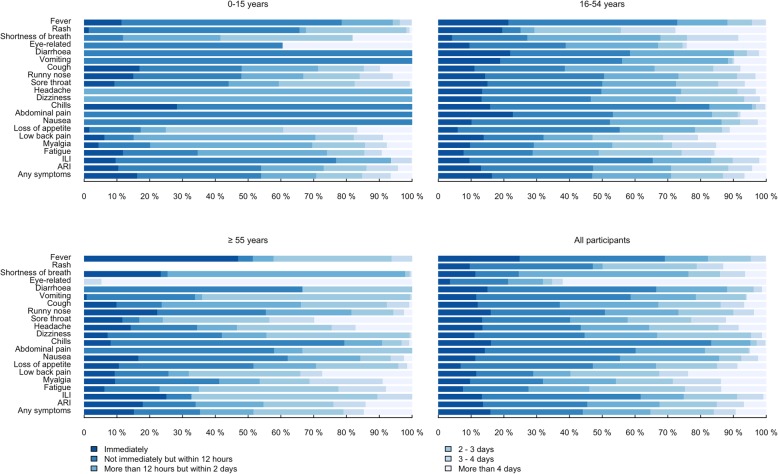
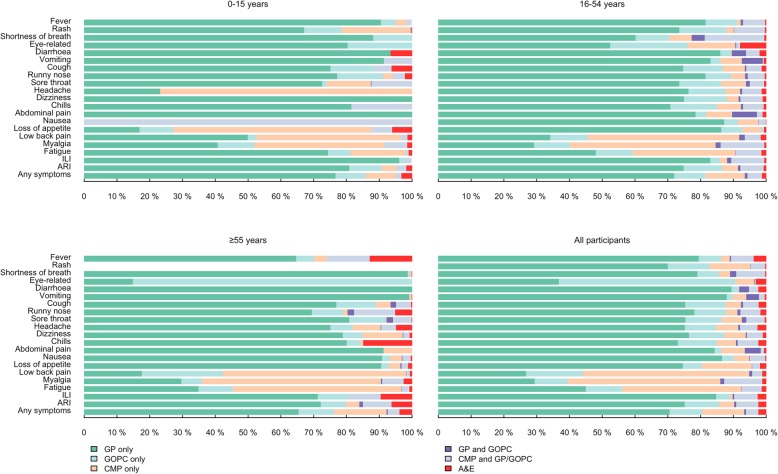
We recruited 2564 participants who reported a total of 4370 illness episodes and 7914 symptoms. Fatigue was the most frequently reported symptom, followed by headache and runny nose, with 30-day incidence rate of 9.1, 7.7, and 7.7% respectively. 78% of the participants who had fever sought medical consultation, followed by those with rash (60%) and shortness of breath (58%). Older adults (aged ≥55y) who had symptoms including fever, sore throat, and headache had a significantly higher consultation rate comparing to the other age groups. The 30-day incidence rates of influenza-like illness (ILI) and acute respiratory illness (ARI) were 0.8 and 7.2% respectively, and the consultation rates among these participants were 91 and 64%. Private general practitioner clinics was the main service utilized by participants for most of the symptoms considered, especially those related to acute illness such as fever, diarrhoea and vomiting. Chinese medicine clinics were mostly likely to be visited by participants with low back pain, myalgia and fatigue. Among participants who have sought medical services, most were within 3 days of symptom onset.
Healthcare-seeking behaviour were different by symptoms and age. Characterization of these patterns provides crucial parameters for estimating the full burden of common infectious diseases from facility-based surveillance system, for planning and allocation of healthcare resources.
针对医疗保健寻求行为的研究通常采用患者护理的视角,或仅限于特定的疾病情况。然而,从患者的角度来看,发病前的症状可能与医疗保健寻求行为更为相关。我们描述了与呼吸道和胃肠道感染相关的特定症状相关的医疗保健寻求行为。
我们在香港进行了一项基于人群的纵向电话调查。我们收集了与呼吸道和胃肠道感染相关的特定症状以及相关人口统计学因素的医疗保健寻求行为数据。我们进行了描述性分析,并按不同年龄组估计了寻求医疗咨询的参与者比例、利用的服务类型以及从症状出现到寻求医疗保健的时间。后分层用于补偿无应答,多次插补用于处理缺失和右删失数据。
我们招募了 2564 名参与者,他们报告了总共 4370 个疾病发作和 7914 个症状。疲劳是最常报告的症状,其次是头痛和流鼻涕,30 天发病率分别为 9.1%、7.7%和 7.7%。78%有发热症状的参与者寻求医疗咨询,其次是皮疹(60%)和呼吸急促(58%)。有发热、喉咙痛和头痛等症状的老年(≥55 岁)参与者的咨询率明显高于其他年龄组。流感样疾病(ILI)和急性呼吸道疾病(ARI)的 30 天发病率分别为 0.8%和 7.2%,这些参与者的咨询率分别为 91%和 64%。私人全科医生诊所是参与者考虑的大多数症状的主要服务,特别是与发热、腹泻和呕吐等急性疾病相关的症状。中医诊所最有可能被腰痛、肌肉痛和疲劳的参与者光顾。在寻求医疗服务的参与者中,大多数人在症状出现后 3 天内就诊。
症状和年龄不同,医疗保健寻求行为也不同。这些模式的特征提供了从基于设施的监测系统估计常见传染病全部负担的关键参数,以便规划和分配医疗保健资源。