Department of Disease Control, London School of Hygiene & Tropical Medicine, London, UK.
MRC Tropical Epidemiology Group, London School of Hygiene & Tropical Medicine, London, UK.
Lancet Planet Health. 2020 Mar;4(3):e116-e123. doi: 10.1016/S2542-5196(20)30037-1.
Child growth faltering persists in sub-Saharan Africa despite the scale-up of nutrition, water, and sanitation interventions over the past 2 decades. High temperatures have been hypothesised to contribute to child growth faltering via an adaptive response to heat, reduced appetite, and the energetic cost of thermoregulation. We did a cross-sectional study to assess whether child growth faltering is related to environmental temperature in sub-Saharan Africa.
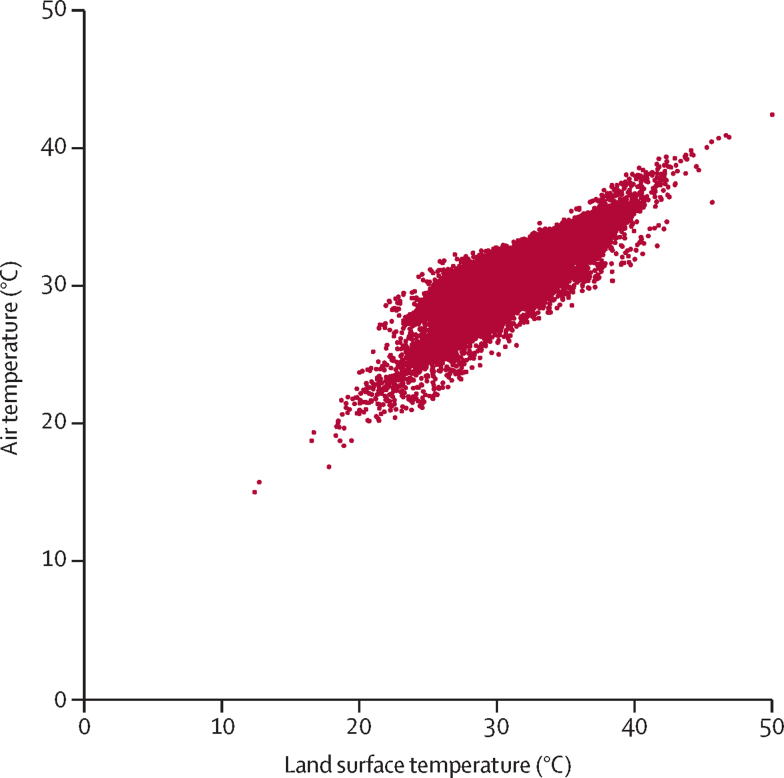
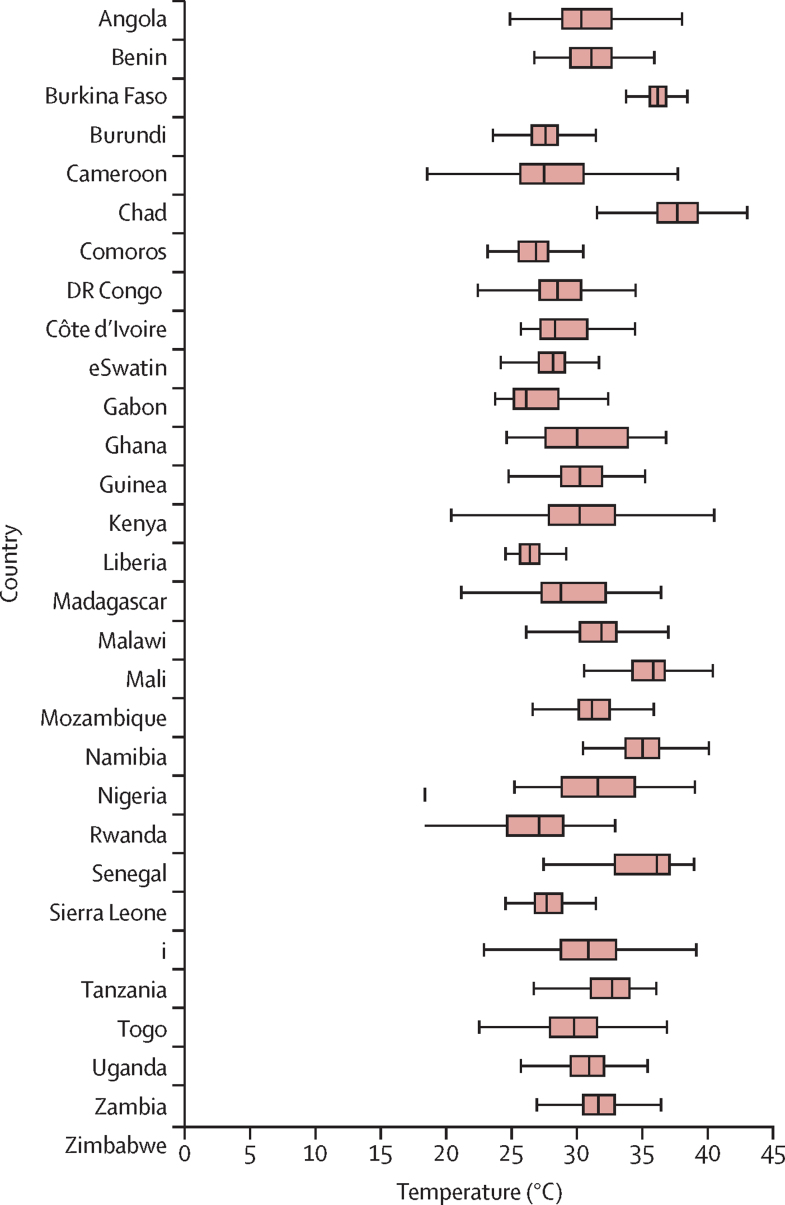
Data were extracted from 52 Demographic and Heath Surveys, dating from 2003 to 2016, that recorded anthropometric data in children aged 0-5 years, and were linked with remotely sensed monthly mean daytime land surface temperature for 2000-16. The odds of stunting (low height-for-age), wasting (low weight-for-height), and underweight (low weight-for-age) relative to monthly mean daytime land surface temperature were determined using multivariable logistic regression.
The study population comprised 656 107 children resident in 373 012 households. Monthly mean daytime land surface temperature above 35°C was associated with increases in the odds of wasting (odds ratio 1·27, 95% CI 1·16-1·38; p<0·0001), underweight (1·09, 1·02-1·16; p=0·0073), and concurrent stunting with wasting (1·23, 1·07-1·41; p=0·0037), but a reduction in stunting (0·90, 0·85-0·96; p=0·00047) compared with a monthly mean daytime land surface temperature of less than 30°C.
Children living in hotter parts of sub-Saharan Africa are more likely to be wasted, underweight, and concurrently stunted and wasted, but less likely to be stunted, than in cooler areas. Studies are needed to further investigate the relationship between temperature and child growth, including whether there is a direct effect not mediated by food security, regional wealth, and other environmental variables. Rising temperature, linked to anthropogenic climate change, might increase child growth faltering in sub-Saharan Africa.
UK Medical Research Council and UK Global Challenges Research Fund.
尽管过去 20 年来在营养、水和环境卫生方面进行了大规模干预,撒哈拉以南非洲地区儿童生长迟缓问题仍然存在。有人假设,高温可能通过对热的适应性反应、减少食欲以及体温调节的能量成本导致儿童生长迟缓。我们进行了一项横断面研究,以评估儿童生长迟缓是否与撒哈拉以南非洲的环境温度有关。
从 2003 年至 2016 年期间进行的 52 项人口与健康调查中提取数据,这些调查记录了 0-5 岁儿童的人体测量数据,并与 2000-16 年期间的遥感每月平均日间陆地表面温度相关联。使用多变量逻辑回归确定相对于每月平均日间陆地表面温度,发育迟缓(身高矮小)、消瘦(体重不足)和体重不足(体重不足)的发生几率。
研究人群包括居住在 373012 户家庭的 656107 名儿童。日间陆地表面温度高于 35°C 与消瘦(比值比 1.27,95%CI 1.16-1.38;p<0.0001)、体重不足(1.09,1.02-1.16;p=0.0073)和消瘦同时发生的几率增加有关(比值比 1.23,1.07-1.41;p=0.0037),但与日间陆地表面温度低于 30°C 相比,发育迟缓的几率降低(0.90,0.85-0.96;p=0.00047)。
生活在撒哈拉以南非洲较热地区的儿童消瘦、体重不足和消瘦的可能性更高,同时发育迟缓的可能性也更高,但发育迟缓的可能性较低与较凉爽地区相比。需要进一步研究温度与儿童生长之间的关系,包括是否存在不受食品安全、区域财富和其他环境变量影响的直接影响。与人为气候变化有关的气温上升可能会导致撒哈拉以南非洲地区儿童生长迟缓问题加剧。
英国医学研究理事会和英国全球挑战研究基金。