Santini Daniele, Berruti Alfredo, Di Maio Massimo, Procopio Giuseppe, Bracarda Sergio, Ibrahim Toni, Bertoldo Francesco
Department of Oncology, Campus Bio-Medico University, Roma, Italy
Medical Oncology Unit, Department of Medical and Surgical Specialties, Radiological Sciences, and Public Health, University of Brescia, ASST Spedali Civili, Brescia, Italy.
ESMO Open. 2020 Mar;5(2). doi: 10.1136/esmoopen-2019-000652.
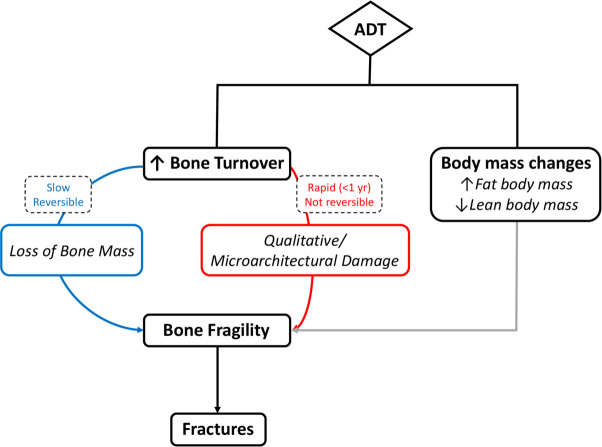
Bone health impairment is a frequent detrimental consequence of the high bone tropism of prostate cancer (PCa) cells. It is further worsened by administration of androgen-deprivation therapy (ADT), the current standard of care in the management of advanced PCa, through a rapid and dramatic increase in bone turnover and body mass changes. As a result, patients may experience substantial pain and poor quality of life (QoL) and have an increased risk of death. Notwithstanding the importance of this issue, however, bone health preservation is not yet a widespread clinical goal in daily practice.To address this urgent unmet need, following a thorough discussion of available data and sharing of their clinical practice experience, a panel of Italian experts in the field of bone health and metabolism formulated a number of practical advices for optimising the monitoring and treatment of bone health in men undergoing ADT during all phases of the disease. The rationale behind the venture was to raise awareness on the importance of bone preservation in this complex setting, while providing an instrument to support physicians and facilitate the management of bone health.Current evidence regarding the effects on bone health of ADT, of novel hormone therapies (which improve progression delay, pain control and QoL while consistently carrying the risk of non-pathological fractures in both non-metastatic and metastatic PCa) and of bone turnover inhibitors (whose use is frequently suboptimal) is reviewed. Finally, the expert opinion to optimise bone health preservation is given.
骨健康损害是前列腺癌细胞高骨嗜性常见的有害后果。对于晚期前列腺癌治疗的当前标准雄激素剥夺疗法(ADT),会使骨转换迅速且显著增加以及体重改变,从而进一步加剧骨健康损害。结果,患者可能会经历严重疼痛和生活质量(QoL)低下,且死亡风险增加。然而,尽管这个问题很重要,但在日常临床实践中,骨健康保护尚未成为广泛的临床目标。为满足这一迫切的未满足需求,在对现有数据进行深入讨论并分享他们的临床实践经验之后,一组意大利骨健康与代谢领域的专家针对在疾病各个阶段接受ADT的男性优化骨健康监测和治疗制定了一些实用建议。开展这项工作的基本原理是提高人们对在这种复杂情况下骨保护重要性的认识,同时提供一种工具来支持医生并促进骨健康管理。本文回顾了关于ADT、新型激素疗法(在非转移性和转移性前列腺癌中均能改善疾病进展延迟、疼痛控制和生活质量,但始终存在非病理性骨折风险)以及骨转换抑制剂(其使用往往未达最佳效果)对骨健康影响的当前证据。最后,给出了优化骨健康保护的专家意见。