Ding Gongwu, Li Jinlei, Lian Zhiwei
School of Public Health, Peking Union Medical College, Beijing, China.
Medicine (Baltimore). 2020 Mar;99(13):e19667. doi: 10.1097/MD.0000000000019667.
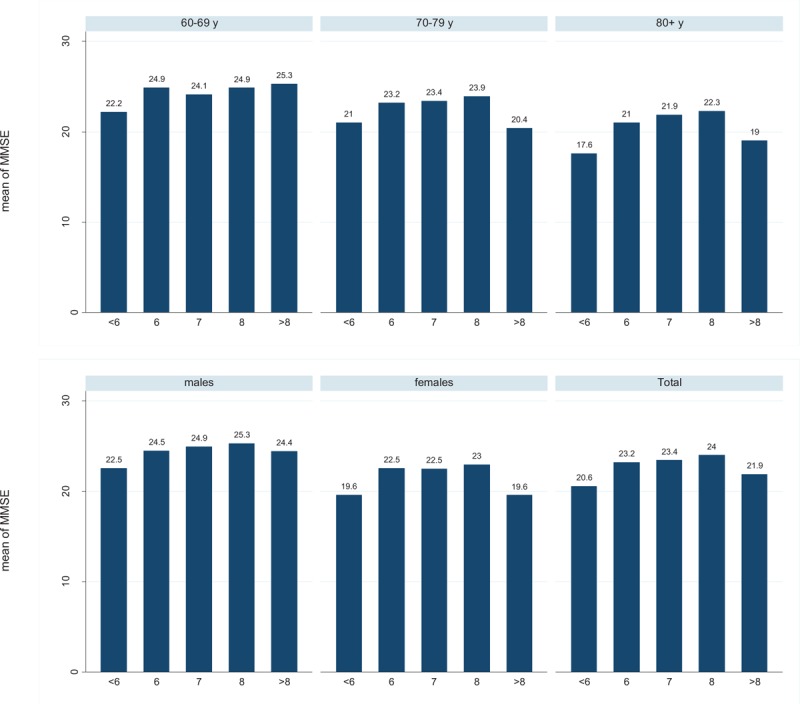
This study aims to examine the association between sleep duration and cognitive impairment in community-dwelling Chinese older adults.The associations between sleep duration and cognitive function have been widely studied across various age ranges but are of particular importance among older adults. However, there are inconsistent findings regarding the relationship between sleep duration and cognitive function in the literature.This study is an observational cross-sectional study. We analyzed data from 1115 Chinese individuals aged 60 and older from 3 Chinese communities (Beijing, Hefei, and Lanzhou). Cognitive impairment was defined as a Mini-Mental State Examination total score less than 24 points. Odds ratios (ORs) of associations were calculated and adjusted for potential confounders in logistic regression models.The prevalence of cognitive impairment was 25.7% (n = 287). Controlling for all demographic, lifestyle factors, and coexisting conditions, the adjusted OR for cognitive impairment was 2.54 (95% CI = 1.70-3.80) with <6 hours sleep and 2.39 (95% CI = 1.41-4.06) with >8 hours sleep.Both short and long sleep durations were related to worse cognitive function among community-dwelling Chinese elderly adults.
本研究旨在探讨中国社区居住的老年人睡眠时间与认知障碍之间的关联。睡眠时间与认知功能之间的关联已在各个年龄段进行了广泛研究,但在老年人中尤为重要。然而,关于睡眠时间与认知功能之间的关系,文献中的研究结果并不一致。本研究是一项观察性横断面研究。我们分析了来自中国3个社区(北京、合肥和兰州)的1115名60岁及以上中国人的数据。认知障碍定义为简易精神状态检查表总分低于24分。在逻辑回归模型中计算关联的比值比(OR),并对潜在混杂因素进行校正。认知障碍的患病率为25.7%(n = 287)。在控制所有人口统计学、生活方式因素和并存疾病后,睡眠时间<6小时时认知障碍的校正OR为2.54(95%CI = 1.70 - 3.80),睡眠时间>8小时时为2.39(95%CI = 1.41 - 4.06)。在中国社区居住的老年人中,睡眠时间过短和过长均与较差的认知功能有关。