
在个体化剂量下,辅助使用布瓦西坦治疗癫痫患者的长期安全性、疗效和生活质量结局:一项长达 11 年的开放性随访试验。
Long-term safety, efficacy, and quality of life outcomes with adjunctive brivaracetam treatment at individualized doses in patients with epilepsy: An up to 11-year, open-label, follow-up trial.
机构信息
Department of Neuroscience, Central Clinical School, Alfred Health, Monash University, Melbourne, Victoria, Australia.
Departments of Medicine and Neurology, Royal Melbourne Hospital, University of Melbourne, Parkville, Victoria, Australia.
出版信息
Epilepsia. 2020 Apr;61(4):636-646. doi: 10.1111/epi.16484. Epub 2020 Mar 28.
OBJECTIVE
To evaluate long-term safety/tolerability of brivaracetam at individualized doses ≤200 mg/d (primary) and maintenance of efficacy over time (secondary) in adults with focal seizures or primary generalized seizures (PGS) enrolled in phase 3, open-label, long-term follow-up trial N01199 (NCT00150800).
METHODS
Patients ≥16 years of age who had completed double-blind, placebo-controlled adjunctive brivaracetam trials NCT00175825, NCT00490035, NCT00464269, or NCT00504881 were eligible. Outcomes included safety, efficacy, and quality of life.
RESULTS
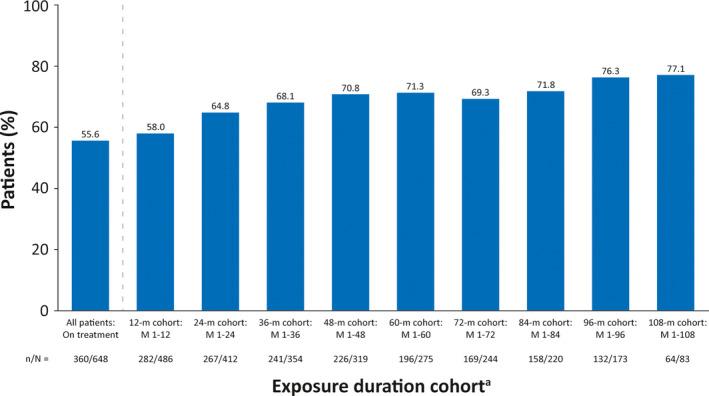
The safety set included 667 patients (focal seizures, 97.8%; PGS, 2.2%); the efficacy set included 648 patients with focal seizures and 15 patients with PGS. Overall, 49.2% of patients had ≥48 months of exposure. Treatment-emergent adverse events (TEAEs) occurred in 91.2% of all patients (91.3% of focal seizures group), brivaracetam discontinuation due to TEAEs in 14.8%, drug-related TEAEs in 56.7%, and serious TEAEs in 22.8%. The most common TEAEs in the focal seizures group (≥15%) were headache (25.3%) and dizziness (21.9%). Mean changes from baseline in Hospital Anxiety and Depression Scale scores at last value during 2-year evaluation were -0.7 (standard deviation [SD] = 4.3) and -0.2 (SD = 4.4) overall. In the focal seizures group, median reduction from baseline in focal seizure frequency/28 days was 57.3%, 50% responder rate was 55.6%, and 6-month and 12-month seizure freedom rates were 30.3% and 20.3%, respectively. Efficacy outcomes improved by exposure duration cohort and then stabilized through the 108-month cohort. Mean improvement from baseline in Patient-Weighted Quality of Life in Epilepsy Inventory total score (efficacy set) was 5.7 (SD = 16.1, Cohen's d = 0.35) at month 12 and 6.5 (SD = 18.0, Cohen's d = 0.36) at month 24.
SIGNIFICANCE
Adjunctive brivaracetam was well tolerated, with a good safety profile in long-term use in adults with epilepsy at individualized doses. Approximately half of the patients remained in the trial at 4 years. Brivaracetam reduced focal seizure frequency versus baseline. Efficacy improved with increasing exposure duration and remained stable through the 9-year cohort.
目的
评估在接受个体化剂量≤200mg/d(主要终点)的成人局灶性发作或原发性全面性癫痫(PGS)患者中,布瓦加坦的长期安全性/耐受性和随着时间推移的疗效维持(次要终点)。该研究为一项 3 期、开放性、长期随访试验 N01199(NCT00150800)。
方法
已完成双盲、安慰剂对照的布瓦加坦辅助治疗试验 NCT00175825、NCT00490035、NCT00464269 或 NCT00504881 的年龄≥16 岁的患者符合条件。主要结局包括安全性、疗效和生活质量。
结果
安全性分析纳入 667 例患者(局灶性发作,97.8%;PGS,2.2%);疗效分析纳入 648 例局灶性发作患者和 15 例 PGS 患者。总体而言,49.2%的患者有≥48 个月的暴露。所有患者中,治疗中出现的不良事件(TEAE)发生率为 91.2%(局灶性发作组为 91.3%),因 TEAEs 而停止治疗的比例为 14.8%,药物相关 TEAEs 发生率为 56.7%,严重 TEAEs 发生率为 22.8%。局灶性发作组最常见的 TEAEs(≥15%)为头痛(25.3%)和头晕(21.9%)。2 年评估期间最后一次就诊时,医院焦虑和抑郁量表评分较基线的平均变化为-0.7(标准差 [SD] = 4.3)和-0.2(SD = 4.4)。在局灶性发作组中,局灶性发作频率/28 天的中位数从基线的降低率为 57.3%,50%应答率为 55.6%,6 个月和 12 个月的无癫痫发作率分别为 30.3%和 20.3%。随着暴露时间队列的增加,疗效结果得到改善,然后在第 108 个月队列中稳定下来。在接受布瓦加坦治疗的癫痫患者中(疗效分析),患者权重的癫痫生活质量问卷(Patient-Weighted Quality of Life in Epilepsy Inventory)总分从基线的平均改善为 12 个月时的 5.7(SD = 16.1,Cohen's d = 0.35)和 24 个月时的 6.5(SD = 18.0,Cohen's d = 0.36)。
意义
布瓦加坦在长期使用时具有良好的耐受性,在个体化剂量下用于治疗癫痫成人的安全性良好。大约一半的患者在 4 年内仍留在试验中。布瓦加坦可降低局灶性发作频率。随着暴露时间的延长,疗效得到改善,在 9 年队列中保持稳定。

 Zotero 插件