Liu Yuzhou, Xiao Feng, Zhuang Yongqing, Lao Jie
Department of Hand Surgery, Huashan Hospital, Fudan University, 12 Wulumuqi Zhong Road, Jing An District, Shanghai, 200040, China.
Key Laboratory of Hand Reconstruction, Ministry of Health, Shanghai, China.
BMC Musculoskelet Disord. 2020 Mar 28;21(1):196. doi: 10.1186/s12891-020-03209-1.
Contralateral cervical 7 nerve (cC7) was used to repair two recipient nerves simultaneously for patients with total brachial plexus avulsion (TBPA).
To evaluate the effect of cC7 transfer to axillary and median nerves in rats with TBPA.
Eighty S-D rats were divided into 4 groups randomly on average. Group A: cC7-median nerve, Group B: cC7-axillary nerve, Group C: cC7-median and axillary nerves, Group D: TBPA without repair. The evaluation tools included behavioral tests, electromyogram (EMG), measurement of cross-sectional area of muscle fiber, nerve fiber count and gene expression assay.
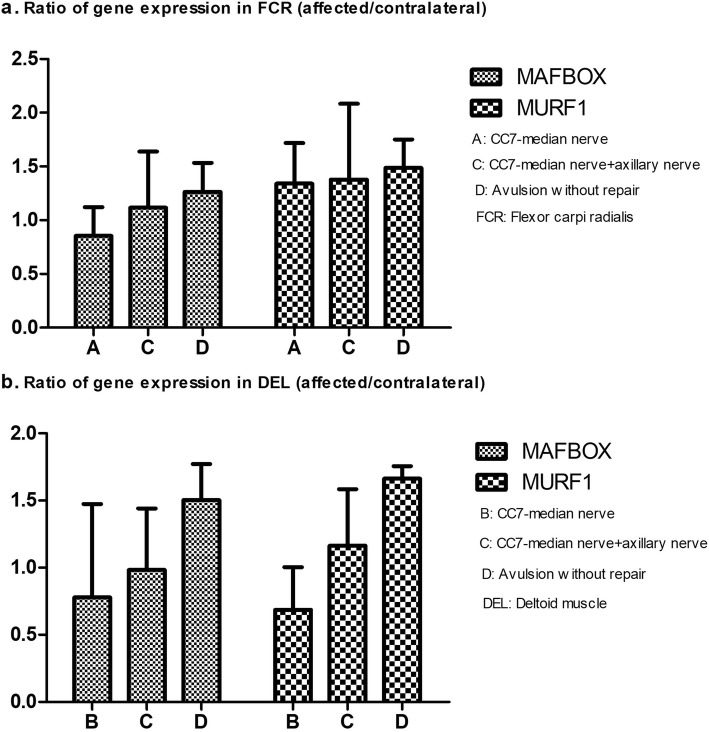
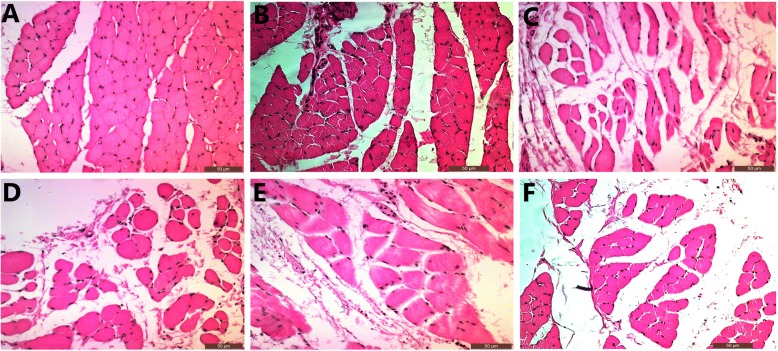
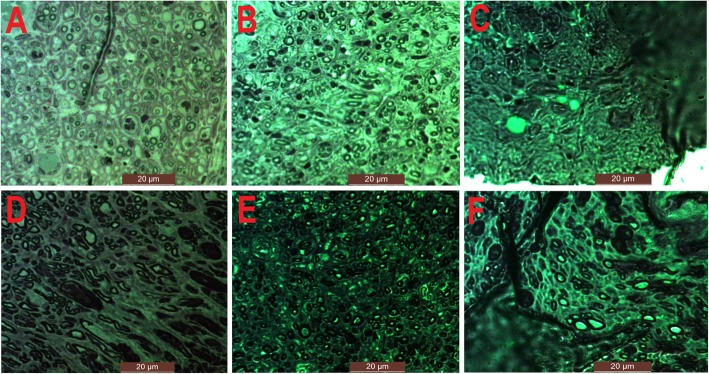
The effective rates of EMG were 90 and 70% in Flexor Carpi Radialis (FCR) in Group A and C, while 70 and 60% in deltoid (DEL) in Group B and C, respectively. In behavioral test, the differences of effective rates between groups were not significant. The mean cross-sectional area of FCR in Group A or C was significantly larger than that in Group D. Either the number of median or axillary nerve fibers in Group A, B or C was statistically more than that in Group D. No matter for FCR or DEL, there were no significant differences in the ratios of relative expression of Muscle Atrophy F-box(MAFBOX)and Muscle RING Finger 1(MURF1)among these groups.
Compared with cC7 transfer to median nerve, cC7 transfer to both median and axillary nerves did not affect median nerve recovery. The deltoid muscle also could be restored. The recovery proportion of axillary nerve was less than that of median nerve.
对于全臂丛神经撕脱伤(TBPA)患者,采用对侧颈7神经(cC7)同时修复两条受区神经。
评估cC7转位至TBPA大鼠的腋神经和正中神经的效果。
80只SD大鼠平均随机分为4组。A组:cC7-正中神经;B组:cC7-腋神经;C组:cC7-正中神经和腋神经;D组:未修复的TBPA。评估工具包括行为学测试、肌电图(EMG)、肌纤维横截面积测量、神经纤维计数和基因表达检测。
A组和C组桡侧腕屈肌(FCR)的EMG有效率分别为90%和70%,而B组和C组三角肌(DEL)的有效率分别为70%和60%。在行为学测试中,各组之间的有效率差异不显著。A组或C组FCR的平均横截面积显著大于D组。A组、B组或C组正中神经或腋神经纤维数量在统计学上均多于D组。无论FCR还是DEL,各组之间肌肉萎缩F盒(MAFBOX)和肌肉环指蛋白1(MURF1)相对表达率均无显著差异。
与cC7转位至正中神经相比,cC7转位至正中神经和腋神经均不影响正中神经恢复。三角肌也可得到恢复。腋神经的恢复比例低于正中神经。