Department of Social and Preventive Medicine, Laval University, 1050, Avenue de la Médecine, Quebec, QC, G1V 0A6, Canada.
CHU de Québec - Université Laval Research Center, 2400, Avenue d'Estimauville, Quebec, QC, G1E 7G9, Canada.
BMC Infect Dis. 2020 Mar 29;20(1):251. doi: 10.1186/s12879-020-4870-x.
The objectives of this review were to evaluate the effect of age at administration of the first dose of a measles-containing vaccine (MCV1) on protection against measles and on antibody response after one- and two-dose measles vaccinations.
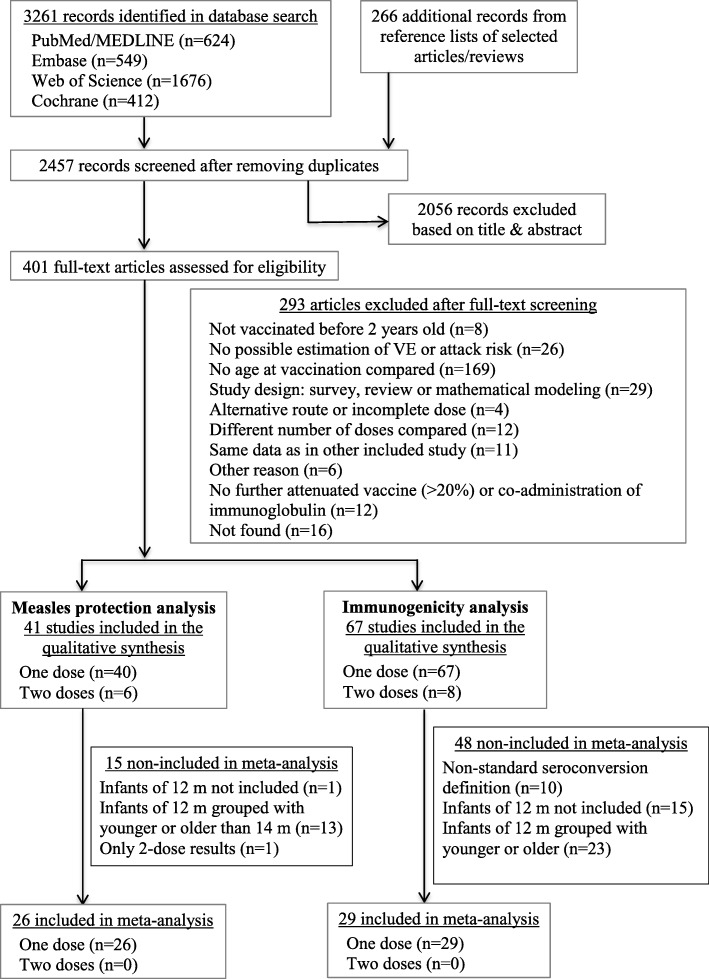
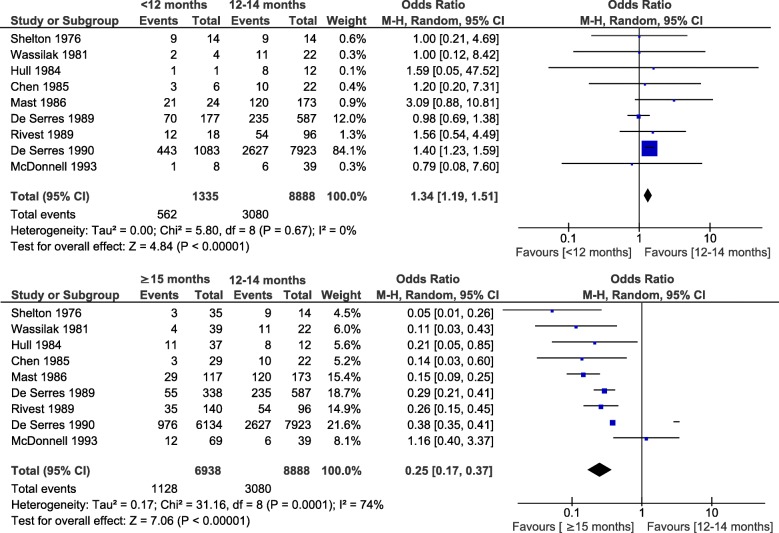
We conducted a systematic review of the PubMed/MEDLINE, Embase, Web of Science and Cochrane databases (1964-2017) to identify observational studies estimating vaccine effectiveness and/or measles attack rates by age at first vaccination as well as experimental studies comparing seroconversion by age at first vaccination. Random effect models were used to pool measles risk ratios (RR), measles odds ratios (OR) and seroconversion RR of MCV1 administered at < 9, 9-11 or ≥ 15 months compared with 12 or 12-14 months of age.
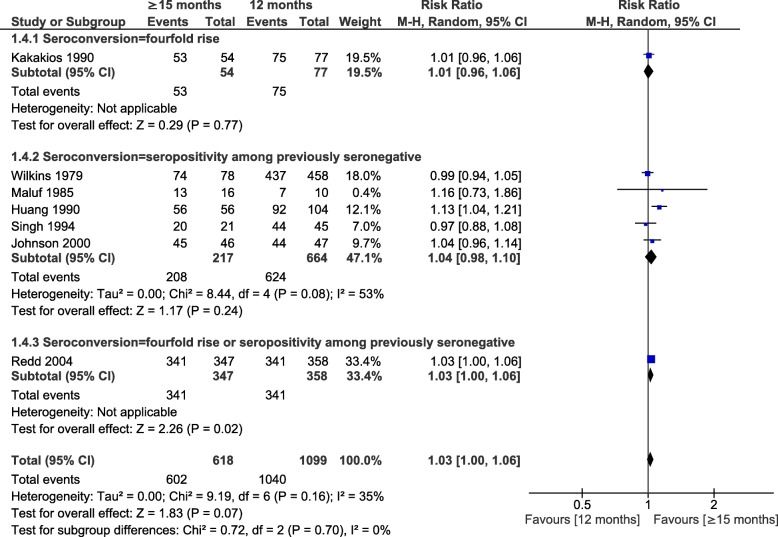
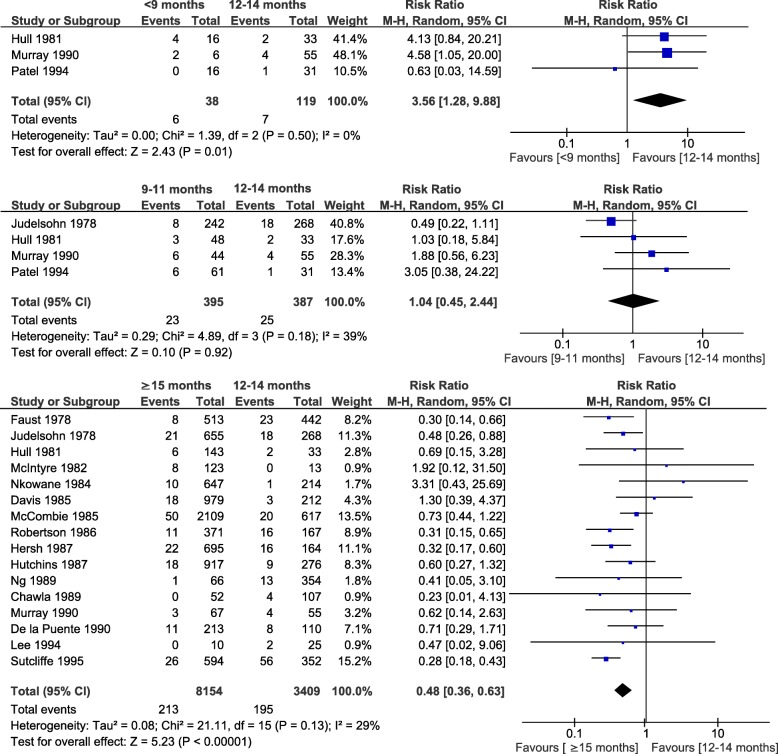
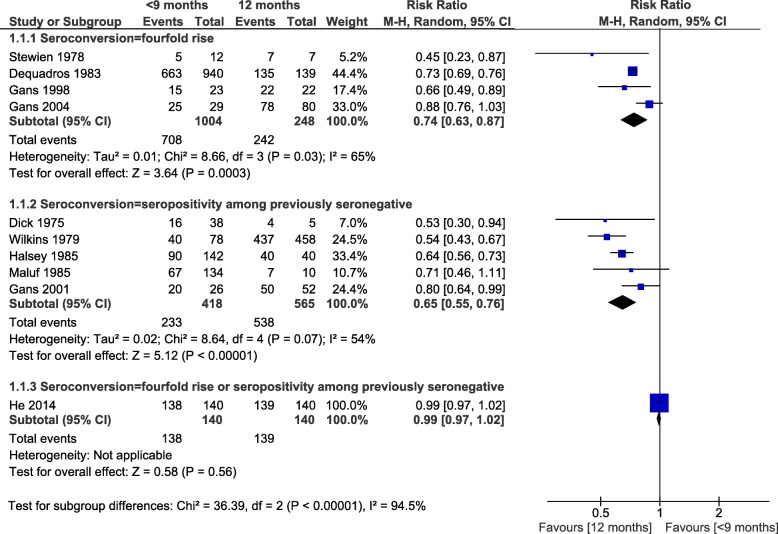
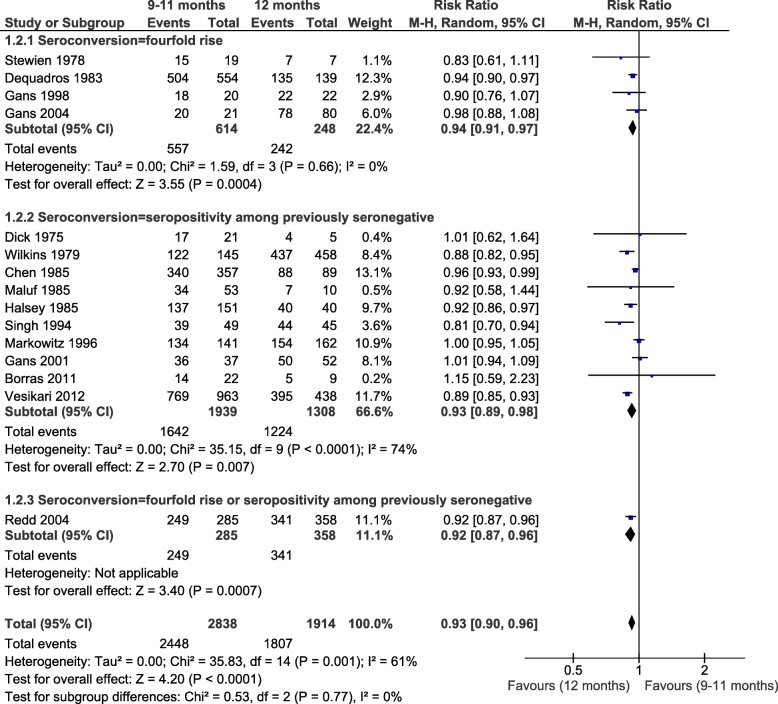
We included 41 and 67 studies in the measles protection and immunogenicity analyses. Older age at MCV1, from 6 to ≥15 months, improved antibody response and measles protection among one-dose recipients. Pooled measles RR ranged from 3.56 (95%CI: 1.28, 9.88) for MCV1 at < 9 months to 0.48 (95%CI: 0.36, 0.63) for MCV1 at ≥15 months, both compared to 12-14 months. Pooled seroconversion RR ranged from 0.93 (95%CI: 0.90, 0.96) for MCV1 at 9-11 months to 1.03 (95%CI: 1.00, 1.06) for MCV1 at ≥15 months, both compared to 12 months. After a second dose, serological studies reported high seropositivity regardless of age at administration of MCV1 while epidemiological data based on few studies suggested lower protection with earlier age at MCV1.
Earlier age at MCV1 decreases measles protection and immunogenicity after one dose and might still have an impact on vaccine failures after two doses of measles vaccine. While two-dose vaccination coverage is most critical to interrupt measles transmission, older age at first vaccination may be necessary to keep the high level of population immunity needed to maintain it.
本研究旨在评估麻疹疫苗(MCV1)首针接种年龄对预防麻疹的效果及对 1 剂和 2 剂麻疹疫苗接种后抗体应答的影响。
我们对 PubMed/MEDLINE、Embase、Web of Science 和 Cochrane 数据库(1964-2017 年)进行了系统检索,以确定评估首针接种年龄对麻疹疫苗有效性和(或)麻疹发病风险的观察性研究,以及比较首针接种年龄对麻疹病毒 1 型血清转化率的实验性研究。采用随机效应模型比较了<9 个月、9-11 个月和≥15 个月与 12 个月或 12-14 个月龄接种 MCV1 的麻疹风险比(RR)、麻疹优势比(OR)和血清转化率 RR。
我们纳入了麻疹保护和免疫原性分析的 41 项和 67 项研究。1 剂麻疹疫苗接种中,首针接种年龄为 6-15 个月时,抗体应答和麻疹保护效果更好。与 12-14 个月龄相比,<9 个月龄时接种 MCV1 的麻疹 RR 为 3.56(95%CI:1.28,9.88),≥15 个月龄时为 0.48(95%CI:0.36,0.63)。与 12 个月龄相比,9-11 个月龄时接种 MCV1 的血清转化率 RR 为 0.93(95%CI:0.90,0.96),≥15 个月龄时为 1.03(95%CI:1.00,1.06)。接种第 2 剂后,血清学研究报告称,无论首针接种 MCV1 的年龄如何,血清阳性率均较高,而基于少数研究的流行病学数据表明,首针接种 MCV1 年龄较早时,保护效果较低。
MCV1 首针接种年龄提前会降低 1 剂麻疹疫苗的保护效果和免疫原性,且可能对 2 剂麻疹疫苗接种后的疫苗失败仍有影响。虽然两剂疫苗接种覆盖率对阻断麻疹传播至关重要,但为了维持高人群免疫水平,首针接种年龄可能需要适当提前。