Lee Ran, Kim Sarah, Na Hyerin, Seo Ji In, Yoon Jang Gwon, Park A Ram, Bae So Hyun, Park So Yeong, Cho Jun Hwi, Kim Jin, Choi Seong-Woo, Kweon Sun-Seog, Sun Bongkyu, Kim Kyunghak, Park Kyung-Hwa, Kim Seong Eun
Gwangju Center for Infectious Diseases Control and Prevention, Gwangju, Republic of Korea.
Department of Public Health, Graduate School, Chonnam National University, Gwangju, Republic of Korea.
Front Public Health. 2024 Dec 19;12:1505489. doi: 10.3389/fpubh.2024.1505489. eCollection 2024.
Measles remains a public health concern, particularly among populations with suboptimal vaccination coverage, including immigrants. Understanding the seroprevalence of measles antibodies in immigrant populations is essential to inform tailored vaccination strategies and reduce the risk of measles reintroduction.
This study evaluated measles IgG seroprevalence among 651 immigrants from 30 countries residing in Gwangju, South Korea. Participants were recruited between September 2022 and August 2024, and measles antibody levels were assessed using the LIAISON® XL assay. Statistical analyses included Fisher's exact and chi-squared tests to identify associations between seropositivity and demographic factors.
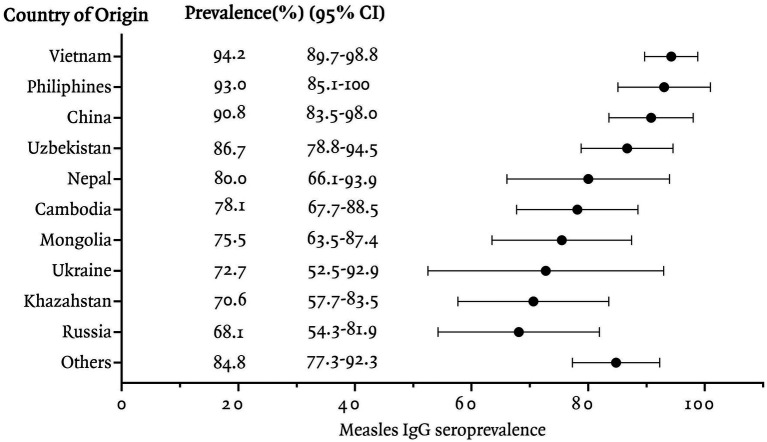
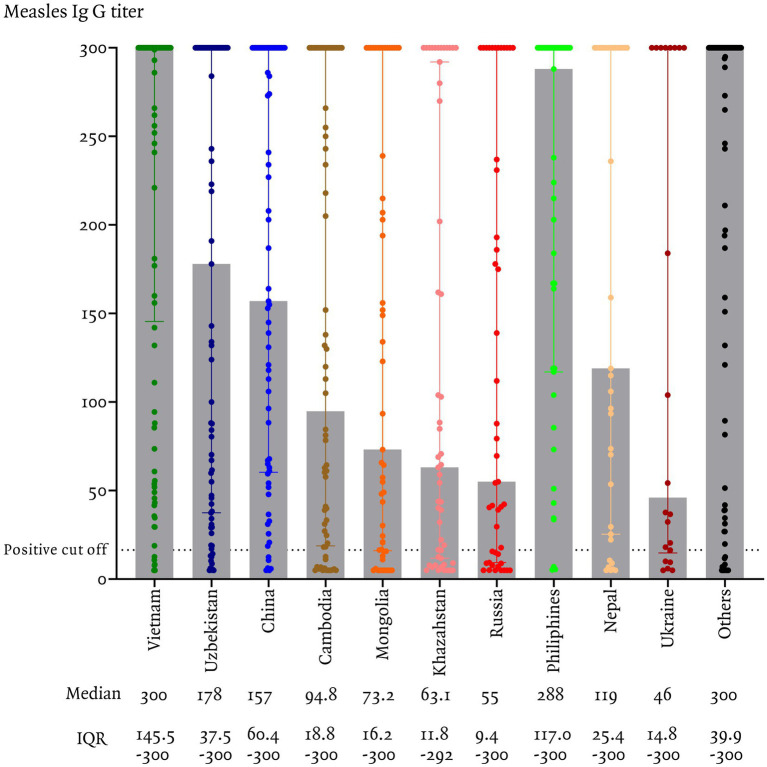
Measles antibody positivity rates varied significantly by age group ( < 0.01). Individuals born after 1995 exhibited the lowest seroprevalence (63.7%), while those born in 1964 or earlier were all seropositive (100%). Seroprevalence was particularly low among immigrants from Russia (68.1%), Kazakhstan (70.6%), Ukraine (72.7%), Mongolia (75.5%), and Cambodia (78.1%). Long-term residents demonstrated higher antibody positivity (92.9%) than other visa categories ( < 0.01), and women had higher seropositivity (85.8%) compared to men (80.0%), with a near-significant difference ( = 0.05).
The higher seropositivity observed among long-term residents and women is likely due to prior immunization with the MMR (Measles Mumps Rubella) vaccine, which is recommended to prevent congenital rubella syndrome as part of pre-pregnancy vaccination protocols. This study underscores the importance of implementing tailored vaccination programs based on the characteristics of immigrant populations and focusing on countries with low seroprevalence to effectively prevent measles reintroduction.
麻疹仍然是一个公共卫生问题,特别是在疫苗接种覆盖率不理想的人群中,包括移民。了解移民人群中麻疹抗体的血清流行率对于制定针对性的疫苗接种策略和降低麻疹再次传入的风险至关重要。
本研究评估了居住在韩国光州的来自30个国家的651名移民中的麻疹IgG血清流行率。在2022年9月至2024年8月期间招募参与者,并使用LIAISON® XL检测法评估麻疹抗体水平。统计分析包括Fisher精确检验和卡方检验,以确定血清阳性与人口统计学因素之间的关联。
麻疹抗体阳性率在不同年龄组之间存在显著差异(<0.01)。1995年以后出生的个体血清流行率最低(63.7%),而1964年或更早出生的个体均为血清阳性(100%)。来自俄罗斯(68.1%)、哈萨克斯坦(70.6%)、乌克兰(72.7%)、蒙古(75.5%)和柬埔寨(78.1%)的移民血清流行率特别低。长期居民的抗体阳性率(92.9%)高于其他签证类别(<0.01),女性的血清阳性率(85.8%)高于男性(80.0%),差异接近显著(=0.05)。
长期居民和女性中观察到的较高血清阳性率可能是由于先前接种了MMR(麻疹、腮腺炎、风疹)疫苗,作为孕前疫苗接种方案的一部分,该疫苗被推荐用于预防先天性风疹综合征。本研究强调了根据移民人群的特征实施针对性疫苗接种计划的重要性,并关注血清流行率低的国家,以有效预防麻疹再次传入。