Pokrovska Tzveta D, Jacobus Egon J, Puliyadi Rathi, Prevo Remko, Frost Sally, Dyer Arthur, Baugh Richard, Rodriguez-Berriguete Gonzalo, Fisher Kerry, Granata Giovanna, Herbert Katharine, Taverner William K, Champion Brian R, Higgins Geoff S, Seymour Len W, Lei-Rossmann Janet
Anticancer Viruses and Cancer Vaccines Research Group, Department of Oncology, University of Oxford, Oxford OX3 7DQ, UK.
Tumour Radiosensitivity Research Group, Department of Oncology, University of Oxford, Oxford OX3 7DQ, UK.
Cancers (Basel). 2020 Mar 26;12(4):798. doi: 10.3390/cancers12040798.
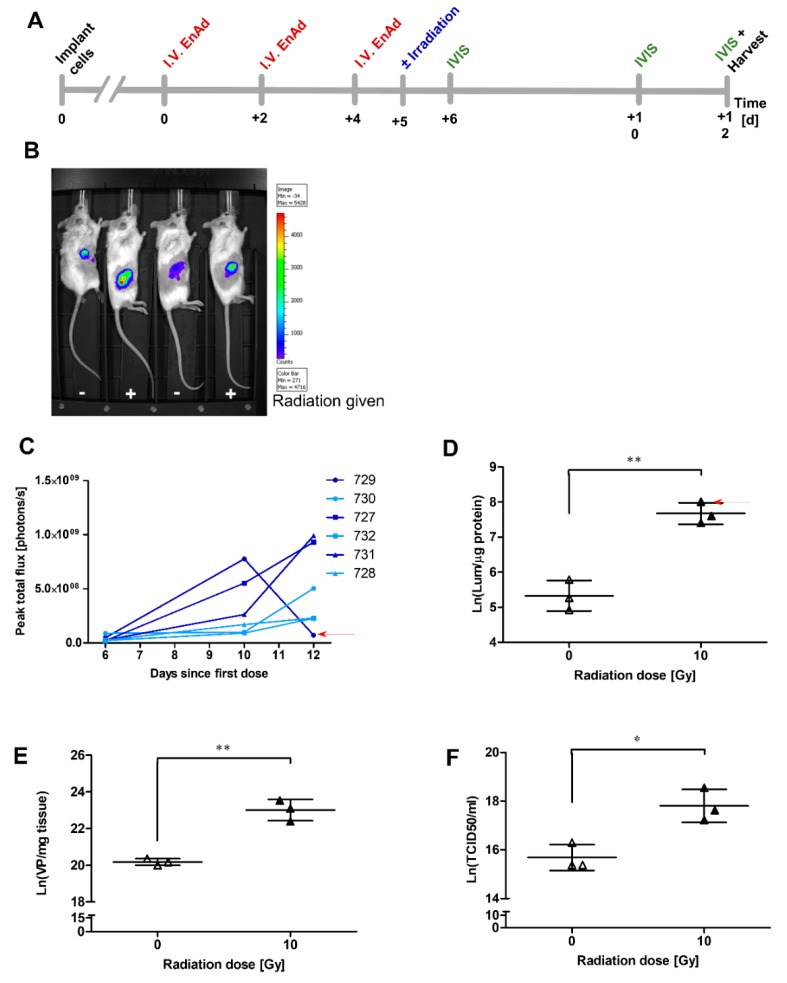
Ionising radiation causes cell death through the induction of DNA damage, particularly double-stranded DNA (dsDNA) breaks. Evidence suggests that adenoviruses inhibit proteins involved in the DNA damage response (DDR) to prevent recognition of double-stranded viral DNA genomes as cellular dsDNA breaks. We hypothesise that combining adenovirus treatment with radiotherapy has the potential for enhancing tumour-specific cytotoxicity through inhibition of the DDR and augmentation of virus production. We show that EnAd, an Ad3/Ad11p chimeric oncolytic adenovirus currently being trialled in colorectal and other cancers, targets the DDR pathway at a number of junctures. Infection is associated with a decrease in irradiation-induced 53BP1 and Rad51 foci formation, and in total DNA ligase IV levels. We also demonstrate a radiation-associated increase in EnAd production in vitro and in a pilot in vivo experiment. Given the current limitations of in vitro techniques in assessing for synergy between these treatments, we adapted the plaque assay to allow monitoring of viral plaque size and growth and utilised the xCELLigence cell adhesion assay to measure cytotoxicity. Our study provides further evidence on the interaction between adenovirus and radiation in vitro and in vivo and suggests these have at least an additive, and possibly a synergistic, impact on cytotoxicity.
电离辐射通过诱导DNA损伤,特别是双链DNA(dsDNA)断裂,导致细胞死亡。有证据表明,腺病毒会抑制参与DNA损伤反应(DDR)的蛋白质,以防止双链病毒DNA基因组被识别为细胞dsDNA断裂。我们假设,将腺病毒治疗与放射疗法相结合,有可能通过抑制DDR和增加病毒产生来增强肿瘤特异性细胞毒性。我们发现,EnAd是一种目前正在结直肠癌和其他癌症中进行试验的Ad3/Ad11p嵌合溶瘤腺病毒,它在多个节点靶向DDR途径。感染与辐射诱导的53BP1和Rad51病灶形成减少以及总DNA连接酶IV水平降低有关。我们还在体外和一项体内初步实验中证明了辐射会使EnAd产生增加。鉴于目前体外技术在评估这些治疗之间协同作用方面的局限性,我们改进了噬斑测定法以监测病毒噬斑大小和生长情况,并利用xCELLigence细胞黏附测定法来测量细胞毒性。我们的研究为腺病毒与辐射在体外和体内的相互作用提供了进一步证据,并表明它们对细胞毒性至少具有相加作用,甚至可能具有协同作用。