Damon Aaron, Clifton William, Valero-Moreno Fidel, Nottmeier Eric
Neurological Surgery, Mayo Clinic, Jacksonville, USA.
Cureus. 2020 Feb 23;12(2):e7081. doi: 10.7759/cureus.7081.
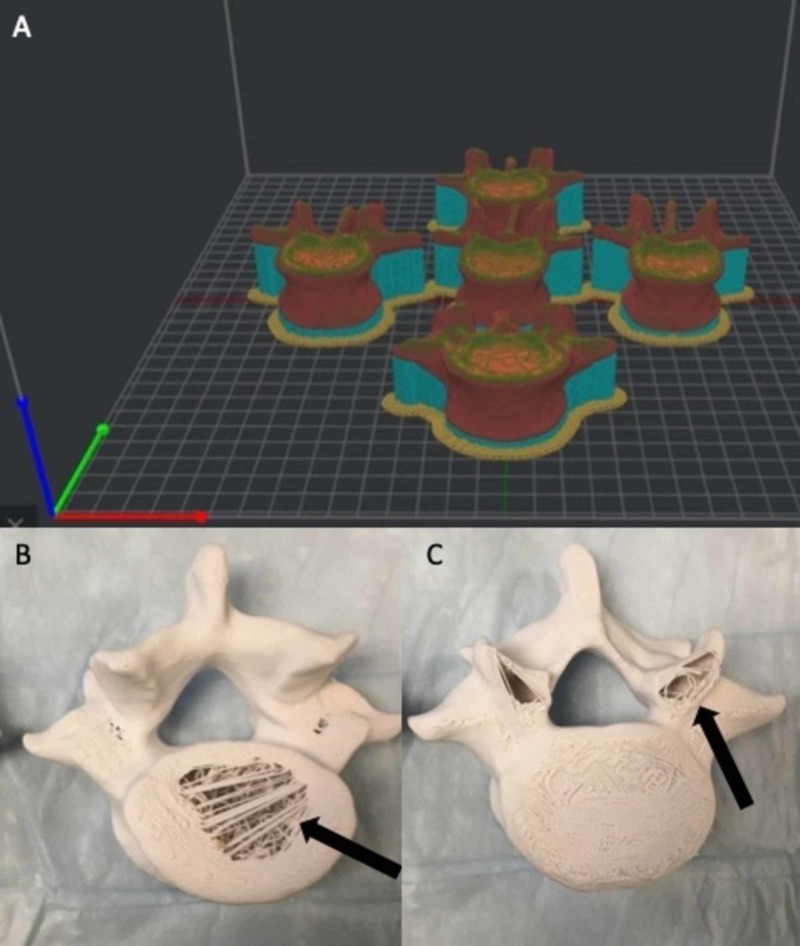
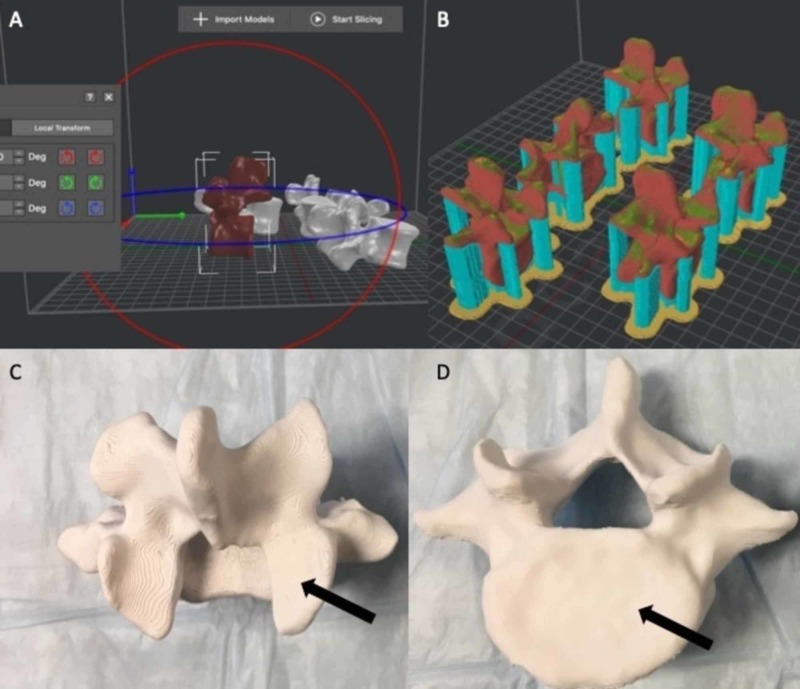
Three-dimensional (3D) printing has revolutionized medical training and patient care. Clinically it is used for patient-specific anatomical modeling with respect to surgical procedures. 3D printing is heavily implemented for simulation to provide a useful tool for anatomical knowledge and surgical techniques. Fused deposition modeling (FDM) is a commonly utilized method of 3D printing anatomical models due to its cost-effectiveness. A potential disadvantage of FDM 3D printing complex anatomical shapes is the limitations of the modeling system in providing accurate representations of multifaceted ultrastructure, such as the facets of the lumbar spine. In order to utilize FDM 3D printing methods in an efficient manner, the pre-printing G-code assembly must be oriented according to the anatomical nature of the print. This article describes the approach that our institution's 3D printing laboratory has used to manipulate models' printing angles in regard to the print bed and nozzle, according to anatomical properties, thus creating quality and cost-effective anatomical spine models for education and procedural simulation.
三维(3D)打印彻底改变了医学培训和患者护理。在临床上,它用于针对手术程序进行特定患者的解剖建模。3D打印大量应用于模拟,为解剖学知识和手术技术提供了有用工具。由于其成本效益,熔融沉积建模(FDM)是3D打印解剖模型常用的方法。FDM 3D打印复杂解剖形状的一个潜在缺点是建模系统在提供多面超微结构(如腰椎小关节)的准确表示方面存在局限性。为了高效利用FDM 3D打印方法,打印前的G代码组件必须根据打印的解剖学性质进行定向。本文描述了我们机构的3D打印实验室根据解剖学特性,针对打印床和喷嘴操纵模型打印角度的方法,从而创建用于教育和程序模拟的高质量且具成本效益的解剖脊柱模型。