Department of Nursing, Memorial Hospital, Memorial Sloan Kettering Cancer Center, New York, NY, USA.
Department of Epidemiology and Biostatistics, Memorial Sloan Kettering Cancer Center, New York, NY, USA.
BMC Palliat Care. 2020 Mar 30;19(1):42. doi: 10.1186/s12904-020-00544-x.
The probability of weaning and of long-term survival of chronically mechanically ventilated cancer patients is unknown, with incomplete information available to guide therapeutic decisions. We sought to determine the probability of weaning and overall survival of cancer patients requiring long-term mechanical ventilation in a specialized weaning unit.
A single-institution retrospective review of patients requiring mechanical ventilation outside of a critical care setting from 2008 to 2012 and from January 1 to December 31, 2018, was performed. Demographic and clinical data were recorded, including cancer specifics, comorbidities, treatments, and outcomes. Overall survival was determined using the Kaplan-Meier approach. Time to weaning was analyzed using the cumulative incidence function, with death considered a competing risk. Prognostic factors were evaluated for use in prospective evaluations of weaning protocols.
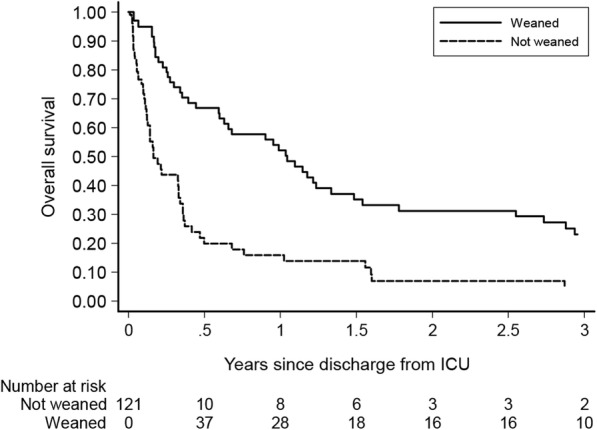
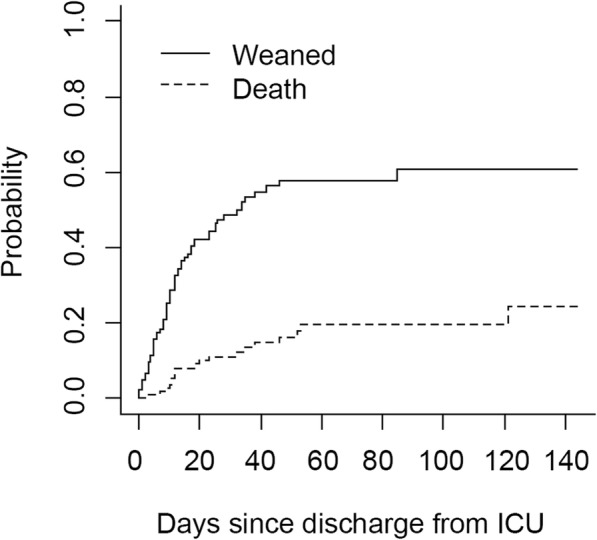
Between 2008 and 2012, 122 patients required mechanical ventilation outside of a critical care setting with weaning as a goal of care. The cumulative incidence of weaning after discharge from the intensive care unit was 42% at 21 days, 49% at 30 days, 58% at 60 days, 61% at 90 days, and 61% at 120 days. The median survival was 0.16 years (95% CI, 0.12 to 0.33) for those not weaned and 1.05 years (95% CI, 0.60 to 1.34) for those weaned. Overall survival at 1 year and 2 years was 52 and 32% among those weaned and 16 and 9% among those not weaned. During 2018, 36 patients at our institution required mechanical ventilation outside of a critical care setting, with weaning as a goal of care. Overall, with a median follow-up of 140 days (range, 0-425 days; average, 141 days), 25% of patients requiring long-term mechanical ventilation (9 of 36) are alive.
Cancer patients can be weaned from long-term mechanical ventilation, even after prolonged periods of support. Implementation of a resource-intensive weaning program did not improve rates of successful weaning. No clear time on mechanical ventilation could be identified beyond which weaning was unprecedented. Short-term overall survival for these patients is poor.
慢性机械通气的癌症患者脱机和长期生存的可能性尚不清楚,可供指导治疗决策的信息也不完整。我们旨在确定在专门的脱机病房中需要长期机械通气的癌症患者的脱机可能性和总体生存率。
对 2008 年至 2012 年和 2018 年 1 月 1 日至 12 月 31 日期间在重症监护室外需要机械通气的患者进行了单机构回顾性研究。记录了人口统计学和临床数据,包括癌症具体情况、合并症、治疗方法和结果。使用 Kaplan-Meier 方法确定总生存率。使用累积发生率函数分析脱机时间,以死亡为竞争风险。评估了预后因素,以用于前瞻性评估脱机方案。
2008 年至 2012 年间,122 例患者在重症监护室外需要机械通气,以脱机为治疗目标。从重症监护病房出院后 21 天、30 天、60 天、90 天和 120 天的脱机累积发生率分别为 42%、49%、58%、61%和 61%。未脱机患者的中位生存时间为 0.16 年(95%CI,0.12 至 0.33),脱机患者的中位生存时间为 1.05 年(95%CI,0.60 至 1.34)。脱机患者 1 年和 2 年的总生存率分别为 52%和 32%,未脱机患者分别为 16%和 9%。2018 年,我院 36 例患者在重症监护室外需要机械通气,以脱机为治疗目标。总体而言,中位随访时间为 140 天(范围 0 至 425 天;平均 141 天),需要长期机械通气的患者中有 25%(9/36)存活。
癌症患者可以从长期机械通气中脱机,即使经过长时间的支持。实施资源密集型脱机方案并未提高脱机成功率。无法确定超过多长时间的机械通气后脱机不再可能。这些患者的短期总生存率较差。