Muzaffar Syed Nabeel, Gurjar Mohan, Baronia Arvind K, Azim Afzal, Mishra Prabhakar, Poddar Banani, Singh Ratender K
Department of Critical Care Medicine, Sanjay Gandhi Postgraduate Institute of Medical Sciences - Lucknow, Índia.
Department of Biostatistics & Health Informatics, Sanjay Gandhi Postgraduate Institute of Medical Sciences - Lucknow, Índia.
Rev Bras Ter Intensiva. 2017 Jan-Mar;29(1):23-33. doi: 10.5935/0103-507X.20170005.
: This study aimed to examine the clinical characteristics, weaning pattern, and outcome of patients requiring prolonged mechanical ventilation in acute intensive care unit settings in a resource-limited country.
: This was a prospective single-center observational study in India, where all adult patients requiring prolonged ventilation were followed for weaning duration and pattern and for survival at both intensive care unit discharge and at 12 months. The definition of prolonged mechanical ventilation used was that of the National Association for Medical Direction of Respiratory Care.
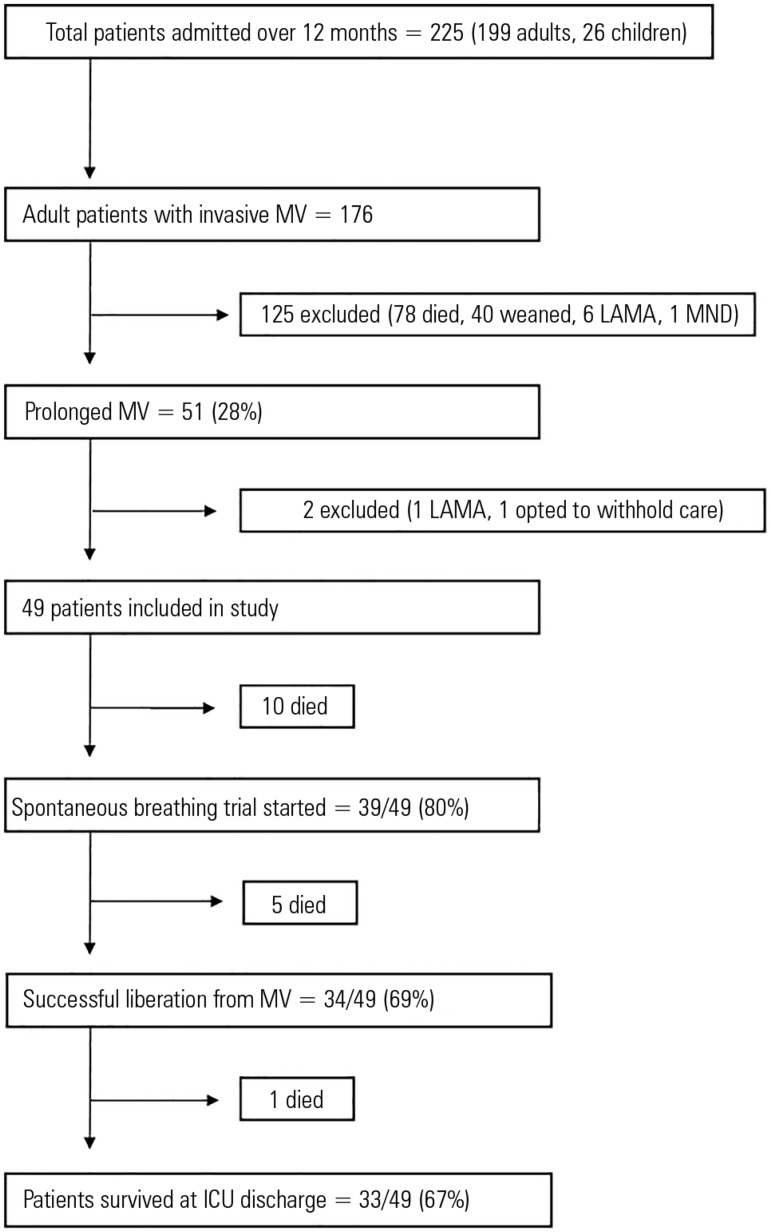
: During the one-year period, 49 patients with a mean age of 49.7 years had prolonged ventilation; 63% were male, and 84% had a medical illness. The median APACHE II and SOFA scores on admission were 17 and 9, respectively. The median number of ventilation days was 37. The most common reason for starting ventilation was respiratory failure secondary to sepsis (67%). Weaning was initiated in 39 (79.5%) patients, with success in 34 (87%). The median weaning duration was 14 (9.5 - 19) days, and the median length of intensive care unit stay was 39 (32 - 58.5) days. Duration of vasopressor support and need for hemodialysis were significant independent predictors of unsuccessful ventilator liberation. At the 12-month follow-up, 65% had survived.
: In acute intensive care units, more than one-fourth of patients with invasive ventilation required prolonged ventilation. Successful weaning was achieved in two-thirds of patients, and most survived at the 12-month follow-up.
本研究旨在调查在一个资源有限国家的急性重症监护病房中,需要长期机械通气的患者的临床特征、撤机模式及预后。
这是一项在印度进行的前瞻性单中心观察性研究,所有需要长期通气的成年患者均被随访撤机持续时间和模式,以及重症监护病房出院时和12个月时的生存率。所采用的长期机械通气的定义是由美国呼吸护理医学指导协会制定的。
在这一年期间,49例平均年龄为49.7岁的患者接受了长期通气;63%为男性,84%患有内科疾病。入院时APACHE II和SOFA评分的中位数分别为17和9。通气天数的中位数为37天。开始通气的最常见原因是脓毒症继发的呼吸衰竭(67%)。39例(79.5%)患者开始撤机,其中34例(87%)成功。撤机持续时间的中位数为14(9.5 - 19)天,重症监护病房住院时间的中位数为39(32 - 58.5)天。血管活性药物支持的持续时间和血液透析需求是通气机撤机失败的显著独立预测因素。在12个月的随访中,65%的患者存活。
在急性重症监护病房中,超过四分之一的有创通气患者需要长期通气。三分之二的患者成功撤机,且大多数患者在12个月随访时存活。