Department of Internal Medicine, National Taiwan University Hospital Hsin-Chu Branch, Hsin-Chu, Taiwan.
Department of Laboratory Medicine, National Taiwan University Hospital, Taipei, Taiwan.
Sci Rep. 2017 May 19;7(1):2148. doi: 10.1038/s41598-017-02418-4.
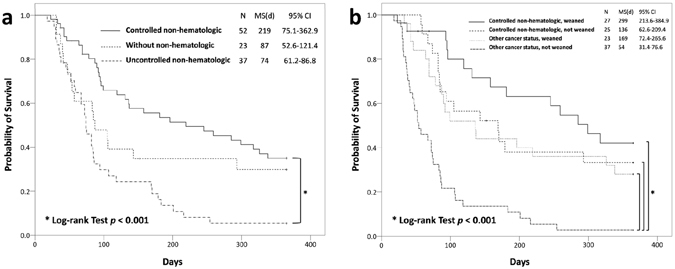
Studies about prognostic assessment in cancer patients requiring prolonged mechanical ventilation (PMV) for post-intensive care are scarce. We retrospectively enrolled 112 cancer patients requiring PMV support who were admitted to the respiratory care center (RCC), a specialized post-intensive care weaning facility, from November 2009 through September 2013. The weaning success rate was 44.6%, and mortality rates at hospital discharge and after 1 year were 43.8% and 76.9%, respectively. Multivariate logistic regression showed that weaning failure, in addition to underlying cancer status, was significantly associated with an increased 1-year mortality (odds ratio, 6.269; 95% confidence interval, 1.800-21.834; P = 0.004). Patients who had controlled non-hematologic cancers and successful weaning had the longest median survival, while those with other cancers who failed weaning had the worst. Patients with low maximal inspiratory pressure, anemia, and poor oxygenation at RCC admission had an increased risk of weaning failure. In conclusion, cancer status and weaning outcome were the most important determinants associated with long-term mortality in cancer patients requiring PMV. We suggest palliative care for those patients with clinical features associated with worse outcomes. It is unknown whether survival in this specific patient population could be improved by modifying the risk of weaning failure.
关于需要长时间机械通气(PMV)进行重症监护后治疗的癌症患者预后评估的研究很少。我们回顾性地纳入了 2009 年 11 月至 2013 年 9 月期间因需要 PMV 支持而入住呼吸治疗中心(RCC)的 112 名癌症患者。撤机成功率为 44.6%,出院时和 1 年后的死亡率分别为 43.8%和 76.9%。多变量逻辑回归显示,除了基础癌症状态外,撤机失败与 1 年死亡率增加显著相关(比值比,6.269;95%置信区间,1.800-21.834;P=0.004)。患有可控制的非血液系统癌症且成功撤机的患者中位生存期最长,而那些患有其他癌症且撤机失败的患者最差。在 RCC 入院时具有低最大吸气压力、贫血和低氧血症的患者撤机失败的风险增加。总之,癌症状态和撤机结果是与需要 PMV 的癌症患者长期死亡率相关的最重要决定因素。我们建议对那些具有预后不良相关临床特征的患者进行姑息治疗。尚不清楚通过改变撤机失败的风险是否可以改善该特定患者群体的生存情况。