NeCamp Timothy, Sen Srijan, Frank Elena, Walton Maureen A, Ionides Edward L, Fang Yu, Tewari Ambuj, Wu Zhenke
Department of Statistics, University of Michigan, Ann Arbor, MI, United States.
Molecular and Behavioral Neuroscience Institute, University of Michigan, Ann Arbor, MI, United States.
J Med Internet Res. 2020 Mar 31;22(3):e15033. doi: 10.2196/15033.
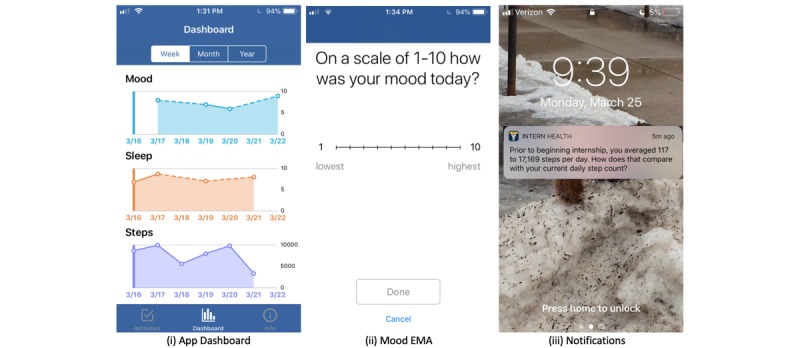
Individuals in stressful work environments often experience mental health issues, such as depression. Reducing depression rates is difficult because of persistently stressful work environments and inadequate time or resources to access traditional mental health care services. Mobile health (mHealth) interventions provide an opportunity to deliver real-time interventions in the real world. In addition, the delivery times of interventions can be based on real-time data collected with a mobile device. To date, data and analyses informing the timing of delivery of mHealth interventions are generally lacking.
This study aimed to investigate when to provide mHealth interventions to individuals in stressful work environments to improve their behavior and mental health. The mHealth interventions targeted 3 categories of behavior: mood, activity, and sleep. The interventions aimed to improve 3 different outcomes: weekly mood (assessed through a daily survey), weekly step count, and weekly sleep time. We explored when these interventions were most effective, based on previous mood, step, and sleep scores.
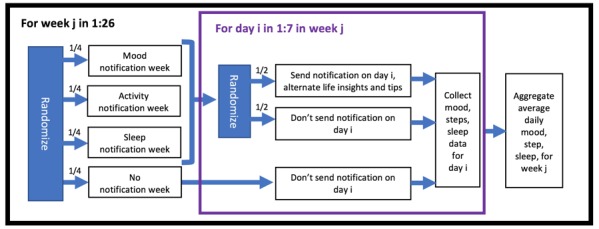
We conducted a 6-month micro-randomized trial on 1565 medical interns. Medical internship, during the first year of physician residency training, is highly stressful, resulting in depression rates several folds higher than those of the general population. Every week, interns were randomly assigned to receive push notifications related to a particular category (mood, activity, sleep, or no notifications). Every day, we collected interns' daily mood valence, sleep, and step data. We assessed the causal effect moderation by the previous week's mood, steps, and sleep. Specifically, we examined changes in the effect of notifications containing mood, activity, and sleep messages based on the previous week's mood, step, and sleep scores. Moderation was assessed with a weighted and centered least-squares estimator.
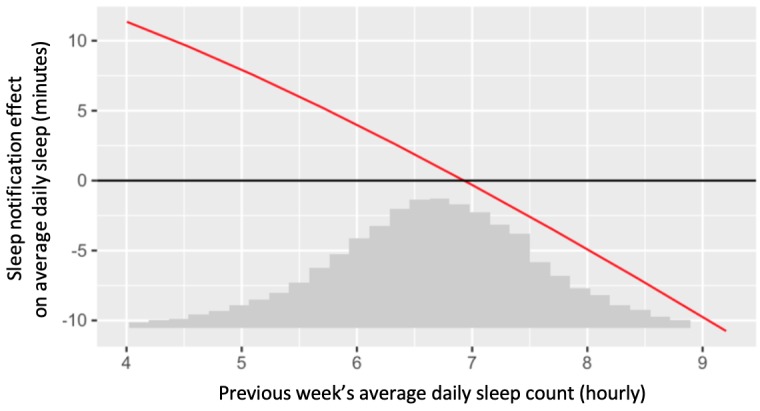
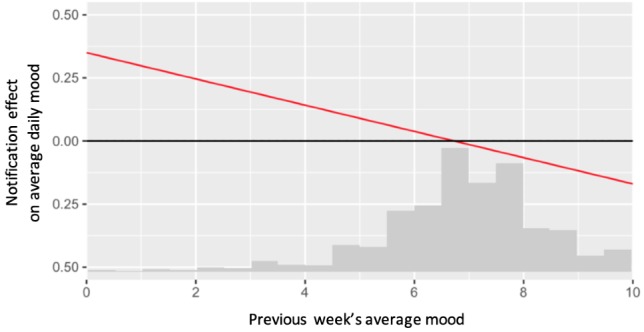
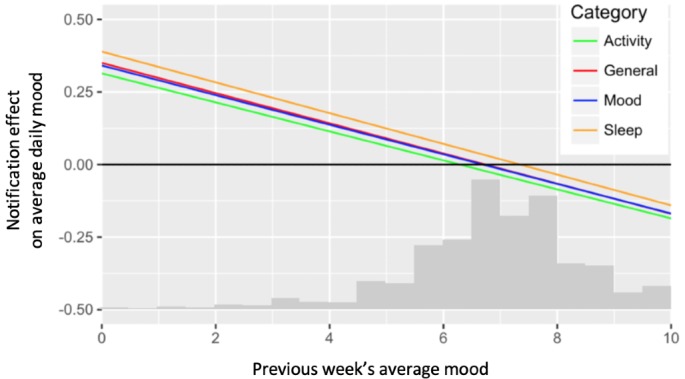
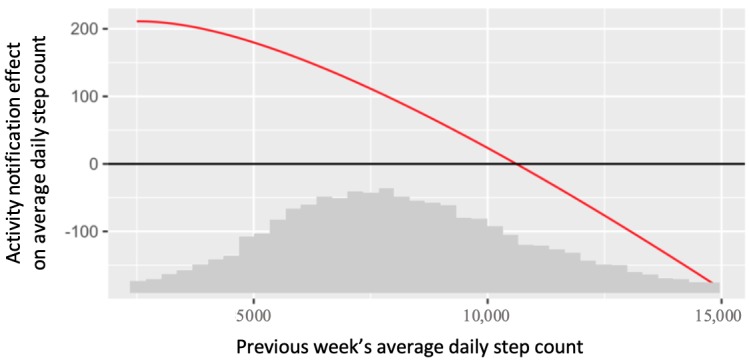
We found that the previous week's mood negatively moderated the effect of notifications on the current week's mood with an estimated moderation of -0.052 (P=.001). That is, notifications had a better impact on mood when the studied interns had a low mood in the previous week. Similarly, we found that the previous week's step count negatively moderated the effect of activity notifications on the current week's step count, with an estimated moderation of -0.039 (P=.01) and that the previous week's sleep negatively moderated the effect of sleep notifications on the current week's sleep with an estimated moderation of -0.075 (P<.001). For all three of these moderators, we estimated that the treatment effect was positive (beneficial) when the moderator was low, and negative (harmful) when the moderator was high.
These findings suggest that an individual's current state meaningfully influences their receptivity to mHealth interventions for mental health. Timing interventions to match an individual's state may be critical to maximizing the efficacy of interventions.
ClinicalTrials.gov NCT03972293; http://clinicaltrials.gov/ct2/show/NCT03972293.
处于压力工作环境中的个体经常会出现心理健康问题,如抑郁症。由于工作环境持续压力大,且获取传统心理健康护理服务的时间或资源不足,降低抑郁症发病率很困难。移动健康(mHealth)干预提供了在现实世界中进行实时干预的机会。此外,干预的交付时间可以基于通过移动设备收集的实时数据。迄今为止,普遍缺乏为移动健康干预的交付时间提供信息的数据和分析。
本研究旨在调查何时向处于压力工作环境中的个体提供移动健康干预,以改善他们的行为和心理健康。移动健康干预针对三类行为:情绪、活动和睡眠。干预旨在改善三种不同的结果:每周情绪(通过每日调查评估)、每周步数和每周睡眠时间。我们根据之前的情绪、步数和睡眠得分,探索这些干预何时最有效。
我们对1565名医学实习生进行了为期6个月的微随机试验。医学实习是医师住院医师培训的第一年,压力很大,导致抑郁症发病率比普通人群高出几倍。每周,实习生被随机分配接收与特定类别(情绪、活动、睡眠或无通知)相关的推送通知。每天,我们收集实习生的每日情绪效价、睡眠和步数数据。我们通过前一周的情绪、步数和睡眠来评估因果效应调节。具体而言,我们根据前一周的情绪、步数和睡眠得分,检查包含情绪、活动和睡眠信息的通知的效果变化。调节用加权和中心化最小二乘估计器进行评估。
我们发现,前一周的情绪对通知对当前周情绪的影响有负向调节作用,估计调节值为 -0.052(P = 0.001)。也就是说,当被研究的实习生前一周情绪低落时,通知对情绪的影响更好。同样,我们发现前一周的步数对活动通知对当前周步数的影响有负向调节作用,估计调节值为 -0.039(P = 0.01),并且前一周的睡眠对睡眠通知对当前周睡眠的影响有负向调节作用,估计调节值为 -0.075(P < 0.001)。对于所有这三个调节因素,我们估计当调节因素值低时,治疗效果为正(有益),当调节因素值高时,治疗效果为负(有害)。
这些发现表明,个体的当前状态对他们接受心理健康移动健康干预的接受度有显著影响。根据个体状态安排干预时间可能对于最大化干预效果至关重要。
ClinicalTrials.gov NCT03972293;http://clinicaltrials.gov/ct2/show/NCT03972293