Graduate School of Education, The University of Tokyo, Tokyo, Japan.
Graduate School of Medicine, The University of Tokyo, Tokyo, Japan.
JMIR Mhealth Uhealth. 2022 Oct 6;10(10):e39150. doi: 10.2196/39150.
Sleep is beneficial for physical and mental health. Several mobile and wearable sleep-tracking devices have been developed, and personalized sleep feedback is the most common functionality among these devices. To date, no study has implemented an objective push-type feedback message and investigated the characteristics of habitual sleep behavior and diurnal symptoms when receiving sleep feedback.
We conducted a mobile health intervention trial to examine whether sending objective push-type sleep feedback changes the self-reported mood, physical symptoms, and sleep behavior of Japanese office workers.
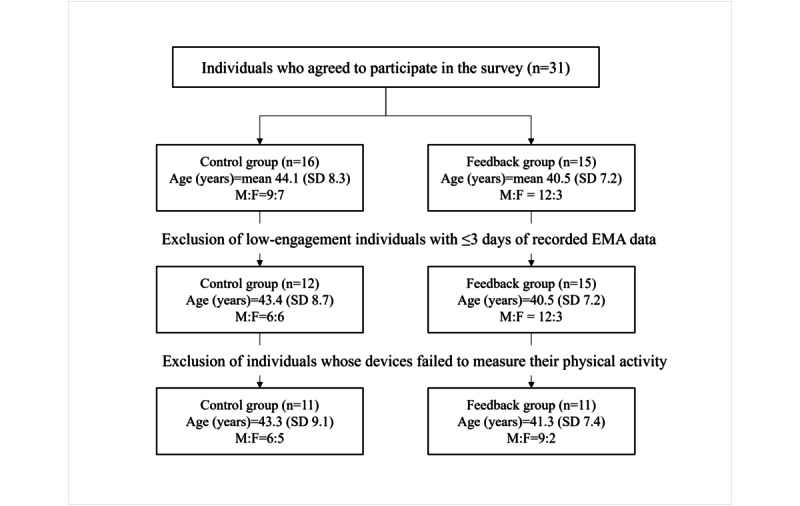
In total, 31 office workers (mean age 42.3, SD 7.9 years; male-to-female ratio 21:10) participated in a 2-arm intervention trial from November 30 to December 19, 2020. The participants were instructed to indicate their momentary mood and physical symptoms (depressive mood, anxiety, stress, sleepiness, fatigue, and neck and shoulder stiffness) 5 times a day using a smartphone app. In addition, daily work performance was rated once a day after work. They were randomly assigned to either a feedback or control group, wherein they did or did not receive messages about their sleep status on the app every morning, respectively. All participants wore activity monitors on their nondominant wrists, through which objective sleep data were registered on the web on a server. On the basis of the estimated sleep data on the server, personalized sleep feedback messages were generated and sent to the participants in the feedback group using the app. These processes were fully automated.
Using hierarchical statistical models, we examined the differences in the statistical properties of sleep variables (sleep duration and midpoint of sleep) and daily work performance over the trial period. Group differences in the diurnal slopes for mood and physical symptoms were examined using a linear mixed effect model. We found a significant group difference among within-individual residuals at the midpoint of sleep (expected a posteriori for the difference: -15, 95% credible interval -26 to -4 min), suggesting more stable sleep timing in the feedback group. However, there were no significant group differences in daily work performance. We also found significant group differences in the diurnal slopes for sleepiness (P<.001), fatigue (P=.002), and neck and shoulder stiffness (P<.001), which was largely due to better scores in the feedback group at wake-up time relative to those in the control group.
This is the first mobile health study to demonstrate that objective push-type sleep feedback improves sleep timing of and physical symptoms in healthy office workers. Future research should incorporate specific behavioral instructions intended to improve sleep habits and examine the effectiveness of these instructions.

睡眠有益于身心健康。目前已经开发出几种移动和可穿戴睡眠追踪设备,而这些设备最常见的功能是提供个性化的睡眠反馈。迄今为止,尚无研究采用客观的推送式反馈信息,并探讨接受睡眠反馈时习惯性睡眠行为和日间症状的特征。
我们开展了一项移动健康干预试验,以检验向日本上班族发送客观的推送式睡眠反馈是否会改变他们自我报告的情绪、身体症状和睡眠行为。
2020 年 11 月 30 日至 12 月 19 日,共有 31 名上班族(平均年龄 42.3 岁,标准差 7.9 岁;男:女为 21:10)参与了一项双臂干预试验。参与者使用智能手机应用程序每天 5 次记录他们的即时情绪和身体症状(抑郁情绪、焦虑、压力、困倦、疲劳以及颈部和肩部僵硬)。此外,他们每天下班后还会对当日的工作表现进行一次评价。参与者被随机分配至反馈组或对照组,分别在每天早上通过应用程序接收或不接收有关其睡眠状态的消息。所有参与者都在非优势手腕上佩戴活动监测器,通过该监测器将客观的睡眠数据记录在服务器上的网络中。基于服务器上估计的睡眠数据,使用应用程序向反馈组的参与者生成并发送个性化的睡眠反馈消息。这些过程均为全自动。
使用分层统计模型,我们检验了试验期间睡眠变量(睡眠时间和睡眠中点)和日常工作表现的统计特性的组间差异。使用线性混合效应模型检验了情绪和身体症状日间斜率的组间差异。我们发现睡眠中点的个体内残差有显著的组间差异(差异的预期后验值:-15,95%可信区间为-26 至-4 分钟),这表明反馈组的睡眠时间更稳定。然而,两组在日常工作表现方面没有显著差异。我们还发现困倦(P<.001)、疲劳(P=.002)和颈部与肩部僵硬(P<.001)的日间斜率存在显著的组间差异,这主要归因于反馈组在醒来时的得分明显高于对照组。
这是第一项采用移动健康研究证明客观的推送式睡眠反馈可改善健康上班族的睡眠定时和身体症状的研究。未来的研究应纳入旨在改善睡眠习惯的特定行为指导,并检验这些指导的有效性。