Kang Changhee, Jeong Seong-Yun, Song Si Yeol, Choi Eun Kyung
Asan Institute for Life Sciences, Asan Medical Center, University of Ulsan College of Medicine, Seoul, Korea.
Department of Convergence Medicine, Asan Medical Center, University of Ulsan College of Medicine, Seoul, Korea.
Radiat Oncol J. 2020 Mar;38(1):1-10. doi: 10.3857/roj.2019.00640. Epub 2020 Mar 25.
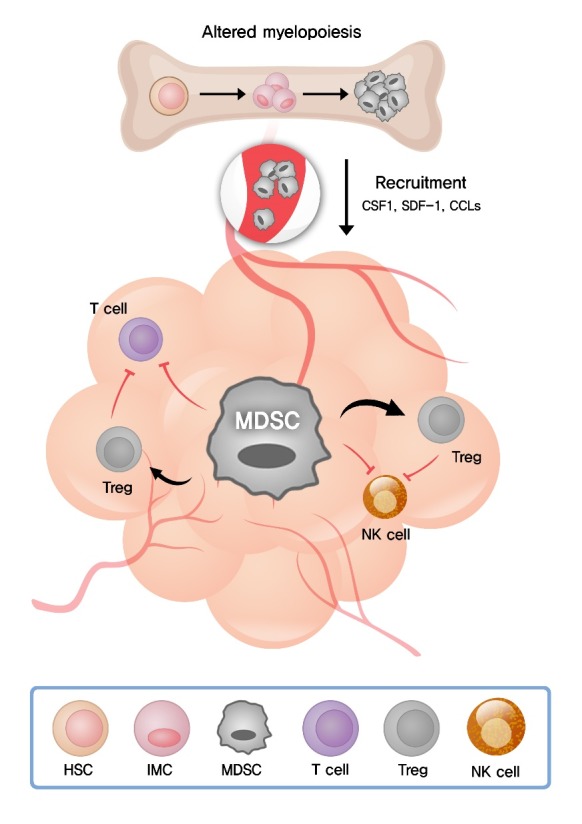
Radiotherapy (RT) has been used for decades as one of the main treatment modalities for cancer patients. The therapeutic effect of RT has been primarily ascribed to DNA damage leading to tumor cell death. Besides direct tumoricidal effect, RT affects antitumor responses through immune-mediated mechanism, which provides a rationale for combining RT and immunotherapy for cancer treatment. Thus far, for the combined treatment with RT, numerous studies have focused on the immune checkpoint inhibitors and have shown promising results. However, treatment resistance is still common, and one of the main resistance mechanisms is thought to be due to the immunosuppressive tumor microenvironment where myeloid-derived suppressor cells (MDSCs) play a crucial role. MDSCs are immature myeloid cells with a strong immunosuppressive activity. MDSC frequency is correlated with tumor progression, recurrence, negative clinical outcome, and reduced efficacy of immunotherapy. Therefore, increasing efforts to target MDSCs have been made to overcome the resistance in cancer treatments. In this review, we focus on the role of MDSCs in RT and highlight growing evidence for targeting MDSCs in combination with RT to improve cancer treatment.
放射疗法(RT)作为癌症患者的主要治疗方式之一已使用了数十年。RT的治疗效果主要归因于导致肿瘤细胞死亡的DNA损伤。除了直接的杀肿瘤作用外,RT还通过免疫介导机制影响抗肿瘤反应,这为RT与免疫疗法联合用于癌症治疗提供了理论依据。迄今为止,对于RT联合治疗,众多研究聚焦于免疫检查点抑制剂并已显示出有前景的结果。然而,治疗耐药性仍然很常见,主要的耐药机制之一被认为是由于免疫抑制性肿瘤微环境,其中髓系来源的抑制细胞(MDSCs)起关键作用。MDSCs是具有强大免疫抑制活性的未成熟髓系细胞。MDSC频率与肿瘤进展、复发、不良临床结局以及免疫疗法疗效降低相关。因此,人们已加大努力靶向MDSCs以克服癌症治疗中的耐药性。在本综述中,我们聚焦于MDSCs在RT中的作用,并强调越来越多的证据表明联合RT靶向MDSCs可改善癌症治疗。