Department of Physiology, Jessenius Faculty of Medicine in Martin, Comenius University in Bratislava, 03601 Martin, Slovakia.
Biomedical Center Martin, Jessenius Faculty of Medicine in Martin, Comenius University in Bratislava, 03601 Martin, Slovakia.
Int J Mol Sci. 2020 Mar 27;21(7):2317. doi: 10.3390/ijms21072317.
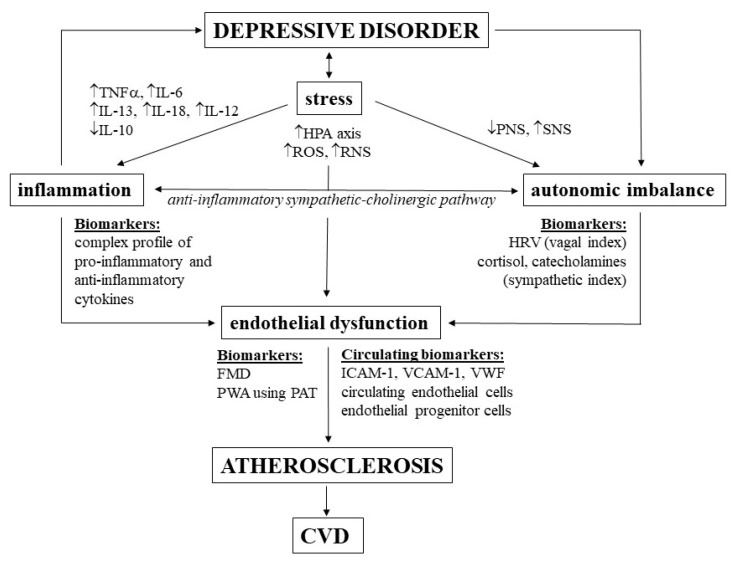
Major depressive disorder (MDD) represents a serious health problem estimated to affect 350 million people globally. Importantly, MDD has repeatedly emerged as an etiological or prognostic factor in cardiovascular disease (CVD) development, including vascular pathology. Several linking pathomechanisms between MDD and CVD involve abnormal autonomic regulation, inflammation, and endothelial dysfunction as an early preclinical stage of atherosclerosis. However, the cause of accelerated atherosclerosis in MDD patients remains unclear. Recently, the causal relationships between MDD and mediator (e.g., inflammation and/or endothelial dysfunction), as well as the causal pathways from the mediator to atherosclerosis, were discussed. Specifically, MDD is accompanied by immune dysregulation, resulting in increased production of proinflammatory cytokines (e.g., interleukin (IL)-6 and tumor necrosis factor (TNF)-α), which could lead to depression-linked abnormalities in brain function. Further, MDD has an adverse effect on endothelial function; for example, circulating markers of endothelial dysfunction (e.g., soluble adhesion molecules, von Willebrand factor) have been linked with depression. Additionally, MDD-linked autonomic dysregulation, which is characterized by disrupted sympathovagal balance associated with excessive circulating catecholamines, can contribute to CVD. Taken together, activated inflammatory response, endothelial dysfunction, and autonomic dysregulation could affect gradual atherosclerosis progression, resulting in a higher risk of developing CVD in MDD. This review focused on the pathomechanisms linking MDD and CVD with respect to neuroimmune regulation, and the description of promising biomarkers, which is important for the early diagnosis and personalized prevention of CVD in major depression.
重度抑郁症(MDD)是一个严重的健康问题,据估计,全球有 3.5 亿人受其影响。重要的是,MDD 反复被认为是心血管疾病(CVD)发展的病因或预后因素,包括血管病理学。MDD 与 CVD 之间的几个联系病理机制涉及异常自主调节、炎症和内皮功能障碍,这是动脉粥样硬化的早期临床前阶段。然而,MDD 患者加速动脉粥样硬化的原因仍不清楚。最近,讨论了 MDD 与介质(例如炎症和/或内皮功能障碍)之间的因果关系,以及从中介到动脉粥样硬化的因果途径。具体而言,MDD 伴有免疫失调,导致促炎细胞因子(例如白细胞介素(IL)-6 和肿瘤坏死因子(TNF)-α)的产生增加,这可能导致与抑郁相关的大脑功能异常。此外,MDD 对内皮功能有不利影响;例如,内皮功能障碍的循环标志物(例如可溶性粘附分子、血管性血友病因子)与抑郁有关。此外,MDD 相关的自主神经调节失调,其特征是与过量循环儿茶酚胺相关的交感神经迷走神经平衡破坏,可导致 CVD。总之,激活的炎症反应、内皮功能障碍和自主神经调节失调可能会影响逐渐的动脉粥样硬化进展,导致 MDD 患者发生 CVD 的风险更高。本综述重点介绍了 MDD 与 CVD 之间与神经免疫调节相关的病理机制,以及有前途的生物标志物的描述,这对于重度抑郁症患者的 CVD 早期诊断和个性化预防非常重要。