Department of Occupational Therapy, School of Arts & Sciences, Tufts University, Medford, MA, USA.
Department of Psychology, New England College, Henniker, NH, USA.
Disabil Rehabil. 2021 Nov;43(22):3212-3224. doi: 10.1080/09638288.2020.1741035. Epub 2020 Apr 1.
Social participation is a key determinant of healthy aging, yet little is known about how people with Parkinson's disease manage social living. This study describes individual differences in social self-management practices and their association with symptom severity and health quality of life.
People with Parkinson's disease ( = 90) completed measures of healthy routines, activities and relationships, symptom severity, and health related quality of life. Cluster analysis identified profiles of social self-management practices. Analysis of variance tested differences between profiles in symptom severity and health quality of life.
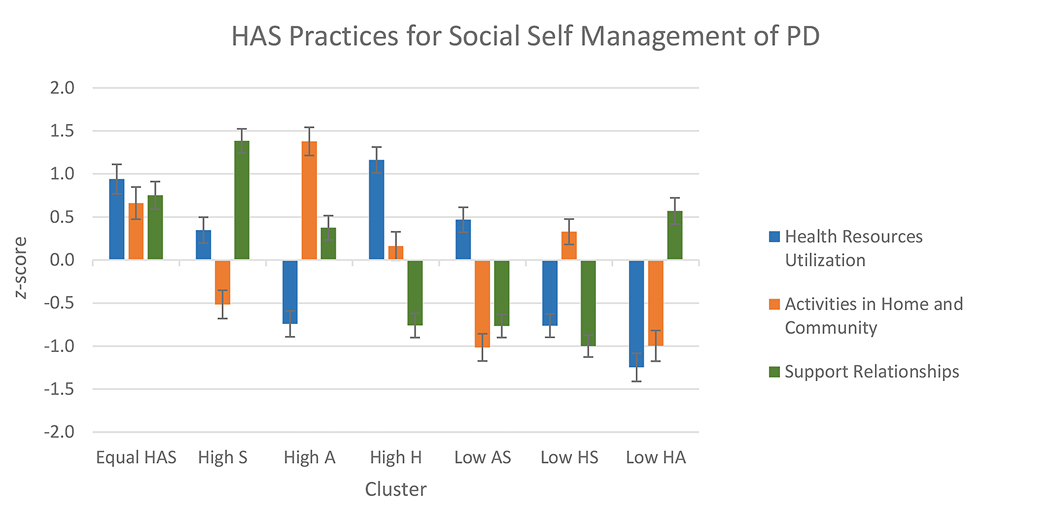
Participants clustered into one of seven groups according to different combinations of three practices: , , and . The healthiest cluster engaged equally in all three practices at above sample average degree of engagement. Four clusters that engaged at or above sample average in experienced less health problems than three clusters that engaged below average. Variation in aspects of social lifestyle unrelated to health appeared also to contribute to profile diversity.
Findings provide insight into similarity and variation in how people with Parkinson's disease engage with social self-management resources and point to person-centered interventions.Implications for RehabilitationSocial self-management is a biopsychosocial construct to identify and describe self-care practices that engage one's social resources for managing healthful daily living.People with Parkinson's disease vary in their profiles of engaging in social self-management practices in daily living, and this variability relates to severity of symptoms and health quality of life.Learning how to identify health-centered social self-management practices may help people with Parkinson's disease to focus on the healthfulness of their own practices.Learning how to strategically engage one's social resources as part of self-care may help people with Parkinson's disease to master managing their health and well-being in daily life.
社会参与是健康老龄化的关键决定因素,但人们对帕金森病患者如何管理社会生活知之甚少。本研究描述了社会自我管理实践的个体差异及其与症状严重程度和健康生活质量的关系。
90 名帕金森病患者完成了健康常规、活动和关系、症状严重程度以及健康相关生活质量的测量。聚类分析确定了社会自我管理实践的模式。方差分析检验了不同模式在症状严重程度和健康生活质量方面的差异。
参与者根据三种实践中的三种不同组合聚类为七个组:健康常规、活动和关系。最健康的组以高于样本平均程度的方式平等参与所有三种实践。在健康常规、活动和关系中以或高于样本平均程度参与的四个组比以低于平均程度参与的三个组健康问题较少。与健康无关的社会生活方式的变化似乎也促成了模式多样性。
研究结果深入了解了帕金森病患者参与社会自我管理资源的相似性和变异性,并为以人为中心的干预措施提供了依据。
社会自我管理是一个生物心理社会的概念,用于识别和描述参与个人社会资源以管理健康日常生活的自我护理实践。帕金森病患者在日常社交自我管理实践中的参与模式存在差异,这种差异与症状严重程度和健康生活质量有关。了解如何识别以健康为中心的社交自我管理实践可能有助于帕金森病患者关注自身实践的健康性。将个人的社会资源作为自我护理的一部分进行战略性利用,可能有助于帕金森病患者掌握日常管理健康和幸福的能力。