Ma Hui-Ing, Gunnery Sarah D, Stevenson Michael T, Saint-Hilaire Marie, Thomas Cathi A, Tickle-Degnen Linda
Department of Occupational Therapy, College of Medicine, National Cheng Kung University, 1 University Road, Tainan 701, Taiwan.
Department of Psychology, New England College, 98 Bridge St., Henniker, NH, 03242.
Stigma Health. 2019;4(4):462-472. doi: 10.1037/sah0000168.
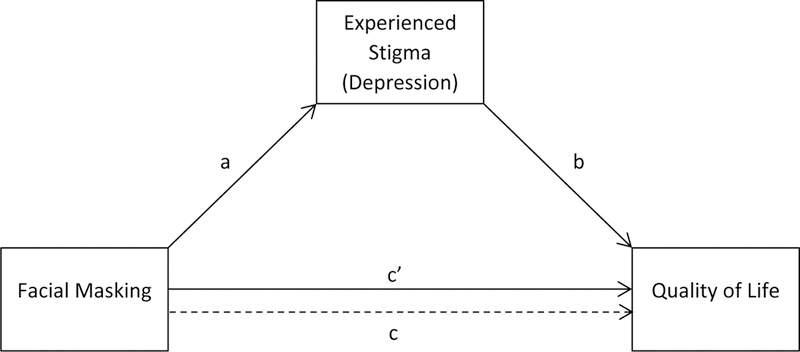
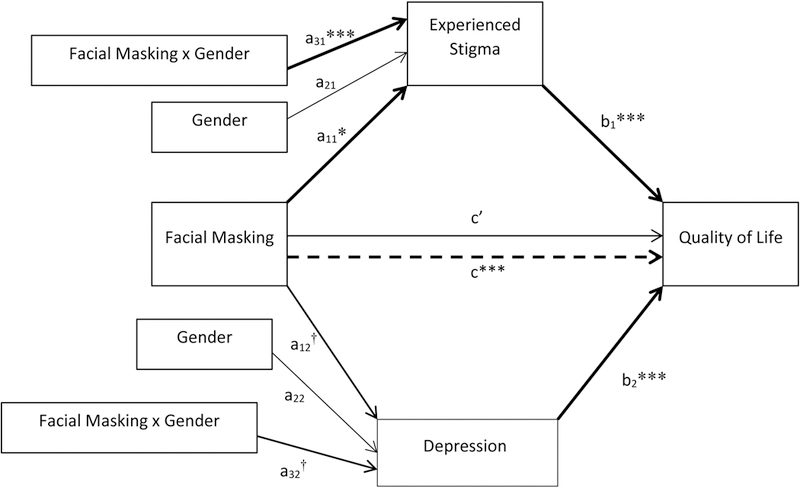
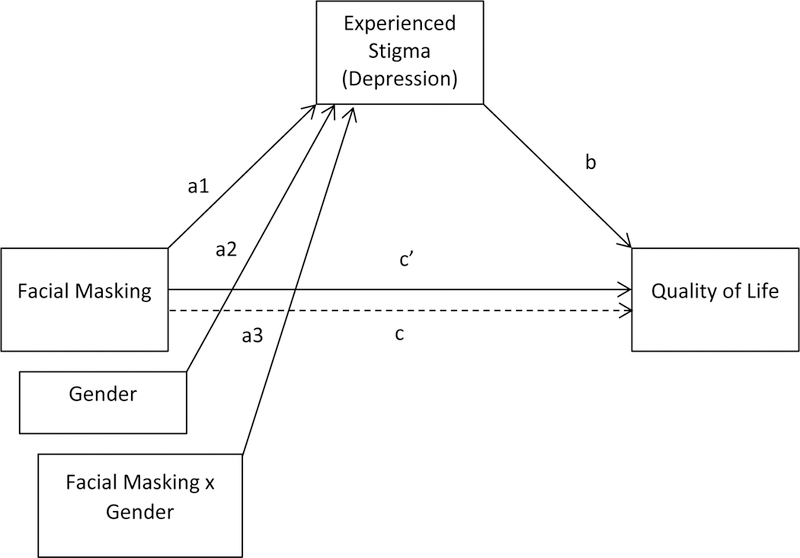
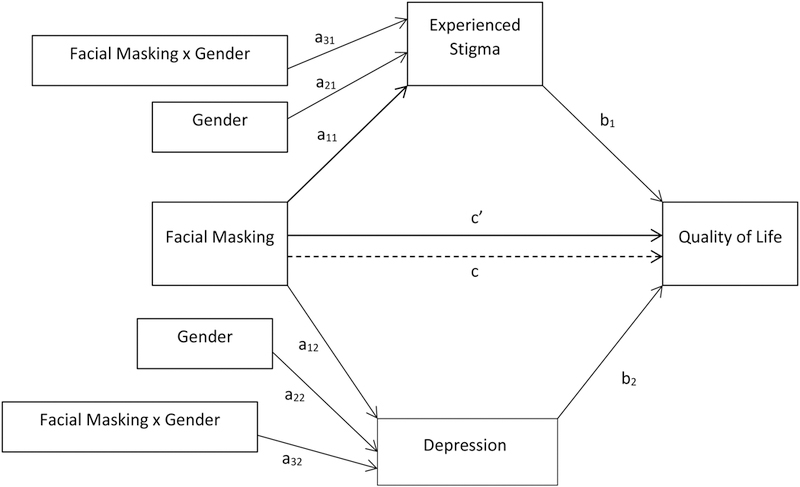
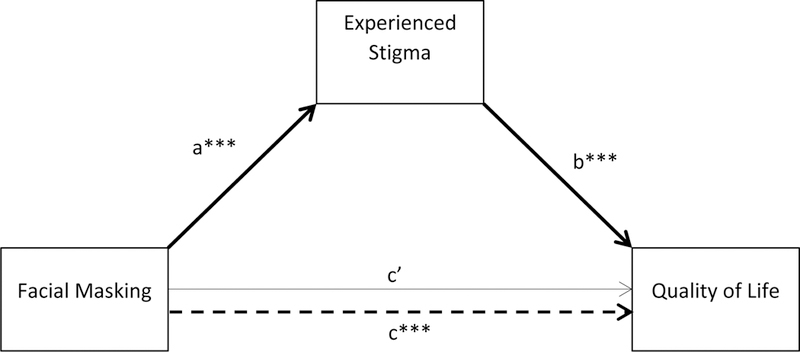
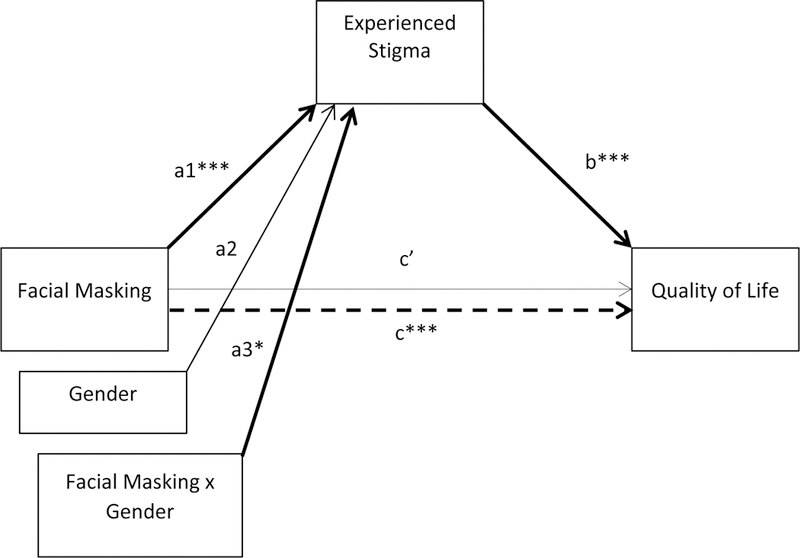
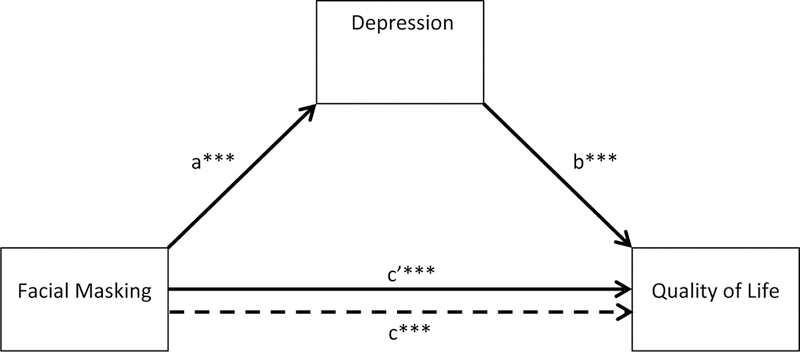
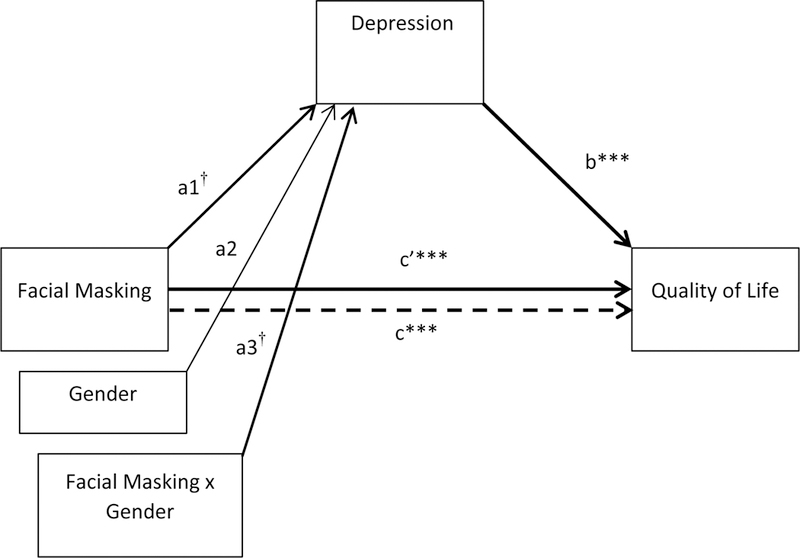
This study examined the relationship between self-reported facial masking and quality of life (QoL) in people with Parkinson's disease (PD), and tested experienced stigma as a mediator and gender as a moderator of this relationship. The strength of stigma as a mediator was compared against an alternative mediator, depression. Ninety people with PD (34 women) rated difficulty showing facial expression (masking), and completed the Stigma Scale for Chronic Illness, Geriatric Depression Scale (15-item), and Parkinson's Disease Questionnaire-39. A conditional process model tested the indirect effect of facial masking on QoL through stigma, separately for women and men. A parallel indirect model included both stigma and depression to compare their statistical and clinical significance as mediators. Gender-moderated mediation of stigma reduced the association between facial masking and QoL to non-significance, suggesting stigma explained the association between facial masking and QoL. While facial masking was more stigmatizing for women than for men, stigma mediated the facial masking-QoL association for both women and men. Stigma (controlling for depression) reached a statistically and clinically significant level of mediation, whereas depression (controlling for stigma) reached a statistically yet not clinically significant level of mediation. People with PD who experience more severe facial masking feel more stigmatized, especially women. Regardless of gender, an increase in stigma from facial masking increases the likelihood of compromised QoL that reaches both statistical and clinical levels of significance.
本研究探讨了帕金森病(PD)患者自我报告的面部表情掩盖与生活质量(QoL)之间的关系,并检验了经历的耻辱感作为这种关系的中介以及性别作为调节因素的作用。将耻辱感作为中介的强度与另一种中介因素——抑郁进行了比较。90名PD患者(34名女性)对表现面部表情的困难程度(表情掩盖)进行了评分,并完成了慢性病耻辱感量表、老年抑郁量表(15项)和帕金森病问卷-39。一个条件过程模型分别对女性和男性检验了面部表情掩盖通过耻辱感对生活质量的间接影响。一个平行间接模型同时纳入了耻辱感和抑郁,以比较它们作为中介的统计和临床意义。耻辱感的性别调节中介作用使面部表情掩盖与生活质量之间的关联不再显著,这表明耻辱感解释了面部表情掩盖与生活质量之间的关联。虽然面部表情掩盖对女性的耻辱感比对男性更强,但耻辱感在女性和男性中均介导了面部表情掩盖与生活质量的关联。耻辱感(控制抑郁因素)达到了具有统计学和临床意义的中介水平,而抑郁(控制耻辱感因素)仅达到了具有统计学意义但不具有临床意义的中介水平。经历更严重面部表情掩盖的PD患者会感到更受耻辱,尤其是女性。无论性别如何,面部表情掩盖导致的耻辱感增加都会增加生活质量受损的可能性,且这种受损在统计学和临床水平上均具有显著性。