PET Radiochemistry, Division of Radiotherapy and Imaging, the Institute of Cancer Research, 123 Old Brompton Road, London SW7 3RP, UK.
Division of Radiopharmaceutical Chemistry, German Cancer Research Center (DKFZ), Im Neuenheimer Feld 280, 69120 Heidelberg, Germany.
Molecules. 2020 Mar 29;25(7):1562. doi: 10.3390/molecules25071562.
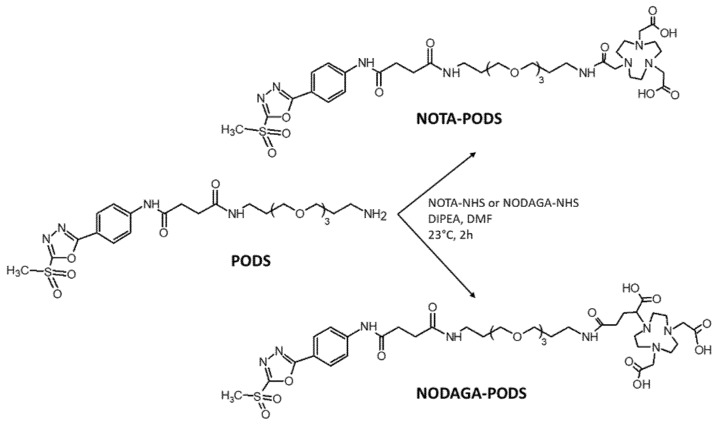
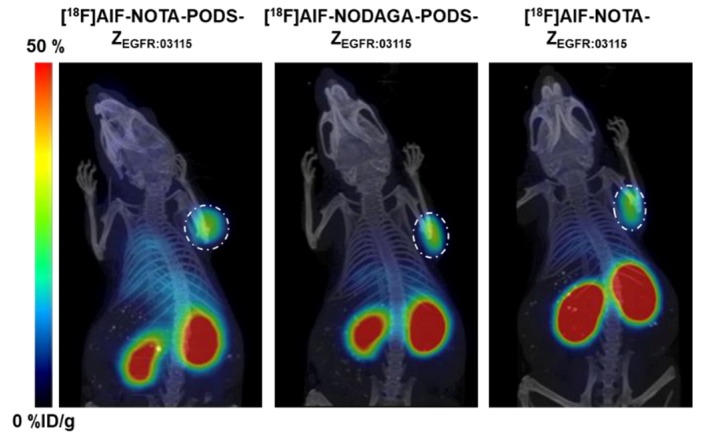
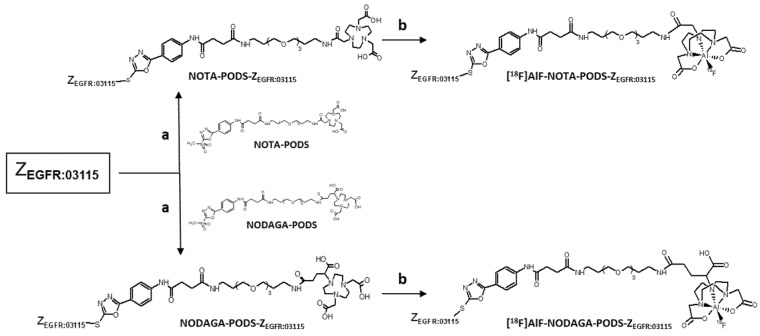
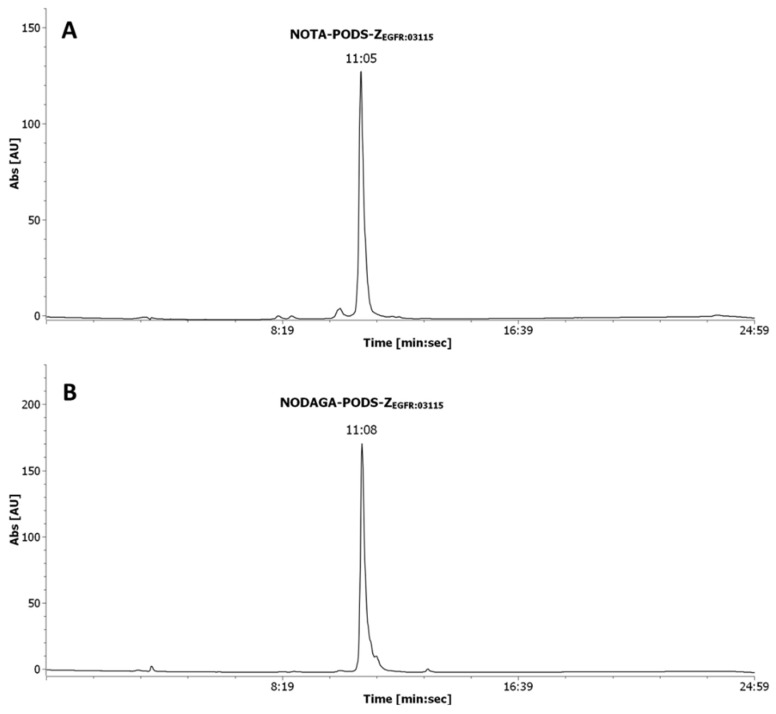
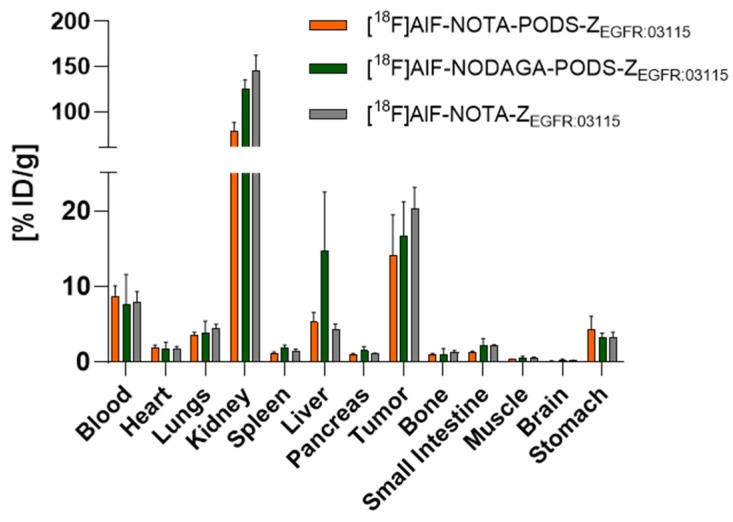
Site-selective bioconjugation of cysteine-containing peptides and proteins is currently achieved via a maleimide-thiol reaction (Michael addition). When maleimide-functionalized chelators are used and the resulting bioconjugates are subsequently radiolabeled, instability has been observed both during radiosynthesis and post-injection in vivo, reducing radiochemical yield and negatively impacting performance. Recently, a phenyloxadiazolyl methylsulfone derivative (PODS) was proposed as an alternative to maleimide for the site-selective conjugation and radiolabeling of proteins, demonstrating improved in vitro stability and in vivo performance. Therefore, we have synthesized two novel PODS-bearing bifunctional chelators (NOTA-PODS and NODAGA-PODS) and attached them to the EGFR-targeting affibody molecule Z. After radiolabeling with the aluminum fluoride complex ([F]AlF), both conjugates showed good stability in murine serum. When injected in high EGFR-expressing tumor-bearing mice, [F]AlF-NOTA-PODS-Z and [F]AlF-NODAGA-PODS-Z showed similar pharmacokinetics and a specific tumor uptake of 14.1 ± 5.3% and 16.7 ± 4.5% ID/g at 1 h post-injection, respectively. The current results are encouraging for using PODS as an alternative to maleimide-based thiol-selective bioconjugation reactions.
目前,通过马来酰亚胺-巯基反应(迈克尔加成)实现含半胱氨酸的肽和蛋白质的位点选择性生物缀合。当使用马来酰亚胺功能化螯合剂并且随后对所得生物缀合物进行放射性标记时,已经观察到在放射合成和体内注射后都存在不稳定性,这降低了放射化学产率并产生负面影响。最近,提出了苯并恶二唑基甲基砜衍生物(PODS)作为马来酰亚胺的替代品,用于蛋白质的位点选择性缀合和放射性标记,表现出改善的体外稳定性和体内性能。因此,我们合成了两种新型的含 PODS 的双功能螯合剂(NOTA-PODS 和 NODAGA-PODS),并将其连接到 EGFR 靶向亲和体分子 Z 上。用铝氟化物络合物([F]AlF)放射性标记后,两种缀合物在鼠血清中均表现出良好的稳定性。当在高 EGFR 表达的荷瘤小鼠中注射时,[F]AlF-NOTA-PODS-Z 和 [F]AlF-NODAGA-PODS-Z 在 1 h 后分别显示出相似的药代动力学和特定肿瘤摄取,分别为 14.1±5.3%和 16.7±4.5%ID/g。当前的结果令人鼓舞,可将 PODS 用作基于马来酰亚胺的巯基选择性生物缀合反应的替代品。