Imboma Titus S, Gao De-Ping, You Min-Sheng, You Shijun, Lövei Gabor L
State Key Laboratory of Ecological Pest Control for Fujian and Taiwan Crops, Institute of Applied Ecology, Fujian Agricultural and Forestry University, Fuzhou 350002, China.
Joint International Research Laboratory of Ecological Pest Control, Ministry of Education, Fuzhou 350002, China.
Insects. 2020 Mar 29;11(4):212. doi: 10.3390/insects11040212.
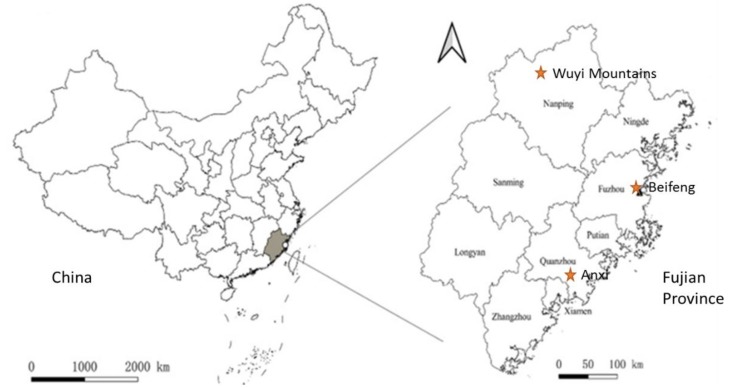
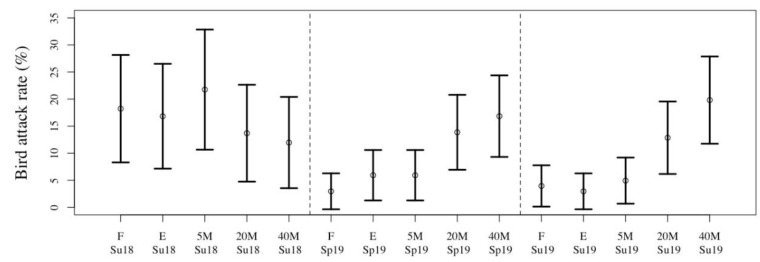
Tea () is an important food product with thousands of years of human use. Being a non-washable food, no pesticide residues are allowed, which increases the importance of natural means of plant protection. Predation, a component of natural pest control, is an important contributor to this, but its level and sustainability are not known in most of the areas of tea production. We quantified predation intensity using the artificial sentinel prey method in a tea-growing landscape containing remnants of the original forest vegetation in Fujian Province, China. The most common predators were chewing arthropods (49.8% of predation events) and birds (48.1%). Overall, predation rates at the edges of forest fragments (18.9% d) were lower than either in fragment interiors (25.4%d) or in the surrounding tea plantations (19.2-24.1%d). Arthropod predation was higher inside, and at the edge of, forest fragments than within plantations, and generally decreased with increasing distance from a fragment edge, indicating limited spillover of arthropod predators from the native habitat remnants to the cultivated matrix at the local scale. Bird predation, though, showed a different trend: it was lower on the inside of forest fragments than in the tea planation, and bird attack rates increased at increasing distances (up to 40 m) from the forest fragment edge. We also found a reciprocal relationship between attack rates by birds and arthropods, suggesting intra-guild predation. Measures protecting arthropod natural enemies could increase the combined pest suppression effect, contributing to pesticide-free tea production in China.
茶()是一种有着数千年人类食用历史的重要食品。作为一种不可清洗的食品,不允许有农药残留,这增加了植物天然保护手段的重要性。捕食是自然害虫控制的一个组成部分,对此有重要贡献,但在大多数茶叶生产地区,其水平和可持续性尚不清楚。我们在中国福建省一个保留了原始森林植被残余的茶园景观中,使用人工哨兵猎物法对捕食强度进行了量化。最常见的捕食者是咀嚼式节肢动物(占捕食事件的49.8%)和鸟类(占48.1%)。总体而言,森林斑块边缘的捕食率(18.9% d)低于斑块内部(25.4% d)或周围茶园(19.2 - 24.1% d)。节肢动物捕食在森林斑块内部和边缘高于茶园,并且通常随着与斑块边缘距离的增加而降低,这表明在局部尺度上节肢动物捕食者从原生栖息地残余向栽培基质的溢出有限。然而,鸟类捕食呈现出不同的趋势:它在森林斑块内部低于茶园,并且鸟类攻击率在距离森林斑块边缘增加(直至40米)时上升。我们还发现鸟类和节肢动物的攻击率之间存在相互关系,表明存在种间捕食。保护节肢动物天敌的措施可以增强综合害虫抑制效果,有助于中国的无农药茶叶生产。