Department of Biology, Faculty of Medicine, Masaryk University, Brno, Czech Republic.
Department of Immunology, Veterinary Research Institute, Brno, Czech Republic.
PLoS One. 2020 Apr 1;15(4):e0230926. doi: 10.1371/journal.pone.0230926. eCollection 2020.
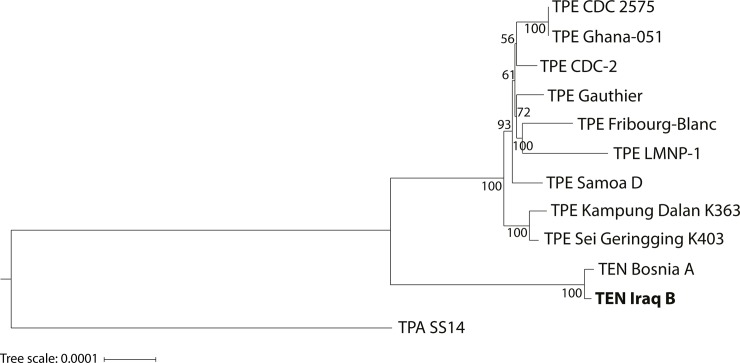
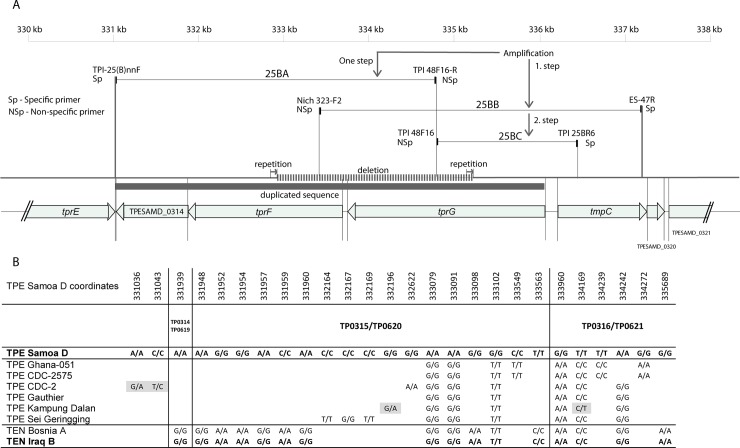
Treponema pallidum subsp. endemicum (TEN) is the causative agent of endemic syphilis (bejel). Until now, only a single TEN strain, Bosnia A, has been completely sequenced. The only other laboratory TEN strain available, Iraq B, was isolated in Iraq in 1951 by researchers from the US Centers for Disease Control and Prevention. In this study, the complete genome of the Iraq B strain was amplified as overlapping PCR products and sequenced using the pooled segment genome sequencing method and Illumina sequencing. Total average genome sequencing coverage reached 3469×, with a total genome size of 1,137,653 bp. Compared to the genome sequence of Bosnia A, a set of 37 single nucleotide differences, 4 indels, 2 differences in the number of tandem repetitions, and 18 differences in the length of homopolymeric regions were found in the Iraq B genome. Moreover, the tprF and tprG genes that were previously found deleted in the genome of the TEN Bosnia A strain (spanning 2.3 kb in length) were present in a subpopulation of TEN Iraq B and Bosnia A microbes, and their sequence was highly similar to those found in T. p. subsp. pertenue strains, which cause the disease yaws. The genome sequence of TEN Iraq B revealed close genetic relatedness between both available bejel-causing laboratory strains (i.e., Iraq B and Bosnia A) and also genetic variability within the bejel treponemes comparable to that found within yaws- or syphilis-causing strains. In addition, genetic relatedness to TPE strains was demonstrated by the sequence of the tprF and tprG genes found in subpopulations of both TEN Iraq B and Bosnia A. The loss of the tprF and tprG genes in most TEN microbes suggest that TEN genomes have been evolving via the loss of genomic regions, a phenomenon previously found among the treponemes causing both syphilis and rabbit syphilis.
苍白密螺旋体亚种地方性亚种(TEN)是地方性梅毒(贝杰尔病)的病原体。到目前为止,只有一个 TEN 菌株,即波斯尼亚 A,已经被完全测序。唯一另一个可用的实验室 TEN 菌株是 1951 年由美国疾病控制与预防中心的研究人员在伊拉克分离的伊拉克 B。在这项研究中,使用重叠 PCR 产物扩增伊拉克 B 株的全基因组,并使用聚合片段基因组测序方法和 Illumina 测序进行测序。总平均基因组测序覆盖率达到 3469×,基因组大小总计为 1,137,653bp。与波斯尼亚 A 基因组序列相比,在伊拉克 B 基因组中发现了一组 37 个单核苷酸差异、4 个插入缺失、2 个串联重复数目的差异和 18 个同源多聚区域长度的差异。此外,先前在 TEN 波斯尼亚 A 株基因组中发现缺失的 tprF 和 tprG 基因(长度为 2.3kb)存在于 TEN 伊拉克 B 和波斯尼亚 A 微生物的一个亚群中,其序列与引起雅司病的 T. p. subsp. pertenue 菌株非常相似。TEN 伊拉克 B 的基因组序列揭示了两个现有的引起贝杰尔病的实验室菌株(即伊拉克 B 和波斯尼亚 A)之间密切的遗传相关性,以及贝杰尔密螺旋体内部的遗传变异性与引起雅司病或梅毒的菌株相当。此外,通过在 TEN 伊拉克 B 和波斯尼亚 A 的亚群中发现的 tprF 和 tprG 基因的序列,证明了与 TPE 菌株的遗传相关性。大多数 TEN 微生物中 tprF 和 tprG 基因的缺失表明,TEN 基因组通过缺失基因组区域在进化,这种现象以前在引起梅毒和兔梅毒的密螺旋体中发现过。