Department of Psychology, Harvard University, 33 Kirkland Street, Cambridge, MA, 02138, USA.
Department of Psychology, University of Washington, Box 351525, Seattle, WA, 98195, USA.
BMC Med. 2020 Apr 1;18(1):96. doi: 10.1186/s12916-020-01561-6.
Transdiagnostic processes confer risk for multiple types of psychopathology and explain the co-occurrence of different disorders. For this reason, transdiagnostic processes provide ideal targets for early intervention and treatment. Childhood trauma exposure is associated with elevated risk for virtually all commonly occurring forms of psychopathology. We articulate a transdiagnostic model of the developmental mechanisms that explain the strong links between childhood trauma and psychopathology as well as protective factors that promote resilience against multiple forms of psychopathology.
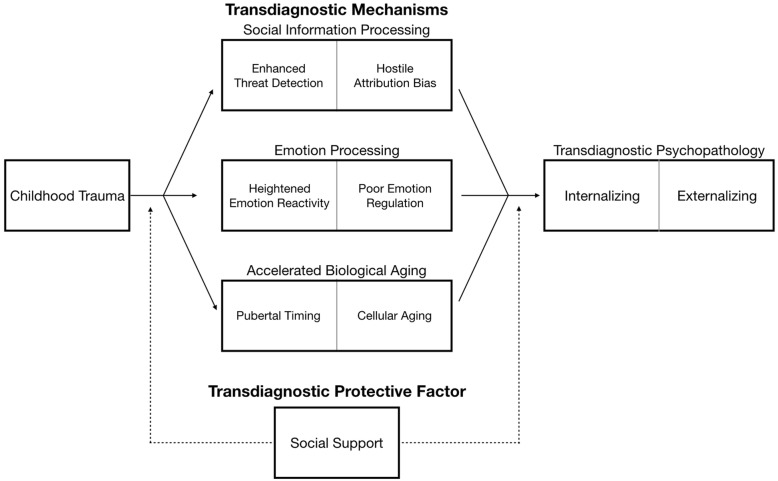
We present a model of transdiagnostic mechanisms spanning three broad domains: social information processing, emotional processing, and accelerated biological aging. Changes in social information processing that prioritize threat-related information-such as heightened perceptual sensitivity to threat, misclassification of negative and neutral emotions as anger, and attention biases towards threat-related cues-have been consistently observed in children who have experienced trauma. Patterns of emotional processing common in children exposed to trauma include elevated emotional reactivity to threat-related stimuli, low emotional awareness, and difficulties with emotional learning and emotion regulation. More recently, a pattern of accelerated aging across multiple biological metrics, including pubertal development and cellular aging, has been found in trauma-exposed children. Although these changes in social information processing, emotional responding, and the pace of biological aging reflect developmental adaptations that may promote safety and provide other benefits for children raised in dangerous environments, they have been consistently associated with the emergence of multiple forms of internalizing and externalizing psychopathology and explain the link between childhood trauma exposure and transdiagnostic psychopathology. Children with higher levels of social support, particularly from caregivers, are less likely to develop psychopathology following trauma exposure. Caregiver buffering of threat-related processing may be one mechanism explaining this protective effect.
Childhood trauma exposure is a powerful transdiagnostic risk factor associated with elevated risk for multiple forms of psychopathology across development. Changes in threat-related social and emotional processing and accelerated biological aging serve as transdiagnostic mechanisms linking childhood trauma with psychopathology. These transdiagnostic mechanisms represent critical targets for early interventions aimed at preventing the emergence of psychopathology in children who have experienced trauma.
跨诊断过程为多种类型的精神病理学提供风险,并解释了不同障碍的同时发生。出于这个原因,跨诊断过程为早期干预和治疗提供了理想的目标。儿童期创伤暴露与几乎所有常见形式的精神病理学的风险升高有关。我们阐述了一个跨诊断模型,该模型解释了儿童期创伤与精神病理学之间的强烈联系,以及促进对多种形式的精神病理学产生弹性的保护因素。
我们提出了一个跨诊断机制模型,该模型跨越三个广泛的领域:社会信息处理、情绪处理和加速的生物老化。经历过创伤的儿童中,一直观察到社会信息处理的变化,这些变化优先考虑与威胁相关的信息,例如对威胁的感知敏感性增加、将负面和中性情绪错误地归类为愤怒以及对与威胁相关的线索的注意力偏见。在暴露于创伤的儿童中,常见的情绪处理模式包括对与威胁相关的刺激的情绪反应性升高、情绪意识低以及情绪学习和情绪调节困难。最近,在多个生物指标上发现了加速老化的模式,包括青春期发育和细胞老化,在暴露于创伤的儿童中。虽然社会信息处理、情绪反应和生物老化速度的这些变化反映了可能促进安全并为在危险环境中长大的儿童提供其他好处的发展适应,但它们与多种内化和外化精神病理学的出现一直相关,并解释了儿童期创伤暴露与跨诊断精神病理学之间的联系。社会支持水平较高的儿童,尤其是来自照顾者的支持,在创伤暴露后不太可能出现精神病理学。与威胁相关的处理的照顾者缓冲可能是解释这种保护作用的一种机制。
儿童期创伤暴露是一种强大的跨诊断风险因素,与整个发展过程中多种形式的精神病理学风险升高有关。与威胁相关的社会和情绪处理的变化以及加速的生物老化是将儿童期创伤与精神病理学联系起来的跨诊断机制。这些跨诊断机制代表了针对经历过创伤的儿童预防精神病理学出现的早期干预的关键目标。