Peirs Cedric, Dallel Radhouane, Todd Andrew J
Université Clermont Auvergne, CHU Clermont-Ferrand, Inserm, Neuro-Dol, Clermont-Ferrand, F-63000, France.
Institute of Neuroscience and Psychology, College of Medical, Veterinary and Life Sciences, University of Glasgow, Glasgow, G12 8QQ, UK.
J Neural Transm (Vienna). 2020 Apr;127(4):505-525. doi: 10.1007/s00702-020-02159-1. Epub 2020 Apr 2.
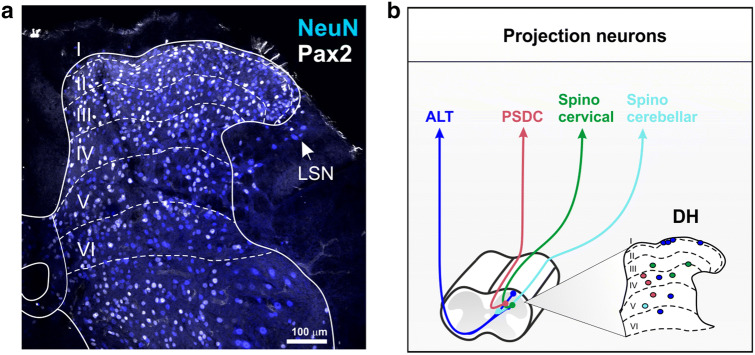
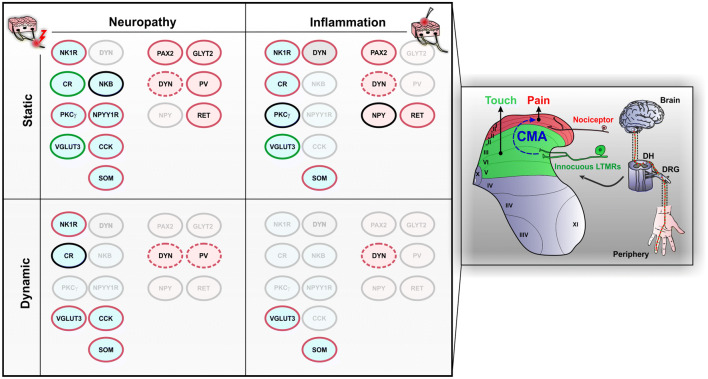
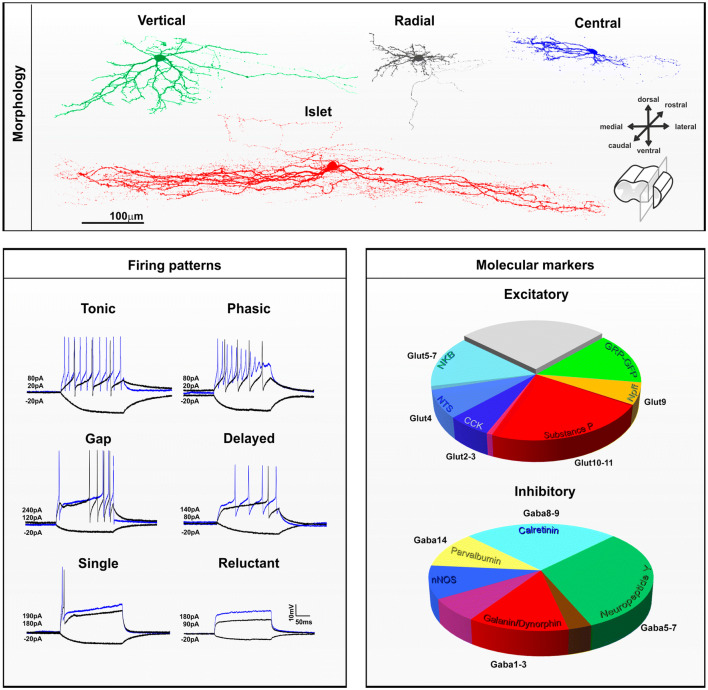
The dorsal horns of the spinal cord and the trigeminal nuclei in the brainstem contain neuron populations that are critical to process sensory information. Neurons in these areas are highly heterogeneous in their morphology, molecular phenotype and intrinsic properties, making it difficult to identify functionally distinct cell populations, and to determine how these are engaged in pathophysiological conditions. There is a growing consensus concerning the classification of neuron populations, based on transcriptomic and transductomic analyses of the dorsal horn. These approaches have led to the discovery of several molecularly defined cell types that have been implicated in cutaneous mechanical allodynia, a highly prevalent and difficult-to-treat symptom of chronic pain, in which touch becomes painful. The main objective of this review is to provide a contemporary view of dorsal horn neuronal populations, and describe recent advances in our understanding of on how they participate in cutaneous mechanical allodynia.
脊髓背角和脑干中的三叉神经核包含对感觉信息处理至关重要的神经元群体。这些区域的神经元在形态、分子表型和内在特性上高度异质,使得难以识别功能上不同的细胞群体,也难以确定它们在病理生理条件下是如何发挥作用的。基于对背角的转录组学和转导组学分析,关于神经元群体的分类越来越趋于一致。这些方法导致发现了几种分子定义的细胞类型,它们与皮肤机械性异常性疼痛有关,皮肤机械性异常性疼痛是慢性疼痛中一种非常普遍且难以治疗的症状,即触摸会变得疼痛。本综述的主要目的是提供对背角神经元群体的当代观点,并描述我们对它们如何参与皮肤机械性异常性疼痛的理解的最新进展。