Department of Biology, University of Regina, 3737 Wascana Parkway, Regina, S4S 0A2, Saskatchewan, Canada.
Laboratory of Geo-Information Science and Remote Sensing, Wageningen University, P.O. Box 47, 6700 AA, Wageningen, The Netherlands.
Ecology. 2020 Jul;101(7):e03052. doi: 10.1002/ecy.3052. Epub 2020 May 5.
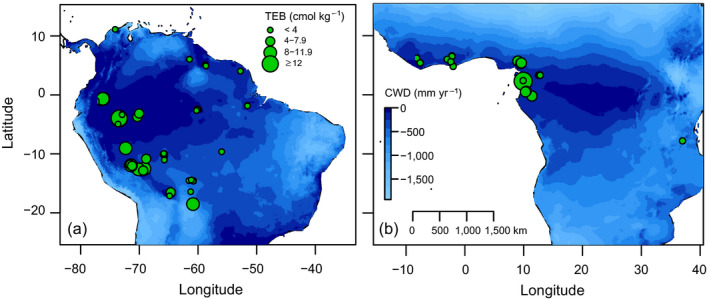
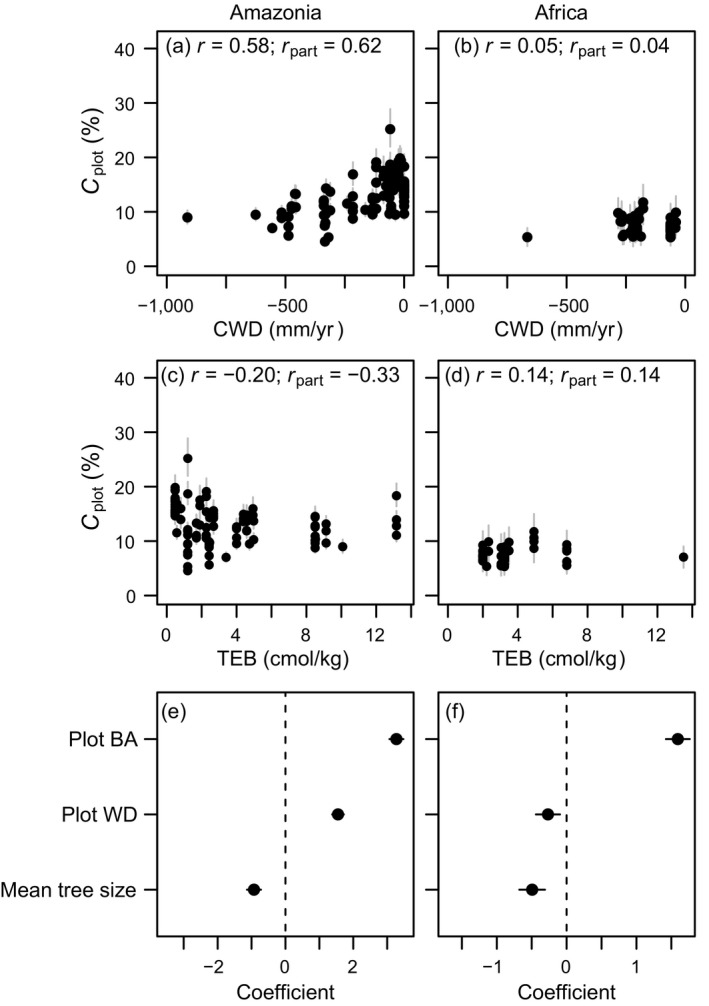
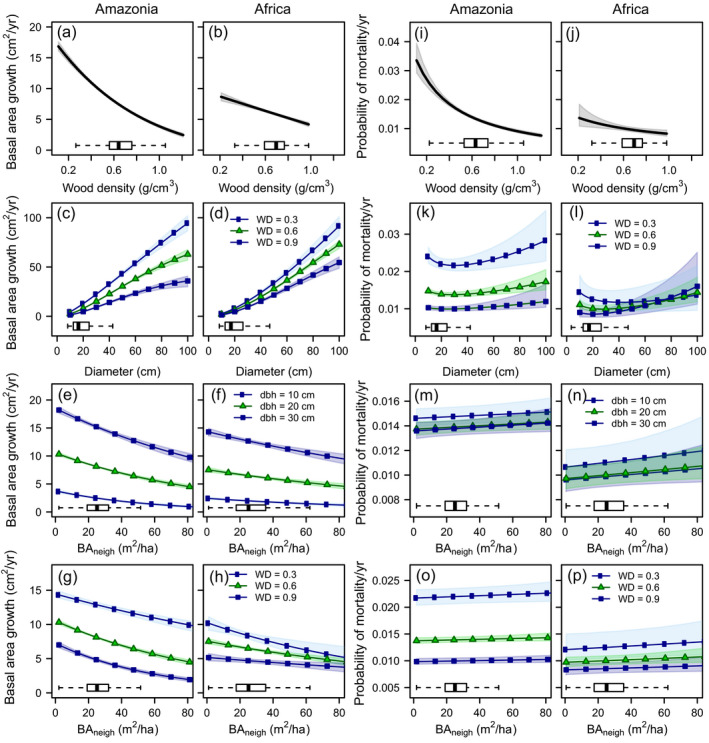
Competition among trees is an important driver of community structure and dynamics in tropical forests. Neighboring trees may impact an individual tree's growth rate and probability of mortality, but large-scale geographic and environmental variation in these competitive effects has yet to be evaluated across the tropical forest biome. We quantified effects of competition on tree-level basal area growth and mortality for trees ≥10-cm diameter across 151 ~1-ha plots in mature tropical forests in Amazonia and tropical Africa by developing nonlinear models that accounted for wood density, tree size, and neighborhood crowding. Using these models, we assessed how water availability (i.e., climatic water deficit) and soil fertility influenced the predicted plot-level strength of competition (i.e., the extent to which growth is reduced, or mortality is increased, by competition across all individual trees). On both continents, tree basal area growth decreased with wood density and increased with tree size. Growth decreased with neighborhood crowding, which suggests that competition is important. Tree mortality decreased with wood density and generally increased with tree size, but was apparently unaffected by neighborhood crowding. Across plots, variation in the plot-level strength of competition was most strongly related to plot basal area (i.e., the sum of the basal area of all trees in a plot), with greater reductions in growth occurring in forests with high basal area, but in Amazonia, the strength of competition also varied with plot-level wood density. In Amazonia, the strength of competition increased with water availability because of the greater basal area of wetter forests, but was only weakly related to soil fertility. In Africa, competition was weakly related to soil fertility and invariant across the shorter water availability gradient. Overall, our results suggest that competition influences the structure and dynamics of tropical forests primarily through effects on individual tree growth rather than mortality and that the strength of competition largely depends on environment-mediated variation in basal area.
树木之间的竞争是热带森林群落结构和动态的重要驱动因素。相邻的树木可能会影响个体树木的生长速度和死亡率,但这些竞争效应在热带森林生物群落中的大规模地理和环境变化尚未得到评估。我们通过开发非线性模型,量化了竞争对树木级别的基面积生长和死亡率的影响,这些模型考虑了木材密度、树木大小和邻域拥挤程度,涵盖了亚马逊和热带非洲成熟热带森林中的 151 个~1 公顷的样地中直径大于等于 10 厘米的树木。使用这些模型,我们评估了水分可用性(即气候水分亏缺)和土壤肥力如何影响预测的样地竞争强度(即由于所有个体树木之间的竞争而导致的生长减少或死亡率增加的程度)。在两个大陆上,树木的基面积生长随木材密度的增加而减少,随树木大小的增加而增加。生长随邻域拥挤程度的增加而减少,这表明竞争很重要。树木死亡率随木材密度的增加而减少,随树木大小的增加而普遍增加,但显然不受邻域拥挤程度的影响。在样地中,样地水平竞争强度的变化与样地基面积(即样地中所有树木的基面积总和)最密切相关,生长减少幅度较大的样地具有较高的基面积,但在亚马逊地区,竞争强度也与样地水平的木材密度有关。在亚马逊地区,由于较湿润森林的基面积较大,竞争强度随水分可用性的增加而增加,但与土壤肥力的关系较弱。在非洲,竞争与土壤肥力的关系较弱,并且在较短的水分可用性梯度上是不变的。总的来说,我们的结果表明,竞争主要通过对个体树木生长的影响而不是死亡率来影响热带森林的结构和动态,并且竞争的强度在很大程度上取决于环境介导的基面积变化。