Museum für Naturkunde-Leibniz Institute for Evolution and Biodiversity Science, Berlin, Germany.
Smithsonian Tropical Research Institute, Ancón, Republic of Panama.
PLoS Biol. 2020 Apr 2;18(4):e3000655. doi: 10.1371/journal.pbio.3000655. eCollection 2020 Apr.
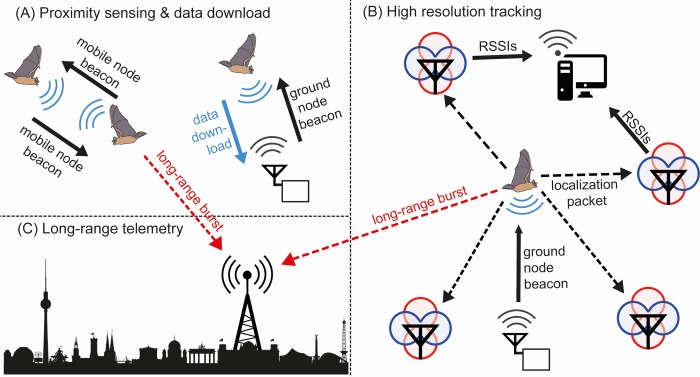
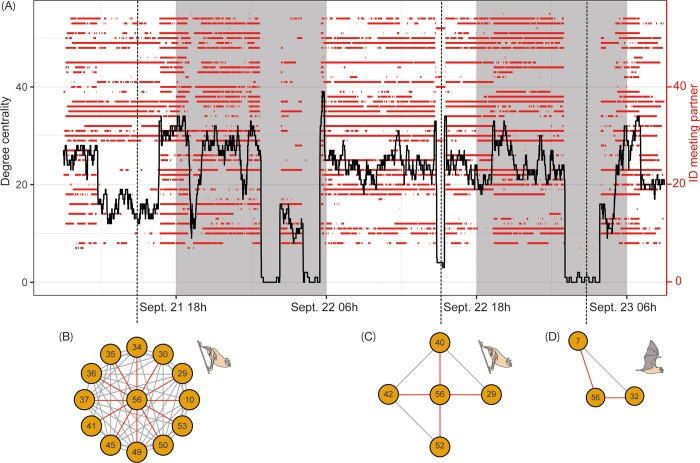
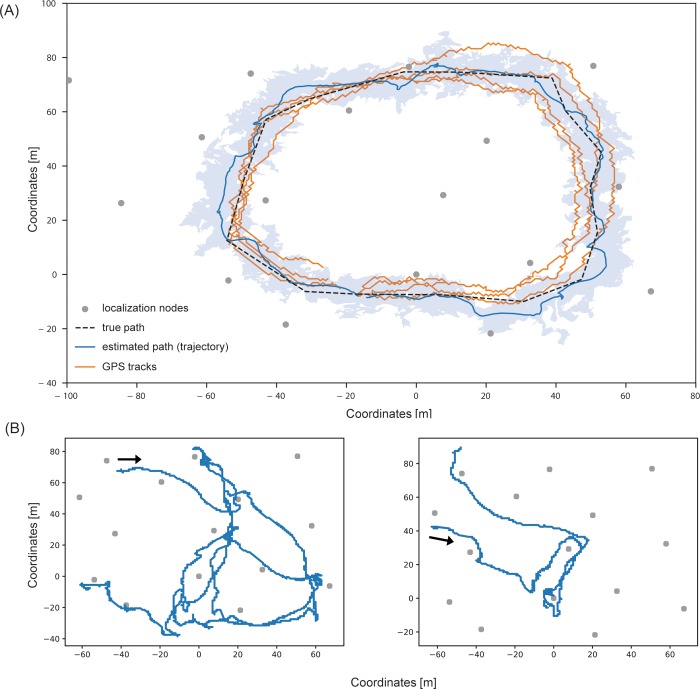
Recent advances in animal tracking technology have ushered in a new era in biologging. However, the considerable size of many sophisticated biologging devices restricts their application to larger animals, whereas older techniques often still represent the state-of-the-art for studying small vertebrates. In industrial applications, low-power wireless sensor networks (WSNs) fulfill requirements similar to those needed to monitor animal behavior at high resolution and at low tag mass. We developed a wireless biologging network (WBN), which enables simultaneous direct proximity sensing, high-resolution tracking, and long-range remote data download at tag masses of 1 to 2 g. Deployments to study wild bats created social networks and flight trajectories of unprecedented quality. Our developments highlight the vast capabilities of WBNs and their potential to close an important gap in biologging: fully automated tracking and proximity sensing of small animals, even in closed habitats, at high spatial and temporal resolution.
近年来,动物追踪技术的进步开创了生物遥测学的新纪元。然而,许多复杂的生物遥测设备体积庞大,限制了它们在大型动物身上的应用,而较旧的技术通常仍然是研究小型脊椎动物的最新技术。在工业应用中,低功耗无线传感器网络(WSN)满足了类似的要求,可用于以低标记质量和高分辨率监测动物行为。我们开发了一种无线生物遥测网络(WBN),它可以在 1 到 2 克的标签质量下实现直接近距离感应、高分辨率跟踪和远程数据下载。用于研究野生蝙蝠的部署创建了具有前所未有的质量的社交网络和飞行轨迹。我们的开发突出了 WBN 的巨大功能及其在生物遥测学中弥补重要空白的潜力:即使在封闭的栖息地中,也可以以高空间和时间分辨率对小型动物进行全自动跟踪和近距离感应。