Division of Endocrinology, Diabetes, and Clinical Nutrition, University Hospital Zurich, 8091, Switzerland.
Division of Endocrinology, Diabetes, and Clinical Nutrition, University Hospital Zurich, 8091, Switzerland; Competence Center Personalized Medicine UZH/ETH, ETH Zurich and University of Zurich, 8091, Switzerland.
Mol Metab. 2020 Jun;36:100967. doi: 10.1016/j.molmet.2020.02.010. Epub 2020 Mar 5.
Decreased muscle mass is a major contributor to age-related morbidity, and strategies to improve muscle regeneration during ageing are urgently needed. Our aim was to identify the subset of relevant microRNAs (miRNAs) that partake in critical aspects of muscle cell differentiation, irrespective of computational predictions, genomic clustering or differential expression of the miRNAs.
miRNA biogenesis was deleted in primary myoblasts using a tamoxifen-inducible CreLox system and combined with an add-back miRNA library screen. RNA-seq experiments, cellular signalling events, and glycogen synthesis, along with miRNA inhibitors, were performed in human primary myoblasts. Muscle regeneration in young and aged mice was assessed using the cardiotoxin (CTX) model.
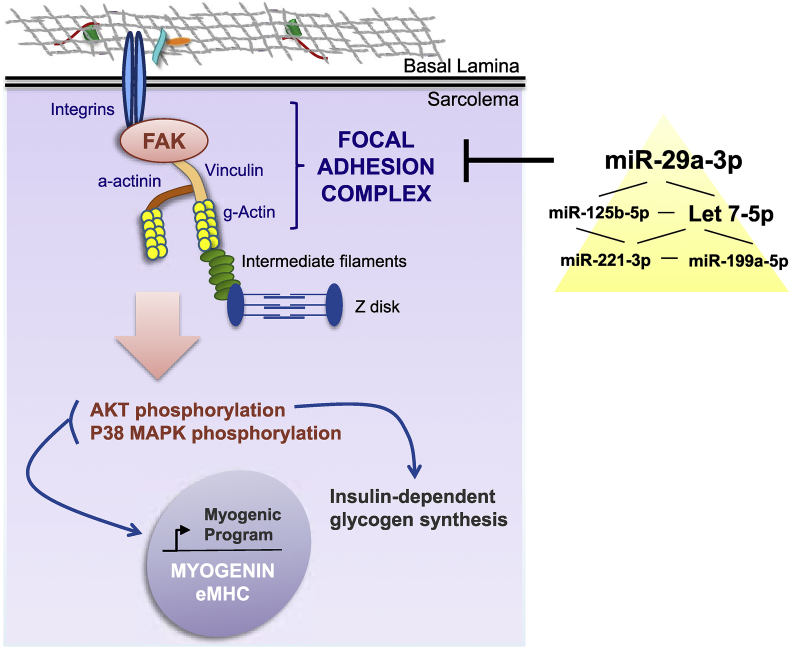
We identified a hierarchical non-clustered miRNA network consisting of highly (miR-29a), moderately (let-7) and mildly active (miR-125b, miR-199a, miR-221) miRNAs that cooperate by directly targeting members of the focal adhesion complex. Through RNA-seq experiments comparing single versus combinatorial inhibition of the miRNAs, we uncovered a fundamental feature of this network, that miRNA activity inversely correlates to miRNA cooperativity. During myoblast differentiation, combinatorial inhibition of the five miRNAs increased activation of focal adhesion kinase (FAK), AKT, and p38 mitogen-activated protein kinase (MAPK), and improved myotube formation and insulin-dependent glycogen synthesis. Moreover, antagonizing the miRNA network in vivo following CTX-induced muscle regeneration enhanced muscle mass and myofiber formation in young and aged mice.
Our results provide novel insights into the dynamics of miRNA cooperativity and identify a miRNA network as therapeutic target for impaired focal adhesion signalling and muscle regeneration during ageing.
肌肉减少是与年龄相关发病率的主要原因,因此迫切需要制定改善衰老过程中肌肉再生的策略。我们的目的是确定参与肌肉细胞分化关键方面的相关 microRNA(miRNA)亚群,而不考虑 miRNA 的计算预测、基因组聚类或差异表达。
使用他莫昔芬诱导的 CreLox 系统在原代成肌细胞中删除 miRNA 生物发生,并与 miRNA 库补回筛选相结合。在人原代成肌细胞中进行 RNA-seq 实验、细胞信号事件以及糖原合成,同时使用 miRNA 抑制剂。使用心脏毒素(CTX)模型评估年轻和老年小鼠中的肌肉再生。
我们确定了一个由高度活跃(miR-29a)、中度活跃(let-7)和轻度活跃(miR-125b、miR-199a、miR-221)miRNA 组成的层次非聚类 miRNA 网络,这些 miRNA 通过直接靶向粘着斑复合物的成员而协同作用。通过比较单个 miRNA 与组合抑制的 RNA-seq 实验,我们揭示了该网络的一个基本特征,即 miRNA 活性与 miRNA 协同作用成反比。在成肌细胞分化过程中,五种 miRNA 的组合抑制增加了粘着斑激酶(FAK)、AKT 和 p38 丝裂原活化蛋白激酶(MAPK)的激活,并改善了肌管形成和胰岛素依赖性糖原合成。此外,在 CTX 诱导的肌肉再生后在体内拮抗 miRNA 网络增强了年轻和老年小鼠的肌肉质量和肌纤维形成。
我们的研究结果提供了 miRNA 协同作用动力学的新见解,并确定了一个 miRNA 网络作为衰老过程中粘着斑信号传导受损和肌肉再生的治疗靶点。