Lee Kwang-Pyo, Shin Yeo Jin, Panda Amaresh C, Abdelmohsen Kotb, Kim Ji Young, Lee Seung-Min, Bahn Young Jae, Choi Jeong Yi, Kwon Eun-Soo, Baek Su-Jin, Kim Seon-Young, Gorospe Myriam, Kwon Ki-Sun
Aging Research Institute, Korea Research Institute of Bioscience and Biotechnology, Daejeon 305-806, Republic of Korea;
Aging Research Institute, Korea Research Institute of Bioscience and Biotechnology, Daejeon 305-806, Republic of Korea; Department of Functional Genomics, Korea University of Science and Technology, Daejeon 305-333, Republic of Korea;
Genes Dev. 2015 Aug 1;29(15):1605-17. doi: 10.1101/gad.263574.115. Epub 2015 Jul 27.
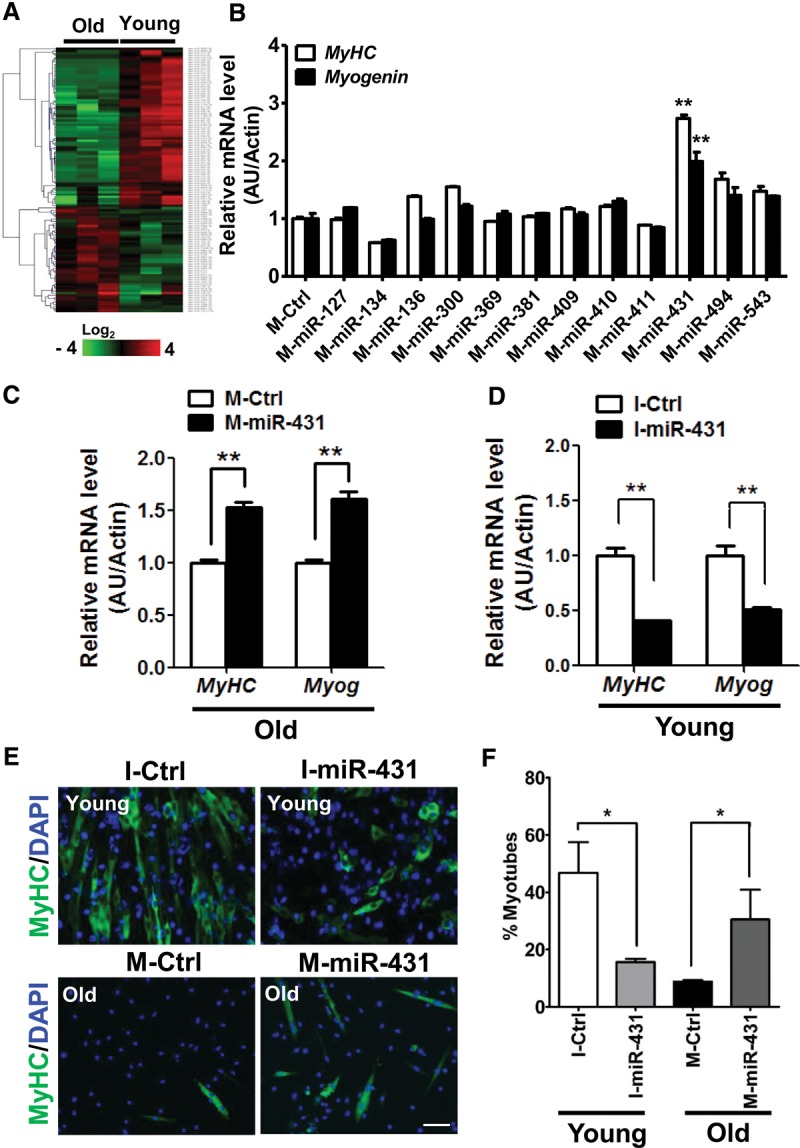
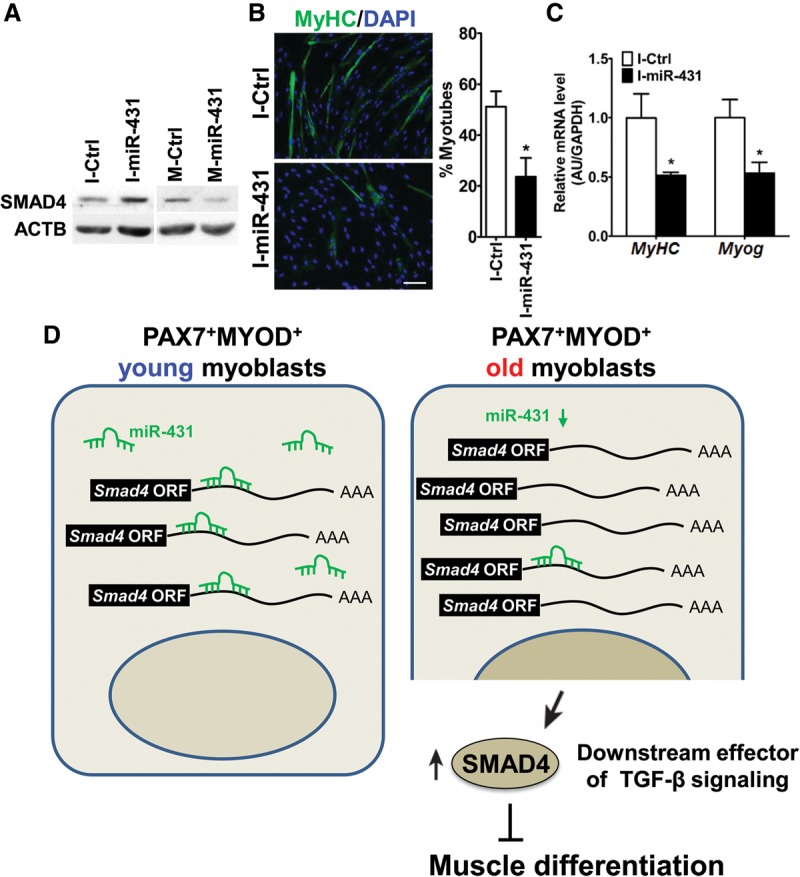
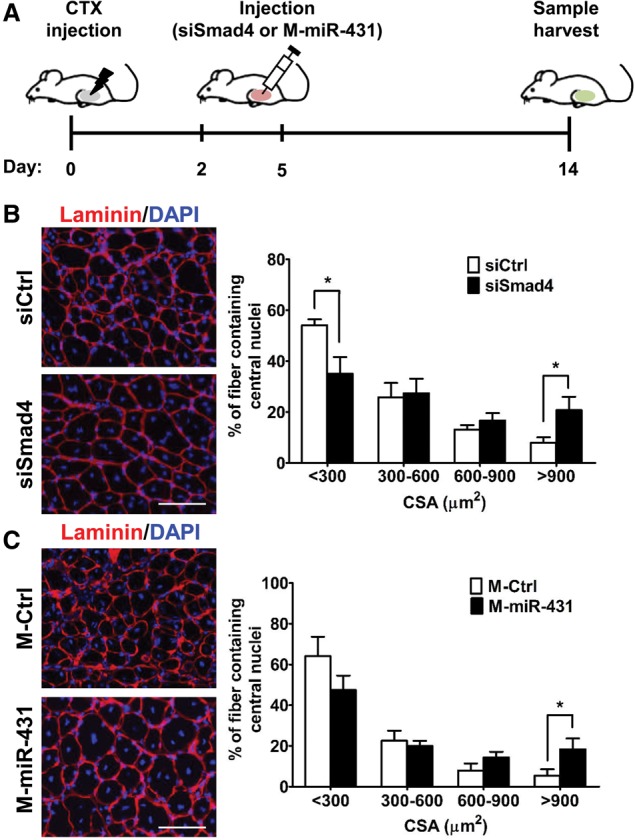
The myogenic capacity of myoblasts decreases in skeletal muscle with age. In addition to environmental factors, intrinsic factors are important for maintaining the regenerative potential of muscle progenitor cells, but their identities are largely unknown. Here, comparative analysis of microRNA (miRNA) expression profiles in young and old myoblasts uncovered miR-431 as a novel miRNA showing markedly reduced abundance in aged myoblasts. Importantly, elevating miR-431 improved the myogenic capacity of old myoblasts, while inhibiting endogenous miR-431 lowered myogenesis. Bioinformatic and biochemical analyses revealed that miR-431 directly interacted with the 3' untranslated region (UTR) of Smad4 mRNA, which encodes one of the downstream effectors of TGF-β signaling. In keeping with the low levels of miR-431 in old myoblasts, SMAD4 levels increased in this myoblast population. Interestingly, in an in vivo model of muscle regeneration following cardiotoxin injury, ectopic miR-431 injection greatly improved muscle regeneration and reduced SMAD4 levels. Consistent with the finding that the mouse miR-431 seed sequence in the Smad4 3' UTR is conserved in the human SMAD4 3' UTR, inhibition of miR-431 also repressed the myogenic capacity of human skeletal myoblasts. Taken together, our results suggest that the age-associated miR-431 plays a key role in maintaining the myogenic ability of skeletal muscle with age.
随着年龄增长,成肌细胞的生肌能力在骨骼肌中会下降。除环境因素外,内在因素对于维持肌肉祖细胞的再生潜能也很重要,但其具体身份大多未知。在此,对年轻和年老成肌细胞中微小RNA(miRNA)表达谱的比较分析发现,miR-431是一种新的miRNA,其在年老成肌细胞中的丰度显著降低。重要的是,提高miR-431可改善年老成肌细胞的生肌能力,而抑制内源性miR-431则会降低肌生成。生物信息学和生化分析表明,miR-431直接与Smad4 mRNA的3'非翻译区(UTR)相互作用,Smad4 mRNA编码TGF-β信号的下游效应器之一。与年老成肌细胞中miR-431水平较低一致,该成肌细胞群体中SMAD4水平升高。有趣的是,在心脏毒素损伤后的肌肉再生体内模型中,异位注射miR-431可显著改善肌肉再生并降低SMAD4水平。与小鼠Smad4 3'UTR中的miR-431种子序列在人类SMAD4 3'UTR中保守这一发现一致,抑制miR-431也会抑制人类骨骼肌成肌细胞的生肌能力。综上所述,我们的结果表明,与年龄相关的miR-431在维持骨骼肌随年龄增长的生肌能力方面起关键作用。