College of Medicine, Princess Nourah bint Abdulrahman University, P.O. Box: 84428, Riyadh, Postal Code: 11671, Saudi Arabia.
High Institute of Public Health, Alexandria University, Alexandria, Egypt.
Infect Dis Poverty. 2020 Apr 3;9(1):31. doi: 10.1186/s40249-020-00648-9.
Schistosomiasis is one of the neglected tropical diseases (NTDs) selected for worldwide elimination in the near future. Egypt has made strong progress against its two endemic species of Schistosoma mansoni and S. haematobium. The former is prevalent in the Nile Delta with the latter dominating in the Nile south of Cairo. Innovative efforts are needed to reach the goal as further reduction of the prevalence has stalled due to ongoing transmission. In this study we aimed to explore the difference between low and high prevalence villages with regard to knowledge attitude and practice about schistosomiasis, utilization of health services, infection and transmission indices.
A hybrid cross-sectional longitudinal study was conducted with three annual follow-ups conducted during 1994-1996. We used a representative systematic random sampling technique investigating 993 individuals from the high prevalence village and 614 from the low prevalence village. Data were analyzed using SPSS, comparing proportions with the Chi square test and means with the Student t test, and ANOVA.
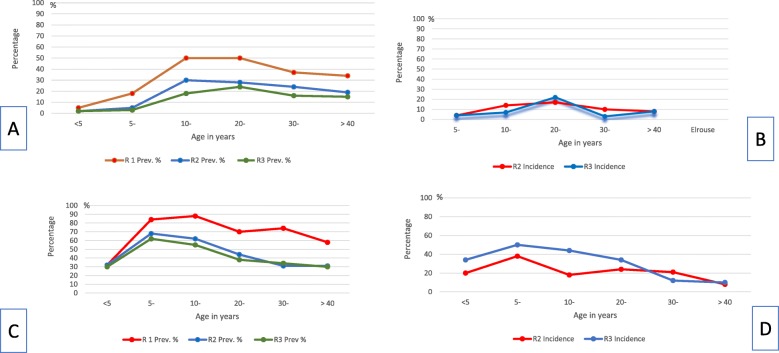
Compliance of faecal sampling and chemotherapy was above 70% in both villages over the whole study period. Selective praziquantel treatment resulted in a significant reduction of prevalence and intensity of infection in both villages, dropping from 35.8% prevalence to 20.6%, in the low-prevalence village, and from 69.5 to 45.9% in the high-prevalence one. Intensity of infection at the base line was 30 eggs per gram (EPG) of stool in the low-prevalence village versus 105 EPG in the high-prevalence village. However, after the second round, reinfection rebounded by 22% in the high-prevalence village, while a slight improvement of the infection indices was demonstrated in the low-prevalence one. The level of knowledge was modest in both villages: people knew about self-protection and treatment, but not much about the role of human excreta for schistosomiasis transmission. While all participants maintained that using the water from the canals was inevitable, inhabitants in the high-prevalence village showed significantly lower scores reflecting higher water contact compared to the low-prevalence one. Many of them (67%) did not utilize the health centre at all compared to 26% of the people in the low-prevalence village. Interestingly, private clinics were seen as the primary source of health care by both villages, but more frequently so in the high-prevalence village (used by 87.2% of the inhabitants) compared to the low-prevalence one (59.8%).
Even if chemotherapy works well as reflected by the observed downregulation of intensity of infection in both villages, reinfection continued due to difficulties to avoid water contact. Efforts must be made to make people understand the role of human excreta for transmission. There is also a need to make people better trust the medical services available.
血吸虫病是被选中在不久的将来进行全球消除的被忽视热带病(NTDs)之一。埃及在对抗其两种地方性物种曼氏血吸虫和埃及血吸虫方面取得了巨大进展。前者在尼罗河三角洲流行,后者在开罗以南的尼罗河占主导地位。由于持续传播,进一步降低流行率的努力已经停滞不前,因此需要创新的努力来实现这一目标。在这项研究中,我们旨在探讨低流行率和高流行率村庄之间在血吸虫病的知识、态度和实践、卫生服务的利用、感染和传播指标方面的差异。
采用混合横断面纵向研究设计,于 1994-1996 年进行了三次年度随访。我们使用代表性的系统随机抽样技术,从高流行率村庄调查了 993 人,从低流行率村庄调查了 614 人。使用 SPSS 进行数据分析,使用卡方检验比较比例,使用学生 t 检验和方差分析比较均值。
在整个研究期间,两个村庄的粪便采样和化疗的依从性均超过 70%。选择性使用吡喹酮治疗导致两个村庄的患病率和感染强度显著降低,从低流行率村庄的 35.8%降至 20.6%,从高流行率村庄的 69.5%降至 45.9%。基线感染强度为低流行率村庄每克粪便 30 个虫卵(EPG),高流行率村庄每克粪便 105 个 EPG。然而,第二轮后,高流行率村庄的再感染率反弹了 22%,而低流行率村庄的感染指数略有改善。两个村庄的知识水平都不高:人们了解自我保护和治疗,但对人类粪便在血吸虫病传播中的作用了解不多。虽然所有参与者都认为使用运河水是不可避免的,但高流行率村庄的居民得分明显较低,反映出他们与水的接触程度更高。与低流行率村庄的 26%相比,他们中许多人(67%)根本不使用卫生中心。有趣的是,私人诊所被两个村庄视为主要的医疗保健来源,但在高流行率村庄更为常见(87.2%的居民使用),而在低流行率村庄则不太常见(59.8%)。
即使化疗效果良好,正如两个村庄感染强度的下调所反映的那样,但由于难以避免与水接触,再感染仍在继续。必须努力使人们了解人类粪便在传播中的作用。还需要使人们更好地信任现有的医疗服务。