ICONE - Innsbruck Cognitive Neuroscience, Department for Hearing, Speech, and Voice Disorders, Medical University of Innsbruck, 6020, Innsbruck, Austria.
Department of Psychology, University of Innsbruck, 6020, Innsbruck, Austria.
Sci Rep. 2020 Apr 2;10(1):5807. doi: 10.1038/s41598-020-62761-x.
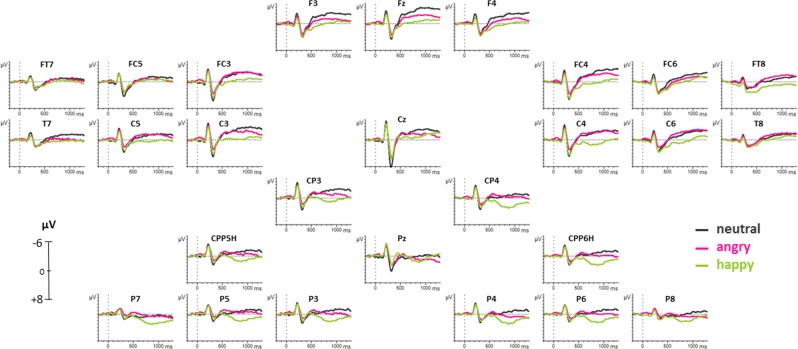
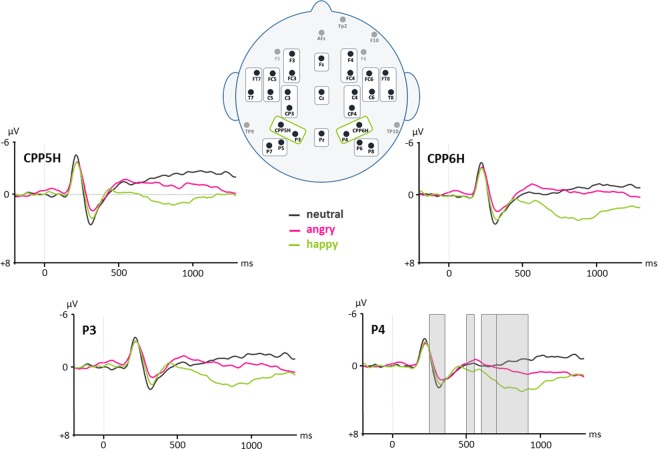
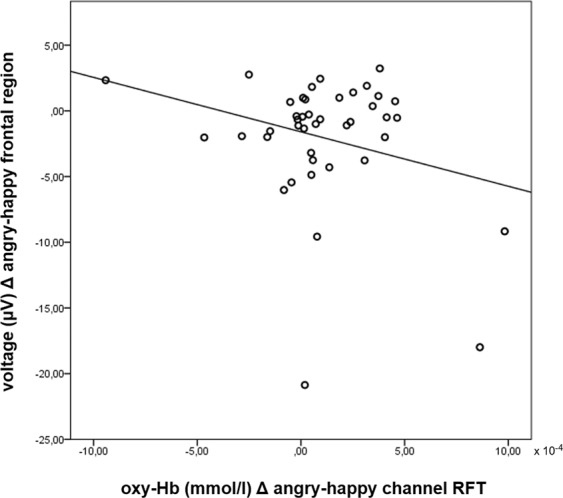
The capability of differentiating between various emotional states in speech displays a crucial prerequisite for successful social interactions. The aim of the present study was to investigate neural processes underlying this differentiating ability by applying a simultaneous neuroscientific approach in order to gain both electrophysiological (via electroencephalography, EEG) and vascular (via functional near-infrared-spectroscopy, fNIRS) responses. Pseudowords conforming to angry, happy, and neutral prosody were presented acoustically to participants using a passive listening paradigm in order to capture implicit mechanisms of emotional prosody processing. Event-related brain potentials (ERPs) revealed a larger P200 and an increased late positive potential (LPP) for happy prosody as well as larger negativities for angry and neutral prosody compared to happy prosody around 500 ms. FNIRS results showed increased activations for angry prosody at right fronto-temporal areas. Correlation between negativity in the EEG and activation in fNIRS for angry prosody suggests analogous underlying processes resembling a negativity bias. Overall, results indicate that mechanisms of emotional and phonological encoding (P200), emotional evaluation (increased negativities) as well as emotional arousal and relevance (LPP) are present during implicit processing of emotional prosody.
区分言语中各种情绪状态的能力是成功社交互动的关键前提。本研究旨在通过应用同步神经科学方法来研究这种区分能力的神经过程,以获得电生理(通过脑电图 EEG)和血管(通过功能近红外光谱 fNIRS)反应。通过使用被动聆听范式,将符合愤怒、快乐和中性韵律的伪词以声学方式呈现给参与者,以捕获情绪韵律处理的隐含机制。事件相关脑电位(ERPs)显示,与快乐韵律相比,快乐韵律的 P200 更大,晚期正电位(LPP)增加,愤怒和中性韵律的负性更大,约为 500ms。fNIRS 结果显示,愤怒韵律在右额颞区的激活增加。EEG 中的负性与愤怒韵律的 fNIRS 激活之间的相关性表明,类似的潜在过程类似于负性偏差。总的来说,结果表明,在情绪韵律的隐含处理过程中,存在情绪和语音编码(P200)、情绪评估(增加的负性)以及情绪唤醒和相关性(LPP)的机制。