Department of Animal Science, University of Nebraska-Lincoln, C203 ANSC, Lincoln, NE 68583, USA.
Bond Life Sciences Center, University of Missouri, 1201 Rollins Street, Columbia, MO 65201, USA.
Gigascience. 2020 Apr 1;9(4). doi: 10.1093/gigascience/giaa029.
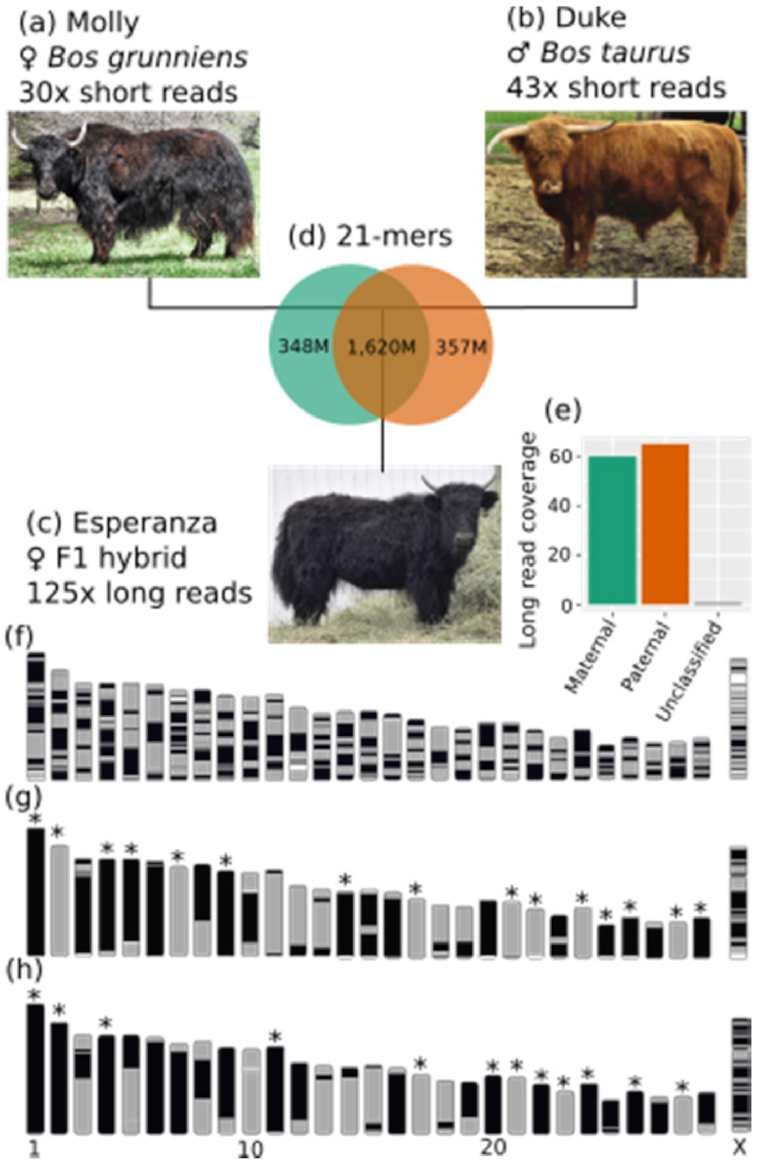
The development of trio binning as an approach for assembling diploid genomes has enabled the creation of fully haplotype-resolved reference genomes. Unlike other methods of assembly for diploid genomes, this approach is enhanced, rather than hindered, by the heterozygosity of the individual sequenced. To maximize heterozygosity and simultaneously assemble reference genomes for 2 species, we applied trio binning to an interspecies F1 hybrid of yak (Bos grunniens) and cattle (Bos taurus), 2 species that diverged nearly 5 million years ago. The genomes of both of these species are composed of acrocentric autosomes.
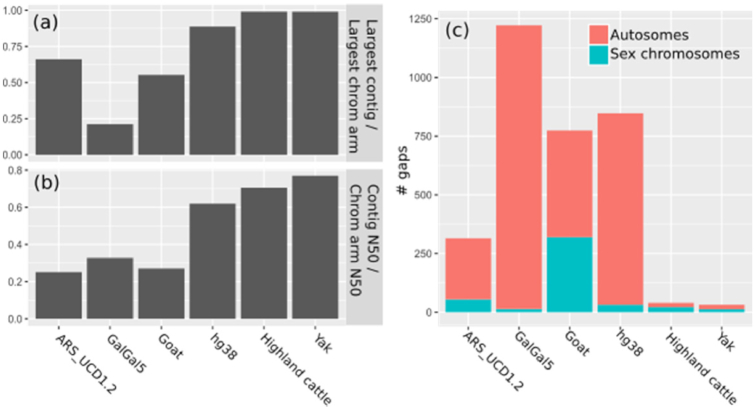
We produced the most continuous haplotype-resolved assemblies for a diploid animal yet reported. Both the maternal (yak) and paternal (cattle) assemblies have the largest 2 chromosomes in single haplotigs, and more than one-third of the autosomes similarly lack gaps. The maximum length haplotig produced was 153 Mb without any scaffolding or gap-filling steps and represents the longest haplotig reported for any species. The assemblies are also more complete and accurate than those reported for most other vertebrates, with 97% of mammalian universal single-copy orthologs present.
The high heterozygosity inherent to interspecies crosses maximizes the effectiveness of the trio binning method. The interspecies trio binning approach we describe is likely to provide the highest-quality assemblies for any pair of species that can interbreed to produce hybrid offspring that develop to sufficient cell numbers for DNA extraction.
作为一种组装二倍体基因组的方法,三重组装的发展使得全单倍型解析参考基因组的构建成为可能。与其他二倍体基因组组装方法不同,该方法通过个体测序的杂合性得到增强,而不是受到阻碍。为了最大限度地提高杂合性,同时为 2 个物种组装参考基因组,我们将三重组装应用于牦牛(Bos grunniens)和牛(Bos taurus)的种间 F1 杂种,这 2 个物种在大约 500 万年前就已经分化。这两个物种的基因组都由近端着丝粒染色体组成。
我们产生了迄今为止报道的二倍体动物中最连续的单倍型解析组装。母本(牦牛)和父本(牛)的组装都具有最大的 2 个单倍体染色体,并且超过三分之一的常染色体同样没有缺口。没有任何支架或缺口填充步骤,最长的单倍体产生的长度为 153Mb,这代表了任何物种报道的最长单倍体。与大多数其他脊椎动物相比,这些组装也更加完整和准确,97%的哺乳动物通用单拷贝直系同源物存在。
种间杂交固有的高杂合性最大限度地提高了三重组装方法的有效性。我们描述的种间三重组装方法很可能为任何能够杂交产生足够数量的细胞用于 DNA 提取的杂种后代的物种对提供最高质量的组装。