Maximum Containment Laboratory, ICMR-National Institute of Virology, Pune, Maharashtra, India.
Influenza Group, ICMR-National Institute of Virology, Pune, Maharashtra, India.
Indian J Med Res. 2020;151(2 & 3):200-209. doi: 10.4103/ijmr.IJMR_663_20.
BACKGROUND & OBJECTIVES: Since December 2019, severe acute respiratory syndrome coronavirus 2 (SARS-CoV-2) has globally affected 195 countries. In India, suspected cases were screened for SARS-CoV-2 as per the advisory of the Ministry of Health and Family Welfare. The objective of this study was to characterize SARS-CoV-2 sequences from three identified positive cases as on February 29, 2020.
Throat swab/nasal swab specimens for a total of 881 suspected cases were screened by E gene and confirmed by RdRp (1), RdRp (2) and N gene real-time reverse transcription-polymerase chain reactions and next-generation sequencing. Phylogenetic analysis, molecular characterization and prediction of B- and T-cell epitopes for Indian SARS-CoV-2 sequences were undertaken.
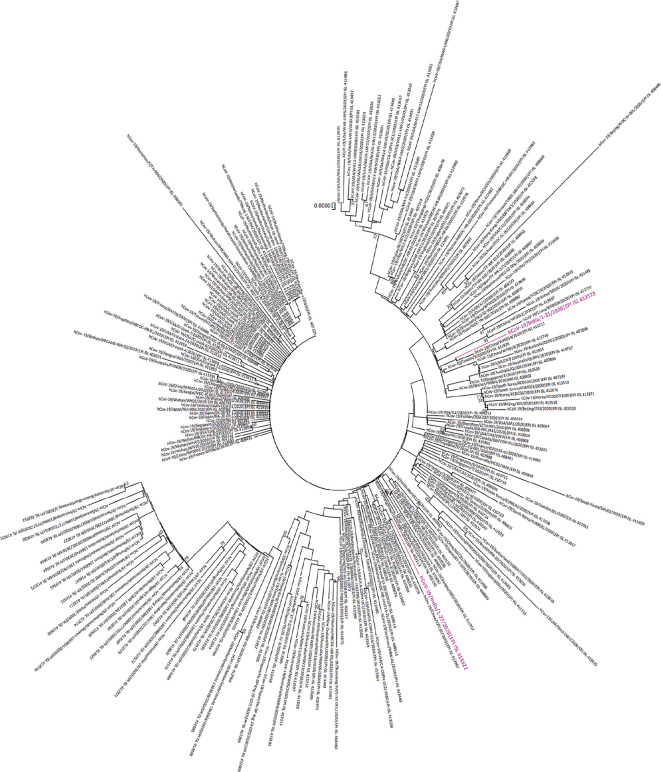
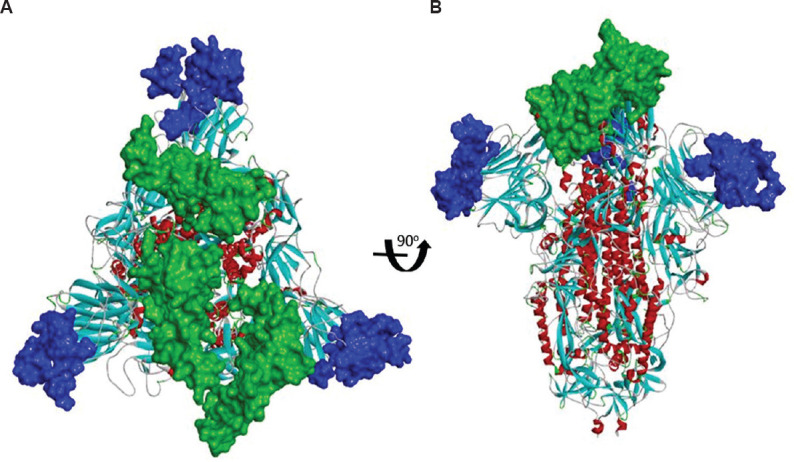
Three cases with a travel history from Wuhan, China, were confirmed positive for SARS-CoV-2. Almost complete (29,851 nucleotides) genomes of case 1, case 3 and a fragmented genome for case 2 were obtained. The sequences of Indian SARS-CoV-2 though not identical showed high (~99.98%) identity with Wuhan seafood market pneumonia virus (accession number: NC 045512). Phylogenetic analysis showed that the Indian sequences belonged to different clusters. Predicted linear B-cell epitopes were found to be concentrated in the S1 domain of spike protein, and a conformational epitope was identified in the receptor-binding domain. The predicted T-cell epitopes showed broad human leucocyte antigen allele coverage of A and B supertypes predominant in the Indian population.
INTERPRETATION & CONCLUSIONS: The two SARS-CoV-2 sequences obtained from India represent two different introductions into the country. The genetic heterogeneity is as noted globally. The identified B- and T-cell epitopes may be considered suitable for future experiments towards the design of vaccines and diagnostics. Continuous monitoring and analysis of the sequences of new cases from India and the other affected countries would be vital to understand the genetic evolution and rates of substitution of the SARS-CoV-2.
自 2019 年 12 月以来,严重急性呼吸综合征冠状病毒 2(SARS-CoV-2)已在全球 195 个国家/地区造成影响。在印度,根据卫生部和家庭福利部的建议,对 SARS-CoV-2 的疑似病例进行了筛查。本研究的目的是对截至 2020 年 2 月 29 日确定的 3 例阳性病例的 SARS-CoV-2 序列进行特征描述。
对 881 例疑似病例的咽喉拭子/鼻腔拭子标本进行了 E 基因检测,并通过 RdRp(1)、RdRp(2)和 N 基因实时逆转录-聚合酶链反应和下一代测序进行了确认。对印度 SARS-CoV-2 序列进行了系统发育分析、分子特征分析和 B 细胞、T 细胞表位预测。
3 例有中国武汉旅行史的病例被确认为 SARS-CoV-2 阳性。获得了病例 1、病例 3 的近乎完整(29851 个核苷酸)基因组和病例 2 的部分基因组。尽管印度 SARS-CoV-2 序列不完全相同,但与武汉海鲜市场肺炎病毒(登录号:NC_045512)高度相似(~99.98%)。系统发育分析表明,印度序列属于不同的聚类。预测的线性 B 细胞表位集中在刺突蛋白的 S1 结构域,受体结合域存在构象表位。预测的 T 细胞表位显示出广泛的人类白细胞抗原等位基因覆盖,主要是印度人群中的 A 和 B 超型。
从印度获得的 2 个 SARS-CoV-2 序列代表了该病毒进入该国的两种不同途径。全球范围内都存在遗传异质性。鉴定的 B 细胞和 T 细胞表位可能适合未来用于疫苗和诊断试剂的设计。对印度和其他受影响国家的新病例序列进行持续监测和分析,对于了解 SARS-CoV-2 的遗传进化和替代率至关重要。