Lucchesi Simone, Furini Simone, Medaglini Donata, Ciabattini Annalisa
Laboratory of Molecular Microbiology and Biotechnology (LA.M.M.B.), Department of Medical Biotechnologies, University of Siena, 53100 Siena, Italy.
Department of Medical Biotechnologies, University of Siena, 53100 Siena, Italy.
Vaccines (Basel). 2020 Mar 20;8(1):138. doi: 10.3390/vaccines8010138.
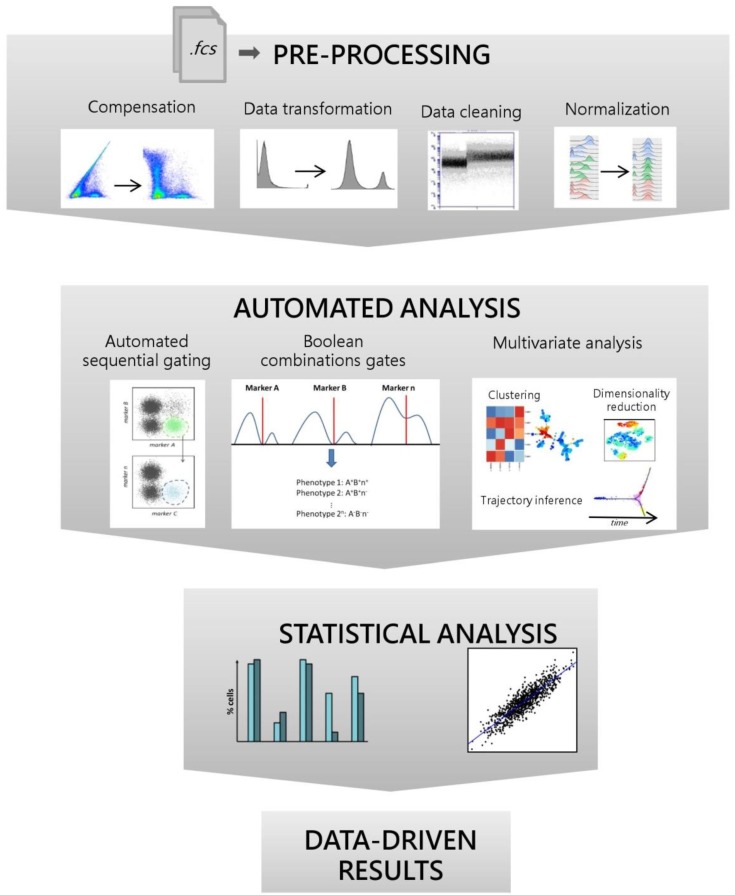
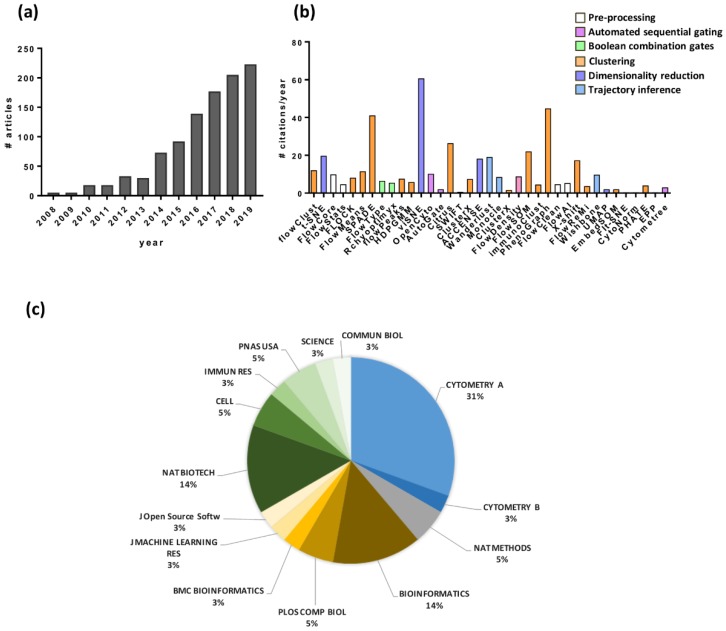
Flow and mass cytometry are used to quantify the expression of multiple extracellular or intracellular molecules on single cells, allowing the phenotypic and functional characterization of complex cell populations. Multiparametric flow cytometry is particularly suitable for deep analysis of immune responses after vaccination, as it allows to measure the frequency, the phenotype, and the functional features of antigen-specific cells. When many parameters are investigated simultaneously, it is not feasible to analyze all the possible bi-dimensional combinations of marker expression with classical manual analysis and the adoption of advanced automated tools to process and analyze high-dimensional data sets becomes necessary. In recent years, the development of many tools for the automated analysis of multiparametric cytometry data has been reported, with an increasing record of publications starting from 2014. However, the use of these tools has been preferentially restricted to bioinformaticians, while few of them are routinely employed by the biomedical community. Filling the gap between algorithms developers and final users is fundamental for exploiting the advantages of computational tools in the analysis of cytometry data. The potentialities of automated analyses range from the improvement of the data quality in the pre-processing steps up to the unbiased, data-driven examination of complex datasets using a variety of algorithms based on different approaches. In this review, an overview of the automated analysis pipeline is provided, spanning from the pre-processing phase to the automated population analysis. Analysis based on computational tools might overcame both the subjectivity of manual gating and the operator-biased exploration of expected populations. Examples of applications of automated tools that have successfully improved the characterization of different cell populations in vaccination studies are also presented.
流式细胞术和质谱细胞术用于定量单个细胞上多种细胞外或细胞内分子的表达,从而对复杂细胞群体进行表型和功能特征分析。多参数流式细胞术特别适合于疫苗接种后免疫反应的深度分析,因为它能够测量抗原特异性细胞的频率、表型和功能特征。当同时研究许多参数时,采用传统的手动分析方法来分析标记物表达的所有可能的二维组合是不可行的,因此需要采用先进的自动化工具来处理和分析高维数据集。近年来,已有许多关于多参数细胞术数据自动化分析工具的报道,自2014年起相关出版物的数量不断增加。然而,这些工具的使用主要局限于生物信息学家,生物医学领域的人员很少常规使用。弥合算法开发者和最终用户之间的差距对于在细胞术数据分析中利用计算工具的优势至关重要。自动化分析的潜力范围从预处理步骤中数据质量的提高,到使用基于不同方法的各种算法对复杂数据集进行无偏倚的、数据驱动的检查。在这篇综述中,我们提供了一个从预处理阶段到自动群体分析的自动化分析流程概述。基于计算工具的分析可能克服手动设门的主观性和对预期群体的操作者偏差探索。还介绍了自动化工具在疫苗接种研究中成功改善不同细胞群体特征的应用实例。