Department of Computer Science, UiT The Arctic University of Norway, Tromsø, Norway.
School of Sport Sciences, Faculty of Health Sciences, UiT The Arctic University of Norway, Tromsø, Norway.
Sci Rep. 2020 Apr 3;10(1):5866. doi: 10.1038/s41598-020-62821-2.
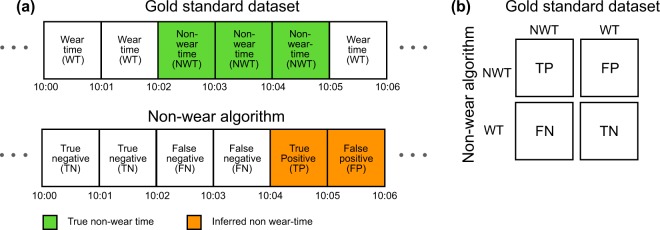
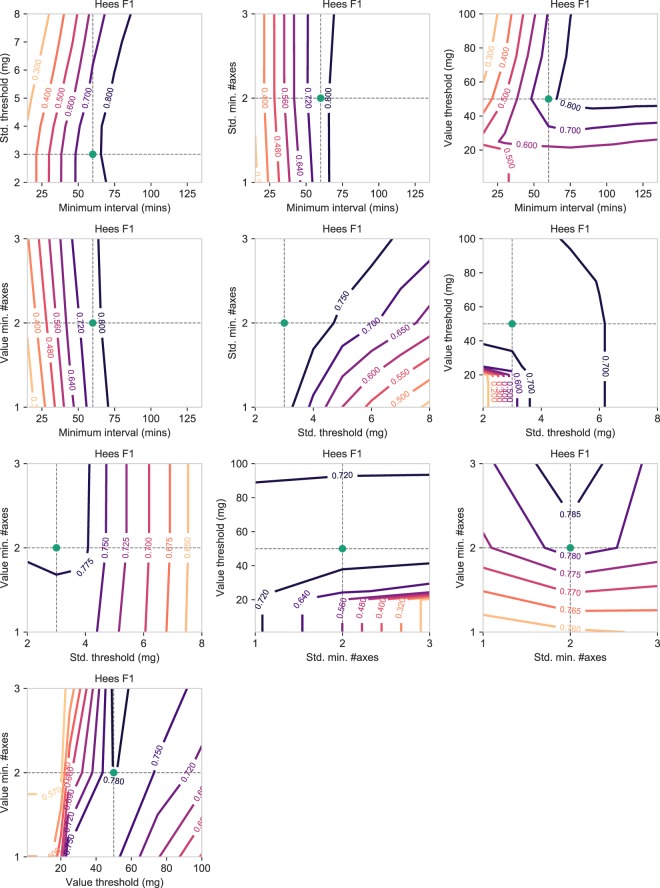
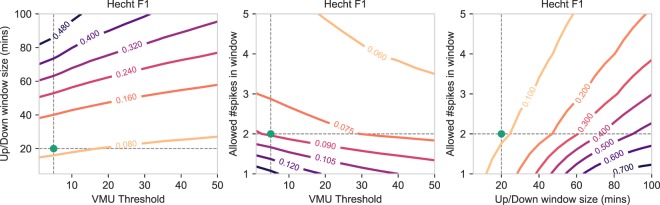
Accurate detection of accelerometer non-wear time is crucial for calculating physical activity summary statistics. In this study, we evaluated three epoch-based non-wear algorithms (Hecht, Troiano, and Choi) and one raw-based algorithm (Hees). In addition, we performed a sensitivity analysis to provide insight into the relationship between the algorithms' hyperparameters and classification performance, as well as to generate tuned hyperparameter values to better detect episodes of wear and non-wear time. We used machine learning to construct a gold-standard dataset by combining two accelerometers and electrocardiogram recordings. The Hecht and Troiano algorithms achieved poor classification performance, while Choi exhibited moderate performance. Meanwhile, Hees outperformed all epoch-based algorithms. The sensitivity analysis and hyperparameter tuning revealed that all algorithms were able to achieve increased classification performance by employing larger intervals and windows, while more stringently defining artificial movement. These classification gains were associated with the ability to lower the false positives (type I error) and do not necessarily indicate a more accurate detection of the total non-wear time. Moreover, our results indicate that with tuned hyperparameters, epoch-based non-wear algorithms are able to perform just as well as raw-based non-wear algorithms with respect to their ability to correctly detect true wear and non-wear episodes.
准确检测加速度计的非佩戴时间对于计算体力活动汇总统计数据至关重要。在本研究中,我们评估了三种基于时段的非佩戴算法(Hecht、Troiano 和 Choi)和一种基于原始数据的算法(Hees)。此外,我们进行了敏感性分析,以深入了解算法超参数与分类性能之间的关系,并生成经过调整的超参数值,以更好地检测佩戴和非佩戴时间的时段。我们使用机器学习通过结合两个加速度计和心电图记录来构建金标准数据集。Hecht 和 Troiano 算法的分类性能较差,而 Choi 算法表现中等。同时,Hees 优于所有基于时段的算法。敏感性分析和超参数调整表明,所有算法都能够通过使用更大的间隔和窗口以及更严格地定义人为运动来提高分类性能,从而降低假阳性(I 类错误)。这些分类增益与降低总非佩戴时间检测的准确性无关。此外,我们的结果表明,经过调整的超参数后,基于时段的非佩戴算法在正确检测真实佩戴和非佩戴时段方面的表现与基于原始数据的非佩戴算法一样好。