Research Unit for Exercise Epidemiology, Department of Sports Science and Clinical Biomechanics, Centre of Research in Childhood Health, University of Southern Denmark, 5230, Odense, Denmark.
Sci Rep. 2023 Feb 13;13(1):2496. doi: 10.1038/s41598-023-29666-x.
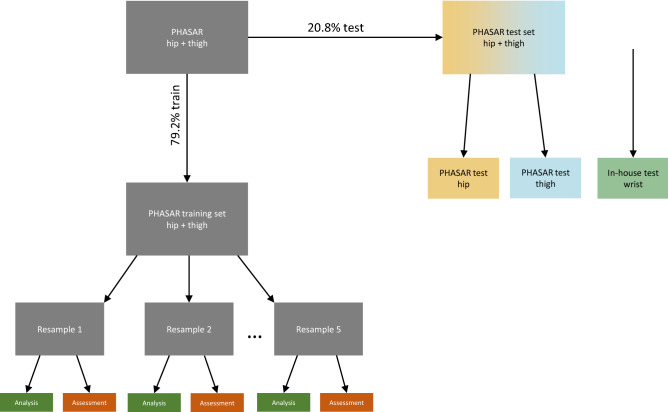
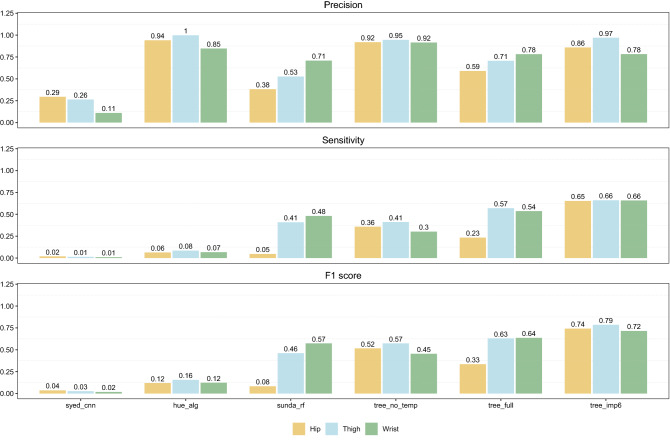
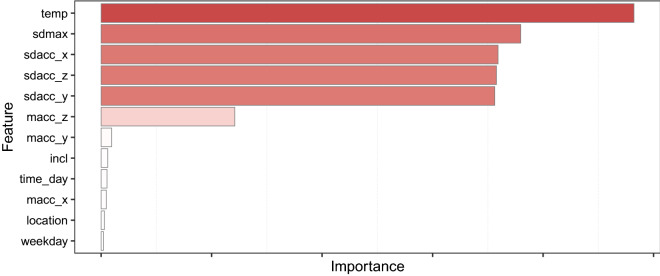
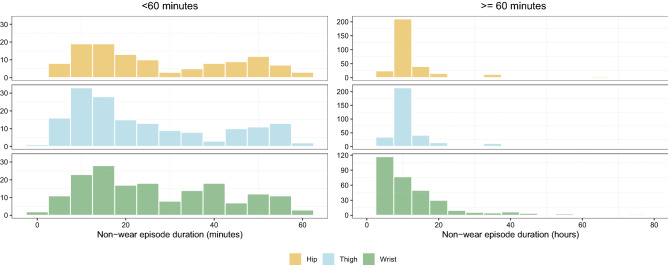
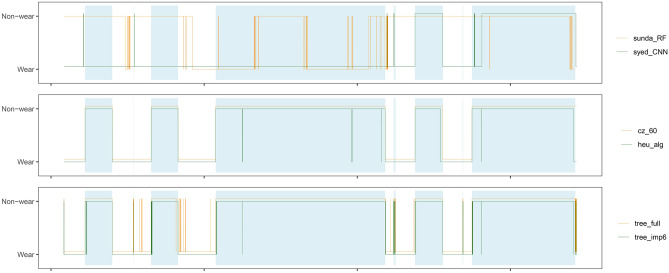
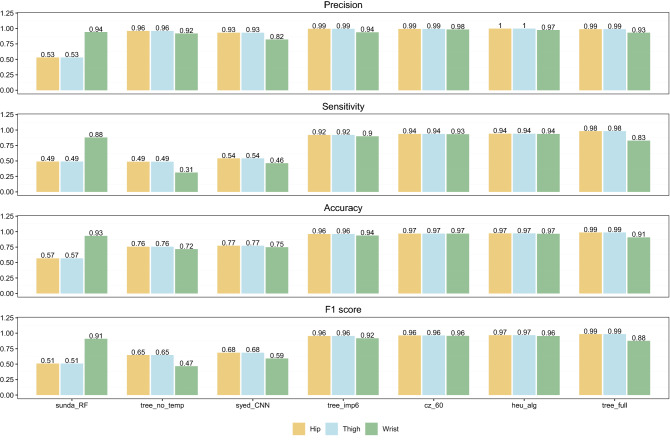
Wearable physical activity sensors are widely used in research and practice as they provide objective measures of human behavior at a low cost. An important challenge for accurate assessment of physical activity behavior in free-living is the detection non-wear. Traditionally, heuristic algorithms that rely on specific interval lengths have been employed to detect non-wear time; however, machine learned models are emerging. We explore the potential of detecting non-wear using decision trees that combine raw acceleration and skin temperature, and we investigate the generalizability of our models, traditional heuristic algorithms, and recently developed machine learned models by external validation. The Decision tree models were trained using one week of data from thigh- and hip-worn accelerometers from 64 children. External validation was performed using data from wrist-worn accelerometers of 42 adolescents. For non-wear episodes longer than 60 min, the heuristic algorithms performed the best with F1-scores above 0.96. However, regarding episodes shorter than 60 min, the best performing method was the decision tree model including the six most important predictors with F1 scores above 0.74 for all sensor locations. We conclude that for classifying non-wear time, researchers should carefully select an appropriate method and we encourage the use of external validation when reporting on machine learned non-wear models.
可穿戴式身体活动传感器在研究和实践中被广泛应用,因为它们可以以较低的成本提供人类行为的客观测量。在自由生活中准确评估身体活动行为的一个重要挑战是检测非佩戴状态。传统上,依赖特定间隔长度的启发式算法被用于检测非佩戴时间;然而,机器学习模型正在出现。我们探索使用结合原始加速度和皮肤温度的决策树来检测非佩戴状态的潜力,并通过外部验证研究我们的模型、传统启发式算法和最近开发的机器学习模型的通用性。决策树模型使用来自 64 名儿童大腿和臀部佩戴的加速度计的一周数据进行训练。使用来自 42 名青少年手腕佩戴的加速度计的数据进行外部验证。对于持续时间超过 60 分钟的非佩戴时段,基于启发式算法的 F1 得分超过 0.96,表现最佳。然而,对于持续时间短于 60 分钟的非佩戴时段,表现最佳的方法是包括六个最重要预测因子的决策树模型,所有传感器位置的 F1 得分均超过 0.74。我们得出结论,对于分类非佩戴时间,研究人员应仔细选择适当的方法,我们鼓励在报告基于机器学习的非佩戴模型时使用外部验证。