Oprescu Stephanie N, Yue Feng, Qiu Jiamin, Brito Luiz F, Kuang Shihuan
Department of Biological Sciences, Purdue University, 915 W State St, West Lafayette, IN 47907, USA.
Department of Animal Sciences, Purdue University, 270 S Russell St, West Lafayette, IN 47907, USA.
iScience. 2020 Apr 24;23(4):100993. doi: 10.1016/j.isci.2020.100993. Epub 2020 Mar 20.
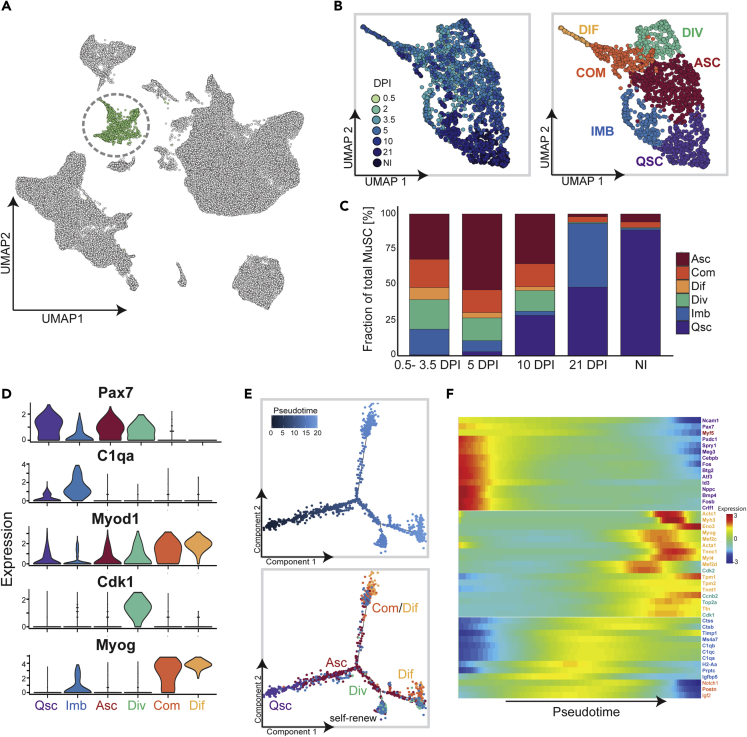
Mammalian skeletal muscle possesses a unique ability to regenerate, which is primarily mediated by a population of resident muscle stem cells (MuSCs) and requires a concerted response from other supporting cell populations. Previous targeted analysis has described the involvement of various specific populations in regeneration, but an unbiased and simultaneous evaluation of all cell populations has been limited. Therefore, we used single-cell RNA-sequencing to uncover gene expression signatures of over 53,000 individual cells during skeletal muscle regeneration. Cells clustered into 25 populations and subpopulations, including a subpopulation of immune gene enriched myoblasts (immunomyoblasts) and subpopulations of fibro-adipogenic progenitors. Our analyses also uncovered striking spatiotemporal dynamics in gene expression, population composition, and cell-cell interaction during muscle regeneration. These findings provide insights into the cellular and molecular underpinning of skeletal muscle regeneration.
哺乳动物骨骼肌具有独特的再生能力,这主要由一群驻留的肌肉干细胞(MuSCs)介导,并且需要其他支持细胞群体的协同反应。先前的靶向分析已经描述了各种特定细胞群体在再生中的作用,但对所有细胞群体进行无偏且同时的评估一直很有限。因此,我们使用单细胞RNA测序来揭示骨骼肌再生过程中超过53,000个单个细胞的基因表达特征。细胞聚集成25个群体和亚群体,包括免疫基因富集的成肌细胞亚群体(免疫成肌细胞)和成纤维脂肪生成祖细胞亚群体。我们的分析还揭示了肌肉再生过程中基因表达、群体组成和细胞间相互作用的显著时空动态。这些发现为骨骼肌再生的细胞和分子基础提供了见解。