Division of Biostatistics, University of Minnesota School of Public Health, Minneapolis, MN, USA.
Department of Epidemiology and Biostatistics, Rutgers School of Public Health, Piscataway, NJ, USA.
Paediatr Perinat Epidemiol. 2020 Nov;34(6):736-743. doi: 10.1111/ppe.12674. Epub 2020 Apr 6.
Preconception life style and health play a pivotal role in positively impacting the health of a pregnancy, and this includes the reduction of exposure to endocrine-disrupting chemicals such as phthalates. We have previously demonstrated that women planning a pregnancy with assisted reproductive technology (ART) have lower phthalate metabolite concentrations than their non-ART-using counterparts.
To determine whether women who intended to become pregnant had lower phthalate metabolite concentrations than those who had an unintended pregnancy, or whether change in phthalate exposure across pregnancy differed between these two groups.
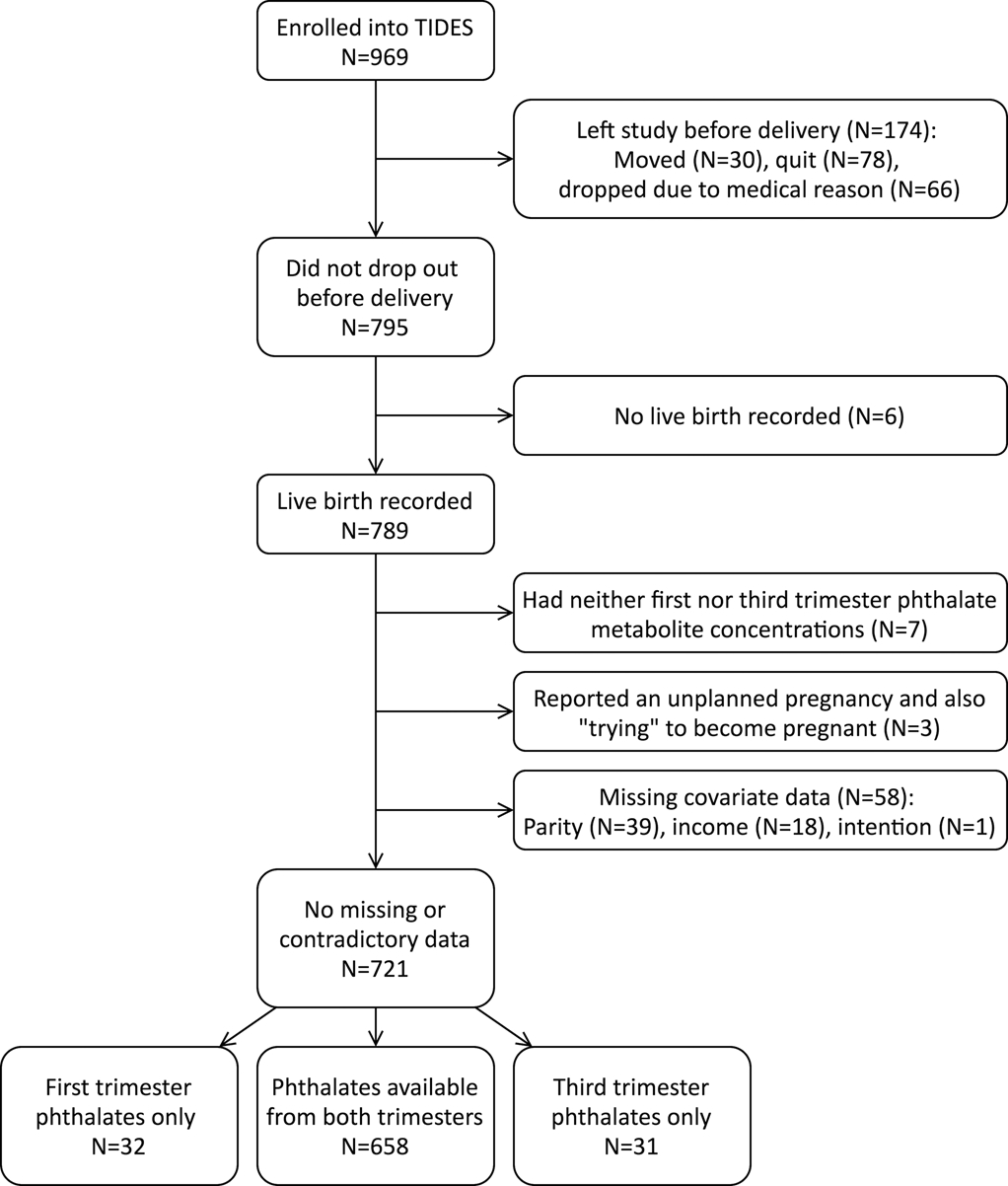
A total of 721 women enrolled in The Infant Development and Environment Study (TIDES), a multicentre US prospective pregnancy cohort; 513 (71%) indicated their pregnancy was planned. Urine samples from first- and third-trimester visits were analysed for 10 specific-gravity-adjusted, natural-log-transformed phthalate metabolites. Simple and multivariable linear regression, adjusting for centre, race, age, income, marital status, and parity, were employed to determine whether phthalate metabolite concentrations differed by pregnancy intention.
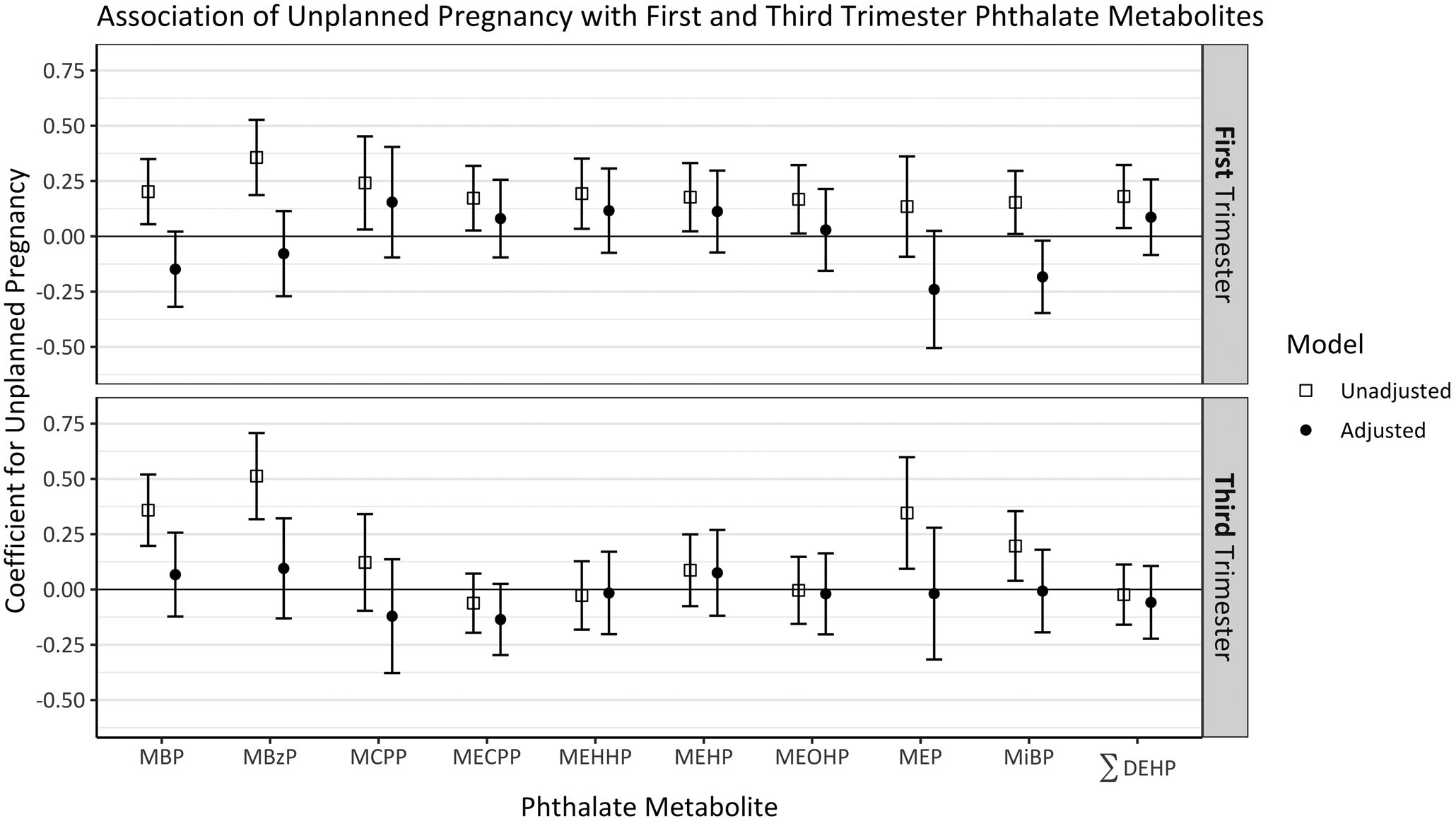
In bivariate analyses, the geometric mean concentrations of all first-trimester and most third-trimester phthalates were higher in women with unplanned pregnancies. However, after covariate adjustment, only first-trimester monoisobutyl phthalate (MiBP) remained associated with pregnancy intention, and the association changed direction such that unplanned pregnancies had lower MiBP concentrations (ß -0.18, 95% CI -0.35, -0.02).
We did not find evidence of a difference in phthalate exposure between pregnancy planners and non-planners.
受孕前的生活方式和健康对妊娠健康有重要影响,包括减少接触邻苯二甲酸酯等内分泌干扰化学物质。我们之前的研究表明,计划接受辅助生殖技术(ART)受孕的女性体内邻苯二甲酸酯代谢物浓度低于非 ART 使用者。
确定计划怀孕的女性与意外怀孕的女性相比,邻苯二甲酸酯代谢物浓度是否较低,或者这两组女性在怀孕期间邻苯二甲酸酯暴露的变化是否不同。
共有 721 名女性参加了婴儿发育与环境研究(TIDES),这是一项美国多中心前瞻性妊娠队列研究;其中 513 名(71%)表示怀孕是计划内的。在第一次和第三次妊娠访问时收集尿液样本,用于分析 10 种特定比重调整、自然对数转换的邻苯二甲酸酯代谢物。采用简单和多变量线性回归,调整中心、种族、年龄、收入、婚姻状况和产次,以确定邻苯二甲酸酯代谢物浓度是否因妊娠意图而异。
在单变量分析中,意外怀孕的女性所有第一次妊娠和大部分第三次妊娠的邻苯二甲酸酯几何平均浓度较高。然而,在调整协变量后,只有第一次妊娠的单异丁基邻苯二甲酸酯(MiBP)与妊娠意图仍相关,且关联方向发生改变,即意外怀孕的 MiBP 浓度较低(-0.18,95%CI -0.35,-0.02)。
我们没有发现妊娠计划者和非计划者之间邻苯二甲酸酯暴露存在差异的证据。