Chen Zibin, Lee Jaehwan
Department of Industrial Design, Hanyang University, ERICA Campus, Ansan 15588, Republic of Korea.
Behav Sci (Basel). 2025 Apr 25;15(5):581. doi: 10.3390/bs15050581.
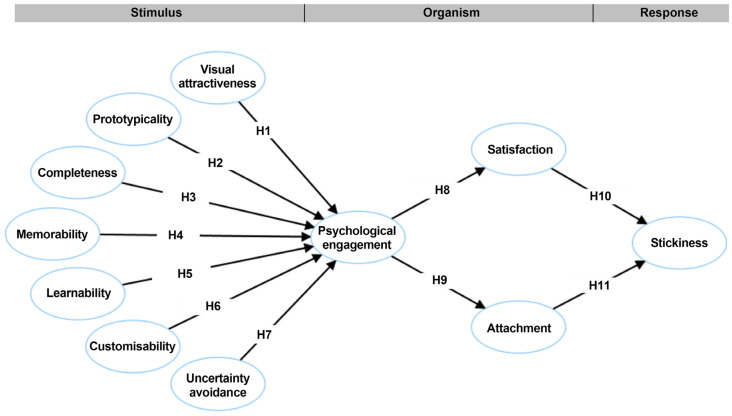
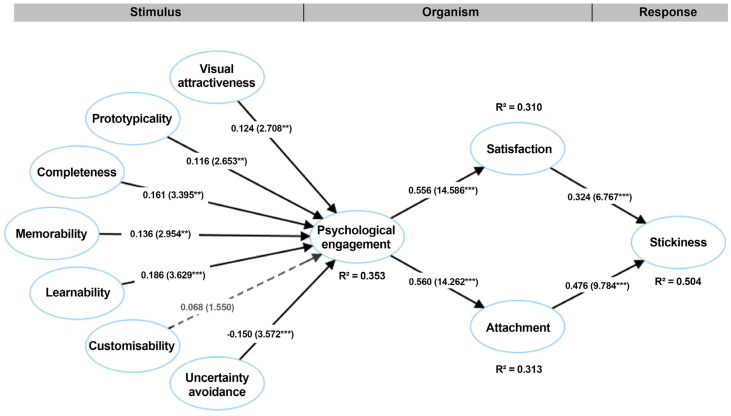
The advantages of mHealth applications have been widely recognized. However, the existing literature rarely explores how user interface (UI) design and individual cultural values influence elderly users' mHealth application stickiness, particularly among the young elderly. This study examines how two UI design attributes (usability and aesthetics) and individual uncertainty avoidance (from Hofstede's cultural dimensions) influence elderly users' stickiness to mHealth applications. The study used PLS-SEM to analyze survey data from 492 elderly people in China. The research results indicate that uncertainty avoidance cultural values are negatively correlated with psychological engagement. The UI design attributes (aesthetic and usability) are positively correlated with psychological engagement, with learnability (usability sub-attributes) having the most significant impact. Furthermore, the study also reveals the serial mediation role of psychological engagement and user internal experiences (satisfaction and attachment). Notably, this study enriches the current literature on user behavior regarding mHealth applications by elucidating the process of user stickiness, incorporating UI design attributes and individual uncertainty avoidance cultural values. These findings offer valuable theoretical and practical insights.
移动健康应用程序的优势已得到广泛认可。然而,现有文献很少探讨用户界面(UI)设计和个人文化价值观如何影响老年用户对移动健康应用程序的粘性,尤其是年轻老年人。本研究考察了两个用户界面设计属性(可用性和美学)以及个人不确定性规避(来自霍夫斯泰德文化维度)如何影响老年用户对移动健康应用程序的粘性。该研究使用偏最小二乘结构方程模型(PLS-SEM)分析了来自中国492名老年人的调查数据。研究结果表明,不确定性规避文化价值观与心理参与呈负相关。用户界面设计属性(美学和可用性)与心理参与呈正相关,其中可学习性(可用性子属性)的影响最为显著。此外,该研究还揭示了心理参与和用户内部体验(满意度和依恋)的串行中介作用。值得注意的是,本研究通过阐明用户粘性的过程,纳入用户界面设计属性和个人不确定性规避文化价值观,丰富了当前关于移动健康应用程序用户行为的文献。这些发现提供了有价值的理论和实践见解。