Department of Disease Control, Moredun Research Institute, Pentlands Science Park, Bush Loan, EH26 0PZ, UK.
Department of Comparative Biology and Experimental Medicine, Faculty of Veterinary Medicine, University of Calgary, CalgCary, Alberta, Canada.
Int J Parasitol Drugs Drug Resist. 2020 Apr;12:68-76. doi: 10.1016/j.ijpddr.2020.03.001. Epub 2020 Mar 6.
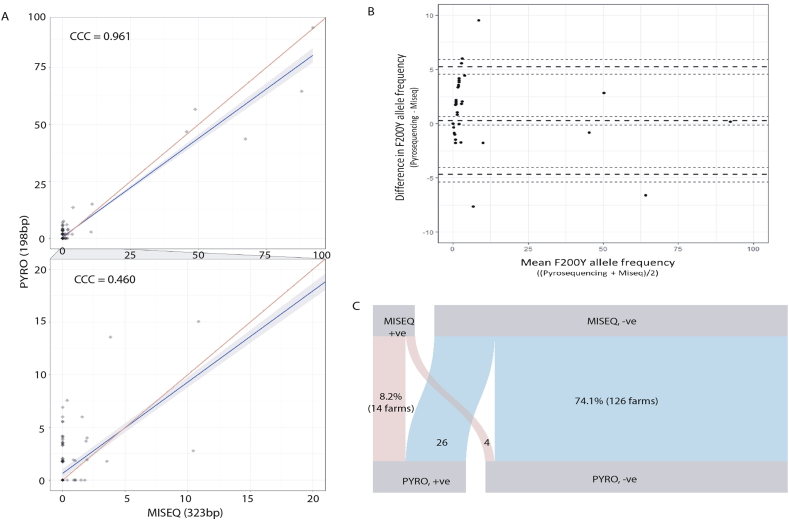
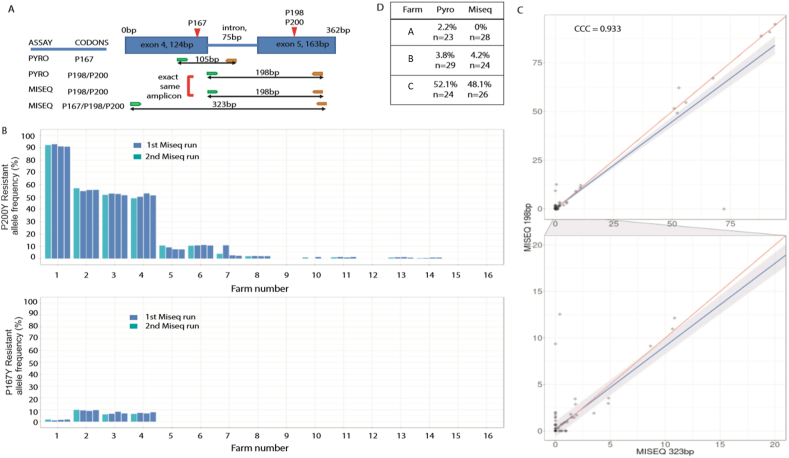
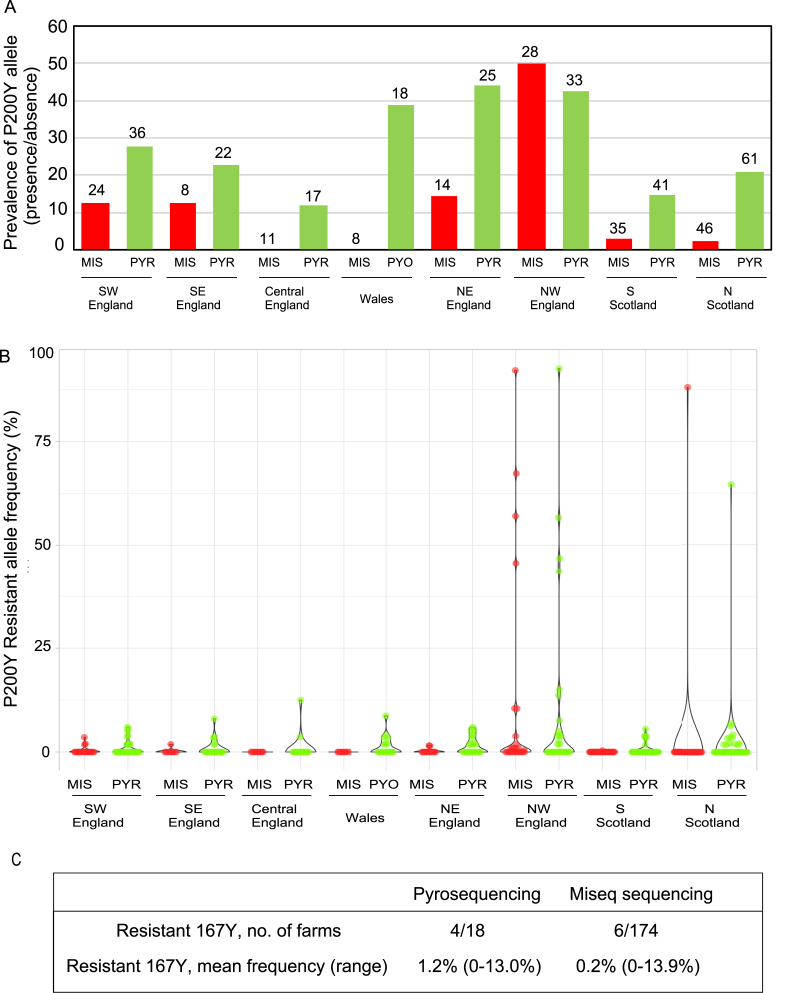
Benzimidazoles (BZ) have been the anthelmintic of choice for controlling Nematodirus battus infections since their release in the 1950s. Despite heavy reliance on this single anthelmintic drug class, resistance was not identified in this nematode until 2010 (Mitchell et al., 2011). The study aimed to explore the prevalence of BZ-resistance mutations in N. battus from UK sheep flocks using deep amplicon sequencing and pyrosequencing platforms. Based on evidence from other gastrointestinal nematodes, resistance in N. battus is likely to be conferred by single nucleotide polymorphisms (SNP) within the β-tubulin isotype 1 locus at codons 167, 198 and 200. Pyrosequencing and deep amplicon sequencing assays were designed to identify the F167Y (TTC to TAC), E198A (GAA to GCA) and F200Y (TTC to TAC) SNPs. Nematodirus battus populations from 253 independent farms were analysed by pyrosequencing; 174 farm populations were included in deep amplicon sequencing and 170 were analysed using both technologies. F200Y was the most prevalent SNP identified throughout the UK, in 12-27% of the populations tested depending on assay, at a low overall individual frequency of 2.2 ± 0.6% (mean ± SEM, based on pyrosequencing results). Four out of the five populations with high frequencies (>20%) of the F200Y mutation were located in NW England. The F167Y SNP was identified, for the first time in this species, in four of the populations tested at a low frequency (1.2% ± 0.01), indicating the early emergence of the mutation. E198A or E198L were not identified in any of the isolates. Results obtained were comparable between both techniques for F200Y (Lins' CCC, r = 0.96) with discrepancies being limited to populations with low frequencies. The recent emergence of resistance in this species will provide a unique opportunity to study the early stages of anthelmintic resistance within a natural setting and track its progress in the future.
苯并咪唑类(BZ)自 20 世纪 50 年代问世以来,一直是控制旋毛虫感染的首选驱虫药。尽管严重依赖于这单一的驱虫药物类别,但直到 2010 年才在这种线虫中发现耐药性(Mitchell 等人,2011 年)。本研究旨在使用深度扩增子测序和焦磷酸测序平台探索英国绵羊群中旋毛虫对 BZ 耐药性突变的流行情况。基于其他胃肠道线虫的证据,旋毛虫的耐药性可能是由β-微管蛋白 1 型 167、198 和 200 位密码子的单核苷酸多态性(SNP)引起的。焦磷酸测序和深度扩增子测序检测旨在确定 F167Y(TTC 至 TAC)、E198A(GAA 至 GCA)和 F200Y(TTC 至 TAC)SNP。通过焦磷酸测序分析了来自 253 个独立农场的旋毛虫种群;174 个农场种群被纳入深度扩增子测序,170 个种群使用两种技术进行分析。F200Y 是整个英国最常见的 SNP,在 12-27%的测试种群中存在,总体个体频率较低,为 2.2±0.6%(基于焦磷酸测序结果的平均值±SEM)。在 F200Y 突变频率较高(>20%)的五个种群中,有四个位于英格兰西北部。首次在该物种中鉴定出 F167Y SNP,在四个测试种群中的频率较低(1.2%±0.01),表明该突变的早期出现。在任何分离株中均未鉴定出 E198A 或 E198L。两种技术对 F200Y 的结果(Lins' CCC,r=0.96)相当,差异仅限于频率较低的种群。该物种中耐药性的新近出现将为在自然环境中研究驱虫药耐药性的早期阶段并追踪其未来进展提供独特的机会。