Department of Cardiology, National Heart Center Singapore, Singapore.
Cardiovascular ACP, Duke-NUS Medical School, Singapore.
Eur Heart J Cardiovasc Imaging. 2021 May 10;22(6):670-679. doi: 10.1093/ehjci/jeaa040.
Hypertensive left ventricular hypertrophy (LVH) is associated with increased cardiovascular events. We previously developed the remodelling index (RI) that incorporated left ventricular (LV) volume and wall-thickness in a single measure of advanced hypertrophy in hypertensive patients. This study examined the prognostic potential of the RI in reference to contemporary LVH classifications.
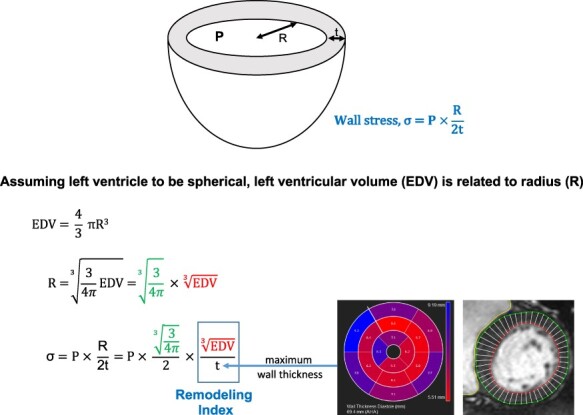
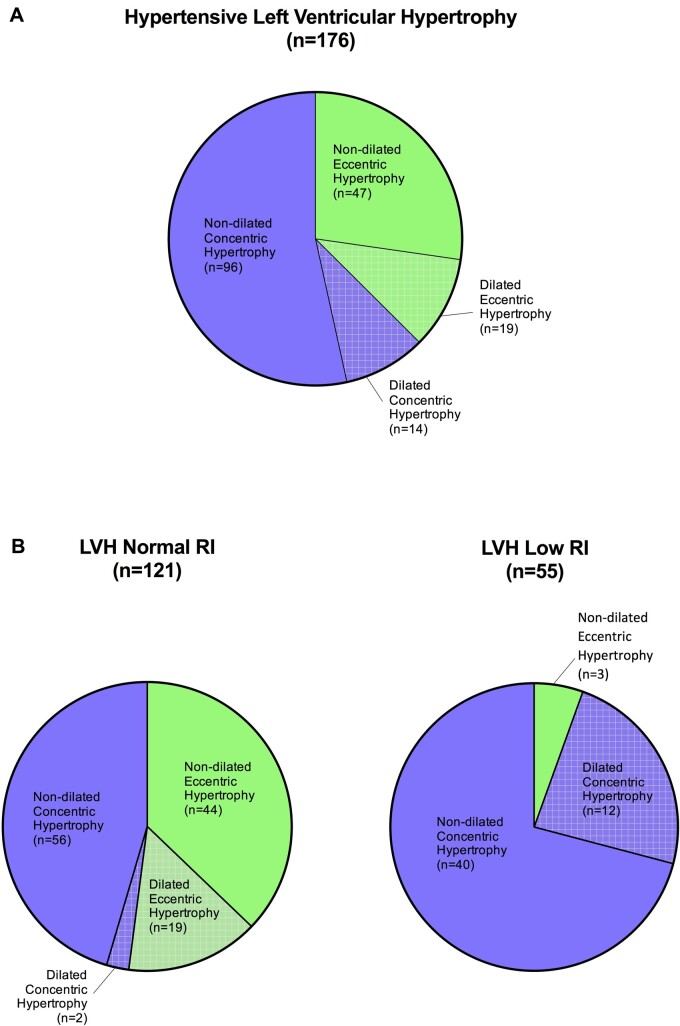
Cardiovascular magnetic resonance was performed in 400 asymptomatic hypertensive patients. The newly derived RI (EDV3t, where EDV is LV end-diastolic volume and t is the maximal wall thickness across 16 myocardial segments) stratified hypertensive patients: no LVH, LVH with normal RI (LVHNormal-RI), and LVH with low RI (LVHLow-RI). The primary outcome was a composite of all-cause mortality, acute coronary syndromes, strokes, and decompensated heart failure. LVHLow-RI was associated with increased LV mass index, fibrosis burden, impaired myocardial function and elevated biochemical markers of myocardial injury (high-sensitive cardiac troponin I), and wall stress. Over 18.3 ± 7.0 months (601.3 patient-years), 14 adverse events occurred (2.2 events/100 patient-years). Patients with LVHLow-RI had more than a five-fold increase in adverse events compared to those with LVHNormal-RI (11.6 events/100 patient-years vs. 2.0 events/100 patient-years, respectively; log-rank P < 0.001). The RI provided incremental prognostic value over and above a model consisting of clinical variables, LVH and concentricity; and predicted adverse events independent of clinical variables, LVH, and other prognostic markers. Concentric and eccentric LVH were associated with adverse prognosis (log-rank P = 0.62) that was similar to the natural history of hypertensive LVH (5.1 events/100 patient-years).
The RI provides prognostic value that improves risk stratification of hypertensive LVH.
高血压性左心室肥厚(LVH)与心血管事件的增加有关。我们之前开发了重塑指数(RI),该指数将 LV 容积和壁厚度纳入一个单一指标中,用于衡量高血压患者的晚期肥厚程度。本研究检查了 RI 在参考当代 LVH 分类时的预后潜力。
对 400 名无症状高血压患者进行心血管磁共振检查。新得出的 RI(EDV3t,其中 EDV 是 LV 舒张末期容积,t 是 16 个心肌节段的最大壁厚)对高血压患者进行分层:无 LVH、LVH 伴正常 RI(LVHNormal-RI)和 LVH 伴低 RI(LVHLow-RI)。主要结局是全因死亡率、急性冠状动脉综合征、中风和失代偿性心力衰竭的综合指标。LVHLow-RI 与 LV 质量指数增加、纤维化负担增加、心肌功能受损和心肌损伤的生化标志物(高敏心肌肌钙蛋白 I)升高和壁应力升高有关。在 18.3±7.0 个月(601.3 患者年)的随访中,发生了 14 例不良事件(2.2 例/100 患者年)。与 LVHNormal-RI 相比,LVHLow-RI 患者的不良事件发生率增加了五倍以上(分别为 11.6 例/100 患者年和 2.0 例/100 患者年,对数秩 P<0.001)。RI 提供了比包含临床变量、LVH 和同心性的模型更具增量预后价值的信息;并预测了独立于临床变量、LVH 和其他预后标志物的不良事件。向心性和离心性 LVH 与不良预后相关(对数秩 P=0.62),与高血压性 LVH 的自然史相似(5.1 例/100 患者年)。
RI 提供了预后价值,可改善高血压性 LVH 的风险分层。