Ding Ran, Yao Yingjie, Sun Binhan, Liu Geng, He Jianguo, Li Tong, Wan Xinhao, Dai Zongbiao, Ponge Dirk, Raabe Dierk, Zhang Chi, Godfrey Andy, Miyamoto Goro, Furuhara Tadashi, Yang Zhigang, van der Zwaag Sybrand, Chen Hao
Key Laboratory for Advanced Materials of Ministry of Education, School of Materials Science and Engineering, Tsinghua University, Beijing 100084, China.
Max-Planck-Institut für Eisenforschung, Max-Planck-Straße 1, 40237 Düsseldorf, Germany.
Sci Adv. 2020 Mar 27;6(13):eaay1430. doi: 10.1126/sciadv.aay1430. eCollection 2020 Mar.
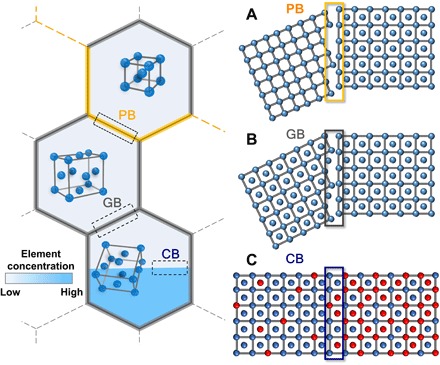
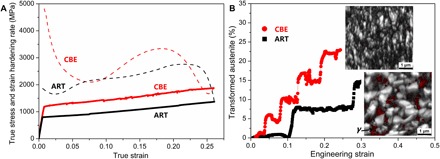
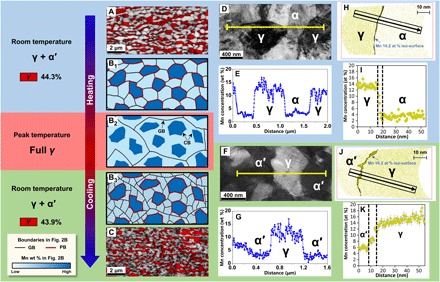
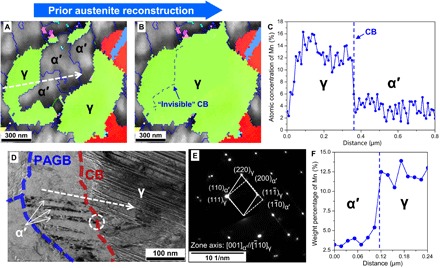
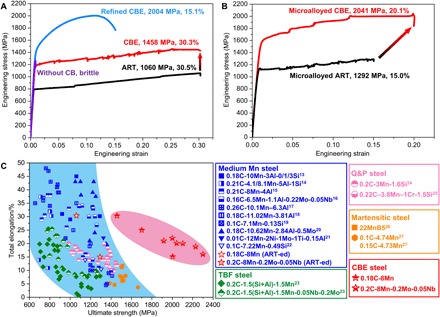
For decades, grain boundary engineering has proven to be one of the most effective approaches for tailoring the mechanical properties of metallic materials, although there are limits to the fineness and types of microstructures achievable, due to the rapid increase in grain size once being exposed to thermal loads (low thermal stability of crystallographic boundaries). Here, we deploy a unique chemical boundary engineering (CBE) approach, augmenting the variety in available alloy design strategies, which enables us to create a material with an ultrafine hierarchically heterogeneous microstructure even after heating to high temperatures. When applied to plain steels with carbon content of only up to 0.2 weight %, this approach yields ultimate strength levels beyond 2.0 GPa in combination with good ductility (>20%). Although demonstrated here for plain carbon steels, the CBE design approach is, in principle, applicable also to other alloys.
几十年来,晶界工程已被证明是调整金属材料力学性能最有效的方法之一,尽管由于一旦暴露于热负荷下晶粒尺寸会迅速增加(晶界的热稳定性低),可实现的微观结构的细度和类型存在限制。在此,我们采用一种独特的化学边界工程(CBE)方法,增加了可用合金设计策略的种类,这使我们能够制造出即使在加热到高温后仍具有超细分层异质微观结构的材料。当应用于碳含量最高仅为0.2重量%的普通钢时,这种方法能产生超过2.0 GPa的极限强度水平,并具有良好的延展性(>20%)。尽管此处以普通碳钢为例进行了演示,但CBE设计方法原则上也适用于其他合金。