• 文献检索
  • 文档翻译
  • 深度研究
  • 学术资讯
  • Suppr Zotero 插件Zotero 插件
  • 邀请有礼
  • 套餐&价格
  • 历史记录
应用&插件
Suppr Zotero 插件Zotero 插件浏览器插件Mac 客户端Windows 客户端微信小程序
定价
高级版会员购买积分包购买API积分包
服务
文献检索文档翻译深度研究API 文档MCP 服务
关于我们
关于 Suppr公司介绍联系我们用户协议隐私条款
关注我们

Suppr 超能文献

核心技术专利:CN118964589B侵权必究
粤ICP备2023148730 号-1Suppr @ 2026

文献检索

告别复杂PubMed语法,用中文像聊天一样搜索,搜遍4000万医学文献。AI智能推荐,让科研检索更轻松。

立即免费搜索

文件翻译

保留排版,准确专业,支持PDF/Word/PPT等文件格式,支持 12+语言互译。

免费翻译文档

深度研究

AI帮你快速写综述,25分钟生成高质量综述,智能提取关键信息,辅助科研写作。

立即免费体验

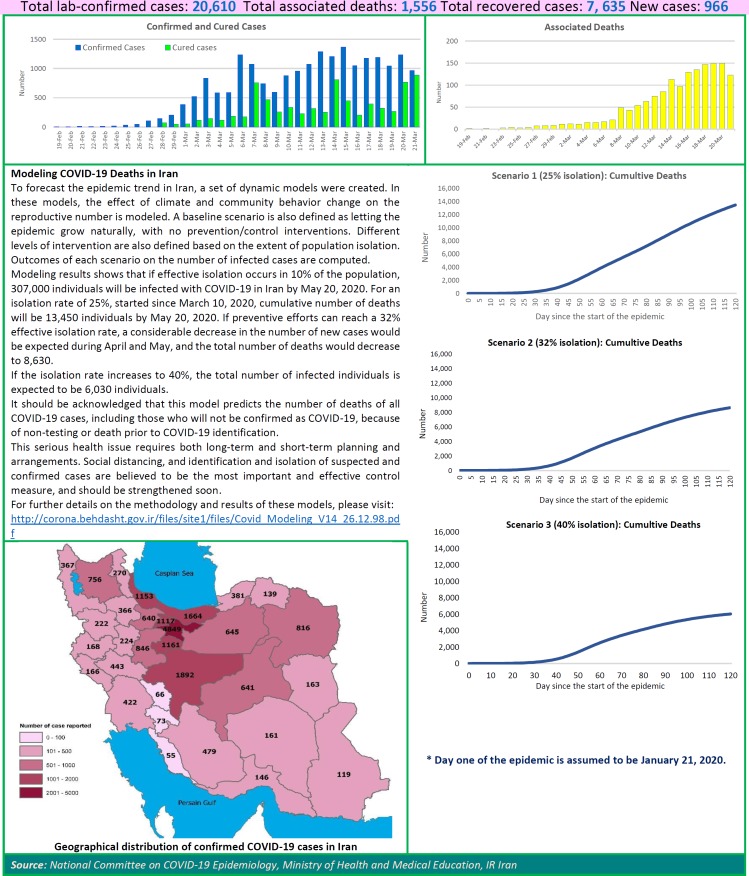
伊朗2020年3月22日冠状病毒病(COVID-19)每日情况报告

Daily Situation Report on Coronavirus disease (COVID-19) in Iran; March 22, 2020.

出版信息

Arch Acad Emerg Med. 2020 Mar 22;8(1):e32. eCollection 2020.

PMID:32259124
原文链接:https://pmc.ncbi.nlm.nih.gov/articles/PMC7114923/
Abstract

To forecast the COVID-19 epidemic trend in Iran, a set of dynamic models were created. In these models, the effect of climate and community behavior change on the reproductive number is modeled. A baseline scenario is also defined as letting the epidemic grow naturally, with no prevention/control interventions. Different levels of intervention are also defined based on the extent of population isolation. Outcomes of each scenario on the number of infected cases are computed. Modeling results shows that if effective isolation occurs in 10% of the population, 307,000 individuals will be infected with COVID-19 in Iran by May 20, 2020. For an isolation rate of 25%, started since March 10, 2020, cumulative number of deaths will be 13,450 individuals by May 20, 2020. If preventive efforts can reach a 32% effective isolation rate, a considerable decrease in the number of new cases would be expected during April and May, and the total number of deaths would decrease to 8,630. If the isolation rate increases to 40%, the total number of infected individuals is expected to be 6,030 individuals. It should be acknowledged that this model predicts the number of deaths of all COVID-19 cases, including those who will not be confirmed as COVID-19, because of non-testing or death prior to COVID-19 identification. This serious health issue requires both long-term and short-term planning and arrangements. Social distancing, and identification and isolation of suspected and confirmed cases are believed to be the most important and effective control measure, and should be strengthened soon. For further details on the methodology and results of these models, please visit: http://corona.behdasht.gov.ir/files/site1/files/Covid_Modeling_V14_26.12.98.pdf.

摘要

为预测伊朗的新冠疫情趋势,创建了一组动态模型。在这些模型中,对气候和社区行为变化对繁殖数的影响进行了建模。还定义了一个基线情景,即让疫情自然发展,不采取预防/控制干预措施。此外,根据人口隔离程度定义了不同级别的干预措施。计算了每种情景下感染病例数的结果。建模结果显示,如果10%的人口进行有效隔离,到2020年5月20日,伊朗将有30.7万人感染新冠病毒。对于自2020年3月10日起开始的25%的隔离率,到2020年5月20日,累计死亡人数将为13450人。如果预防措施能达到32%的有效隔离率,预计4月和5月新病例数将大幅减少,死亡总数将降至8630人。如果隔离率提高到40%,预计感染总人数将为6030人。应该认识到,该模型预测了所有新冠病例的死亡人数,包括那些因未检测或在确诊新冠之前死亡而未被确诊为新冠的病例。这个严重的健康问题需要长期和短期的规划与安排。社交距离以及对疑似和确诊病例的识别与隔离被认为是最重要和有效的控制措施,应尽快加强。有关这些模型的方法和结果的更多详细信息,请访问:http://corona.behdasht.gov.ir/files/site1/files/Covid_Modeling_V14_26.12.98.pdf 。
https://cdn.ncbi.nlm.nih.gov/pmc/blobs/c251/7114923/ee7628f1d51c/aaem-8-e32-g001.jpg

相似文献

1
Daily Situation Report on Coronavirus disease (COVID-19) in Iran; March 22, 2020.伊朗2020年3月22日冠状病毒病(COVID-19)每日情况报告
Arch Acad Emerg Med. 2020 Mar 22;8(1):e32. eCollection 2020.
2
Daily Situation Report on Coronavirus disease (COVID-19) in Iran; March 14, 2020.伊朗2020年3月14日新型冠状病毒肺炎每日疫情报告
Arch Acad Emerg Med. 2020 Mar 14;8(1):e24. eCollection 2020.
3
Daily Situation Report on Coronavirus disease (COVID-19) in Iran; March 15, 2020.伊朗2020年3月15日新型冠状病毒肺炎(COVID-19)每日情况报告。
Arch Acad Emerg Med. 2020 Mar 15;8(1):e25. eCollection 2020.
4
Daily Situation Report on Coronavirus disease (COVID-19) in Iran; March 16, 2020.伊朗2020年3月16日新型冠状病毒肺炎(COVID-19)每日情况报告。
Arch Acad Emerg Med. 2020 Mar 16;8(1):e26. eCollection 2020.
5
Daily Situation Report on Coronavirus disease (COVID-19) in Iran; March 23, 2020.伊朗2020年3月23日冠状病毒病(COVID-19)每日情况报告。
Arch Acad Emerg Med. 2020 Mar 23;8(1):e36. eCollection 2020.
6
Daily Situation Report on Coronavirus disease (COVID-19) in Iran; March 25, 2020.2020年3月25日伊朗新型冠状病毒肺炎(COVID-19)每日情况报告。
Arch Acad Emerg Med. 2020 Mar 25;8(1):e38. eCollection 2020.
7
Tuberculosis结核病
8
Daily Situation Report on Coronavirus disease (COVID-19) in Iran; March 17, 2020.伊朗2020年3月17日冠状病毒病(COVID-19)每日情况报告。
Arch Acad Emerg Med. 2020 Mar 17;8(1):e28. eCollection 2020.
9
Modeling and forecasting trend of COVID-19 epidemic in Iran until May 13, 2020.2020年5月13日前伊朗新冠肺炎疫情的建模与预测趋势
Med J Islam Repub Iran. 2020 Mar 31;34:27. doi: 10.34171/mjiri.34.27. eCollection 2020.
10
Can judgments according to case fatality rate be correct all the time during epidemics? Estimated cases based on CFR in different scenarios and some lessons from early case fatality rate of coronavirus disease 2019 in Iran.在疫情期间,根据病死率做出的判断能一直正确吗?基于病死率在不同情景下估算病例数以及来自伊朗2019冠状病毒病早期病死率的一些经验教训。
Med J Islam Repub Iran. 2020 Mar 29;34:26. doi: 10.34171/mjiri.34.26. eCollection 2020.

引用本文的文献

1
Quarantine, physical distancing and social isolation measures in individuals potentially exposed to SARS-CoV-2 in community settings and health services: a scoping review.社区环境和卫生服务中可能接触严重急性呼吸综合征冠状病毒2(SARS-CoV-2)的个体的隔离、物理距离和社会隔离措施:一项范围综述
Nepal J Epidemiol. 2022 Jun 30;12(2):1182-1202. doi: 10.3126/nje.v12i2.43838. eCollection 2022 Jun.
2
Iran COVID-19 Epidemiology Committee: A Review of Missions, Structures, Achievements, and Challenges.伊朗新冠肺炎疫情流行病学委员会:任务、结构、成就及挑战综述
J Res Health Sci. 2021 Mar 7;21(1):e00505. doi: 10.34172/jrhs.2021.45.
3
Knowledge, attitudes, practices and fear of COVID-19 among Iranians: A quick online survey.
伊朗人对 COVID-19 的知识、态度、实践和恐惧:快速在线调查。
Health Soc Care Community. 2022 May;30(3):1154-1162. doi: 10.1111/hsc.13382. Epub 2021 Apr 23.
4
Assessing Iran's health system according to the COVID-19 strategic preparedness and response plan of the World Health Organization: health policy and historical implications.根据世界卫生组织 COVID-19 战略准备和应对计划评估伊朗的卫生系统:卫生政策和历史意义。
J Prev Med Hyg. 2021 Jan 14;61(4):E508-E519. doi: 10.15167/2421-4248/jpmh2020.61.4.1613. eCollection 2020 Dec.
5
Estimation of the basic reproduction number (𝑅0) of the COVID-19 epidemic in Iran.伊朗新冠疫情基本再生数(𝑅0)的估计。
Med J Islam Repub Iran. 2020 Aug 10;34:95. doi: 10.34171/mjiri.34.95. eCollection 2020.
6
Modeling and forecasting trend of COVID-19 epidemic in Iran until May 13, 2020.2020年5月13日前伊朗新冠肺炎疫情的建模与预测趋势
Med J Islam Repub Iran. 2020 Mar 31;34:27. doi: 10.34171/mjiri.34.27. eCollection 2020.
7
Is reporting many cases of COVID-19 in Iran due to strength or weakness of Iran's health system?伊朗报告的大量新冠肺炎病例是由于伊朗卫生系统的强大还是薄弱?
Iran J Microbiol. 2020 Apr;12(2):73-76.