Department of Surgery, Leiden, the Netherlands.
Department of Medical Oncology, Leiden, the Netherlands.
Br J Surg. 2020 Aug;107(9):1145-1153. doi: 10.1002/bjs.11568. Epub 2020 Apr 7.
Surgery is increasingly being omitted in older patients with operable breast cancer in the Netherlands. Although omission of surgery can be considered in frail older patients, it may lead to inferior outcomes in non-frail patients. Therefore, the aim of this study was to evaluate the effect of omission of surgery on relative and overall survival in older patients with operable breast cancer.
Patients aged 80 years or older diagnosed with stage I-II hormone receptor-positive breast cancer between 2003 and 2009 were selected from the Netherlands Cancer Registry. An instrumental variable approach was applied to minimize confounding, using hospital variation in rate of primary surgery. Relative and overall survival was compared between patients treated in hospitals with different rates of surgery.
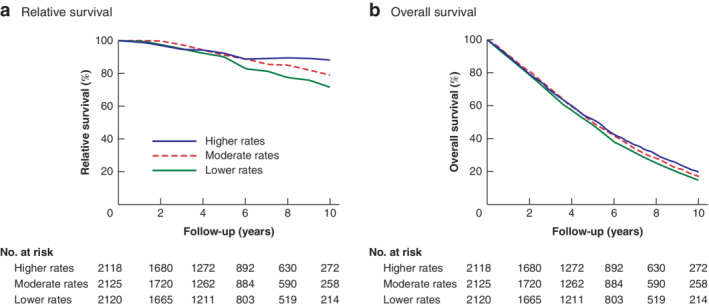
Overall, 6464 patients were included. Relative survival was lower for patients treated in hospitals with lower compared with higher surgical rates (90·2 versus 92·4 per cent respectively after 5 years; 71·6 versus 88·2 per cent after 10 years). The relative excess risk for patients treated in hospitals with lower surgical rates was 2·00 (95 per cent c.i. 1·17 to 3·40). Overall survival rates were also lower among patients treated in hospitals with lower compared with higher surgical rates (48·3 versus 51·3 per cent after 5 years; 15·0 versus 19·7 per cent after 10 years respectively; adjusted hazard ratio 1·07, 95 per cent c.i. 1·00 to 1·14).
Omission of surgery is associated with worse relative and overall survival in patients aged 80 years or more with stage I-II hormone receptor-positive breast cancer. Future research should focus on the effect on quality of life and physical functioning.
在荷兰,越来越多年龄较大且适合手术的乳腺癌患者被排除在手术之外。虽然在虚弱的老年患者中可以考虑不进行手术,但这可能会导致非虚弱患者的预后较差。因此,本研究旨在评估在可手术的老年乳腺癌患者中,不进行手术对相对生存率和总生存率的影响。
从荷兰癌症登记处选择 2003 年至 2009 年间诊断为 I 期-II 期激素受体阳性乳腺癌且年龄在 80 岁或以上的患者。采用工具变量法,利用医院之间手术率的差异,尽量减少混杂因素。比较手术率不同的医院治疗的患者的相对生存率和总生存率。
共有 6464 例患者纳入研究。与手术率较高的医院相比,手术率较低的医院治疗的患者相对生存率较低(5 年后分别为 90.2%和 92.4%;10 年后分别为 71.6%和 88.2%)。在手术率较低的医院接受治疗的患者的相对超额风险为 2.00(95%可信区间为 1.17 至 3.40)。与手术率较高的医院相比,手术率较低的医院治疗的患者的总生存率也较低(5 年后分别为 48.3%和 51.3%;10 年后分别为 15.0%和 19.7%;调整后的危险比为 1.07,95%可信区间为 1.00 至 1.14)。
对于 I 期-II 期激素受体阳性乳腺癌且年龄在 80 岁或以上的患者,不进行手术与相对生存率和总生存率较差相关。未来的研究应集中在对生活质量和身体功能的影响上。