Beijing Key Laboratory of Ornamental Plants Germplasm Innovation & Molecular Breeding, National Engineering Research Center for Floriculture, Beijing Laboratory of Urban and Rural Ecological Environment, Key Laboratory of Genetics and Breeding in Forest Trees and Ornamental Plants of Ministry of Education, School of Landscape Architecture, Beijing Forestry University, Beijing, 100083, China.
Beijing Advanced Innovation Center for Tree Breeding by Molecular Design, Beijing Forestry University, Beijing, 100083, China.
BMC Plant Biol. 2020 Apr 7;20(1):145. doi: 10.1186/s12870-020-02336-0.
Axillary bud is an important agronomic and economic trait in cut chrysanthemum. Bud outgrowth is an intricate process controlled by complex molecular regulatory networks, physio-chemical integrators and environmental stimuli. Temperature is one of the key regulators of bud's fate. However, little is known about the temperature-mediated control of axillary bud at molecular levels in chrysanthemum. A comprehensive study was designed to study the bud outgrowth at normal and elevated temperature in cut chrysanthemum. Leaf morphology, histology, physiological parameters were studied to correlate the leaf activity with bud morphology, sucrose and hormonal regulation and the molecular controllers.
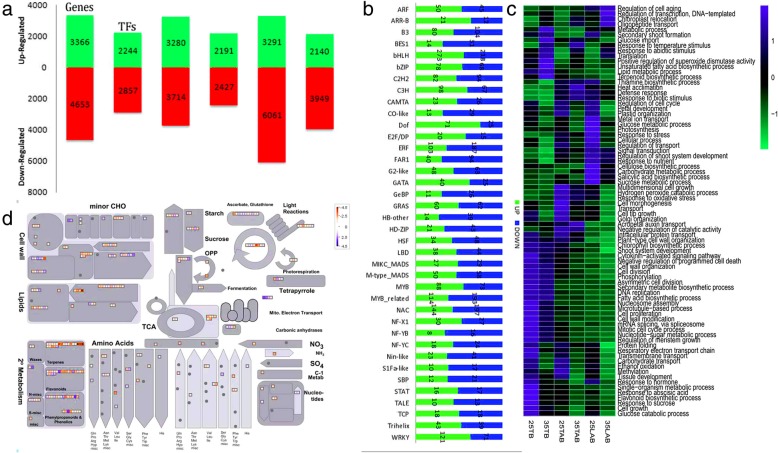
Temperature caused differential bud outgrowth along bud positions. Photosynthetic leaf area, physiological indicators and sucrose utilization were changed considerable due to high temperature. Comparative transcriptome analysis identified a significant proportion of bud position-specific genes.Weighted Gene Co-expression Network Analysis (WGCNA) showed that axillary bud control can be delineated by modules of coexpressed genes; especially, MEtan3, MEgreen2 and MEantiquewhite presented group of genes specific to bud length. A comparative analysis between different bud positions in two temperatures revealed the morpho-physiological traits associated with specific modules. Moreover, the transcriptional regulatory networks were configured to identify key determinants of bud outgrowth. Cell division, organogenesis, accumulation of storage compounds and metabolic changes were prominent during the bud emergence.
RNA-seq data coupled with morpho-physiological integrators from three bud positions at two temperature regimes brings a robust source to understand bud outgrowth status influenced by high temperature in cut chrysanthemum. Our results provide helpful information for elucidating the regulatory mechanism of temperature on axillary bud growth in chrysanthemum.
腋芽是切花菊花的一个重要农艺和经济性状。芽的生长是一个复杂的过程,受复杂的分子调控网络、生理化学整合因子和环境刺激的控制。温度是芽命运的关键调节因子之一。然而,对于菊花中腋芽在分子水平上的温度介导控制,人们知之甚少。本研究旨在全面研究切花菊花在正常和高温条件下的芽生长。研究了叶片形态、组织学、生理参数,以将叶片活性与芽形态、蔗糖和激素调节以及分子控制器相关联。
温度导致腋芽在芽位上的差异生长。由于高温,光合叶面积、生理指标和蔗糖利用发生了相当大的变化。比较转录组分析鉴定了相当比例的芽位特异性基因。加权基因共表达网络分析(WGCNA)表明,腋芽的控制可以通过共表达基因模块来描绘;特别是,MEtan3、MEgreen2 和 MEantiquewhite 呈现出一组特定于芽长的基因。在两种温度下不同芽位之间的比较分析揭示了与特定模块相关的形态生理特征。此外,构建了转录调控网络,以确定芽生长的关键决定因素。细胞分裂、器官发生、储存化合物的积累和代谢变化在芽出现时表现突出。
来自两种温度下三个芽位的 RNA-seq 数据与形态生理整合因子相结合,为理解高温对切花菊花芽生长的影响提供了可靠的来源。我们的结果为阐明温度对菊花腋芽生长的调控机制提供了有价值的信息。