Institute for Parasitology, Centre for Infection Medicine, University of Veterinary Medicine Hannover, Buenteweg 17, 30559, Hanover, Germany.
Bayer Animal Health GmbH, 51373, Leverkusen, Germany.
Parasit Vectors. 2020 Apr 7;13(1):176. doi: 10.1186/s13071-020-04049-7.
Ixodes ricinus constitutes the main European vector tick for the Lyme borreliosis pathogen Borrelia burgdorferi (sensu lato), the relapsing fever borrelia Borrelia miyamotoi, as well as Anaplasma phagocytophilum and several Rickettsia species. Under laboratory conditions, a transovarial transmission to the next tick generation is described for Rickettsia spp. and Borrelia spp., especially regarding B. miyamotoi, whereas the efficiency of transovarial transfer under field conditions is largely unstudied.
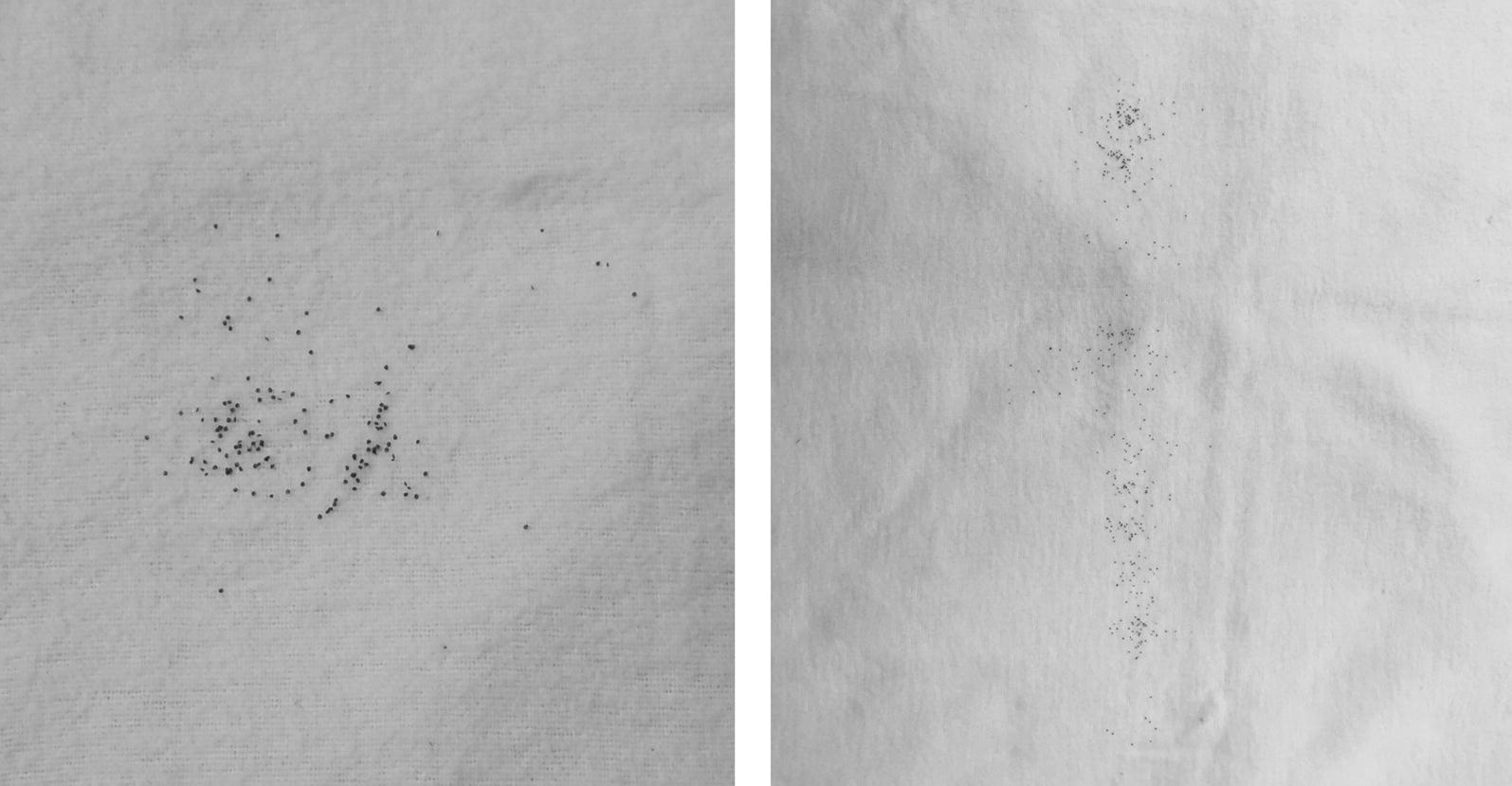
In order to better estimate the potential infection risk by tick larvae for humans and animals, 1500 I. ricinus larvae from 50 collected "nests" (larvae adhering to the flag in a clumped manner) were individually examined for Borrelia, Rickettsia and A. phagocytophilum DNA using quantitative real-time PCR (qPCR).
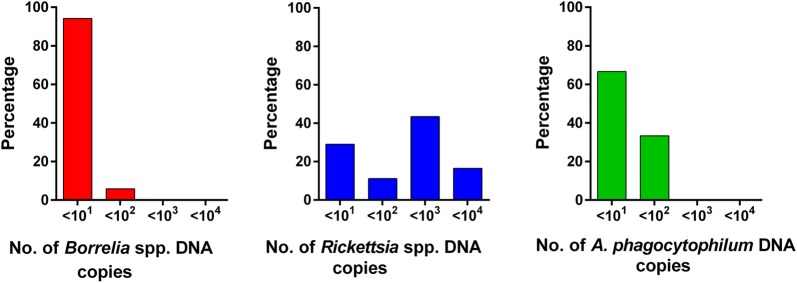
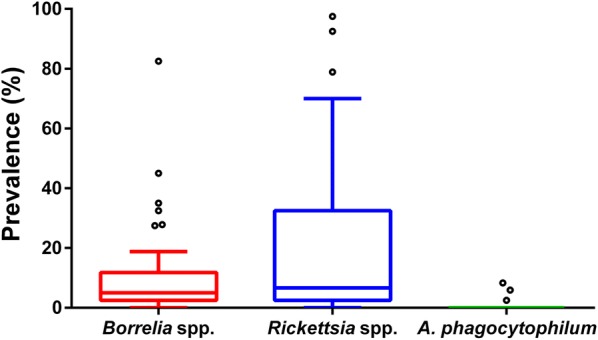
Thirty-nine of 50 nests each (78.0%, 95% CI: 64.0-88.5%) were positive for Borrelia spp. and Rickettsia spp. DNA, and in three nests (6.0%, 95% CI: 1.3-16.5%) A. phagocytophilum DNA was detected. Overall, DNA from at least one pathogen could be detected in 90.0% (45/50, 95% CI: 78.2-96.7%) of the nests. Of the 1500 larvae, 137 were positive for Borrelia spp. DNA (9.1%, 95% CI: 7.7-10.7%), 341 for Rickettsia spp. DNA (22.7%, 95% CI: 20.6-24.9%) and three for A. phagocytophilum DNA (0.2%, 95% CI: 0-0.6%). Quantity of Borrelia spp. and Anaplasma spp. DNA in positive larvae was low, with 2.7 × 10Borrelia 5S-23S gene copies and 2.4 × 10A. phagocytophilum msp2/p44 gene copies detected on average, while Rickettsia-positive samples contained on average 5.4 × 10gltA gene copies. Coinfections were found in 66.0% (33/50, 95% CI: 51.2-78.8%) of the nests and 8.6% (38/443, 95% CI: 6.1-11.6%) of positive larvae. In fact, larvae had a significantly higher probability of being infected with Borrelia spp. or Rickettsia spp. when both pathogens were present in the nest.
This study provides evidence for transovarial transmission of Rickettsia spp. and Borrelia spp. in I. ricinus under field conditions, possibly facilitating pathogen persistence in the ecosystem and reducing the dependence on the presence of suitable reservoir hosts. Further studies are needed to prove transovarial transmission and to explain the surprisingly high proportion of nests containing Rickettsia and/or Borrelia DNA-positive larvae compared to infection rates in adult ticks commonly reported in other studies.
硬蜱构成了莱姆病病原体伯氏疏螺旋体(广义)、回归热疏螺旋体 Borrelia miyamotoi 以及嗜吞噬细胞无形体和几种立克次体的主要欧洲媒介蜱。在实验室条件下,已经描述了 Rickettsia spp. 和 Borrelia spp. 的经卵传递到下一代蜱,特别是对于 B. miyamotoi,而在野外条件下经卵传递的效率在很大程度上尚未得到研究。
为了更好地估计蜱幼虫对人类和动物的潜在感染风险,使用定量实时 PCR (qPCR) 对从 50 个收集的“巢”(以簇状方式附着在旗帜上的幼虫)中收集的 1500 只 Ixodes ricinus 幼虫的 Borrelia、Rickettsia 和嗜吞噬细胞无形体 DNA 进行了单独检测。
50 个巢中的 39 个巢(78.0%,95%置信区间:64.0-88.5%)均为 Borrelia spp. 和 Rickettsia spp. DNA 阳性,3 个巢(6.0%,95%置信区间:1.3-16.5%)检测到嗜吞噬细胞无形体 DNA。总体而言,至少有一种病原体的 DNA 可以在 90.0%(45/50,95%置信区间:78.2-96.7%)的巢中检测到。在 1500 只幼虫中,137 只为 Borrelia spp. DNA 阳性(9.1%,95%置信区间:7.7-10.7%),341 只为 Rickettsia spp. DNA 阳性(22.7%,95%置信区间:20.6-24.9%),3 只为嗜吞噬细胞无形体 DNA 阳性(0.2%,95%置信区间:0-0.6%)。阳性幼虫中 Borrelia spp. 和 Anaplasma spp. DNA 的数量较低,平均检测到 2.7×10Borrelia 5S-23S 基因拷贝和 2.4×10A. phagocytophilum msp2/p44 基因拷贝,而 Rickettsia 阳性样本平均含有 5.4×10gltA 基因拷贝。在 66.0%(50/50,95%置信区间:51.2-78.8%)的巢和 8.6%(38/443,95%置信区间:6.1-11.6%)的阳性幼虫中发现了合并感染。事实上,当两种病原体都存在于巢中时,幼虫感染 Borrelia spp. 或 Rickettsia spp. 的可能性显著增加。
本研究为硬蜱在野外条件下经卵传递 Rickettsia spp. 和 Borrelia spp. 提供了证据,可能有助于病原体在生态系统中的持续存在,并降低对合适储存宿主存在的依赖。需要进一步的研究来证明经卵传递,并解释与其他研究中通常报告的成年蜱的感染率相比,巢中含有 Rickettsia 和/或 Borrelia DNA 阳性幼虫的比例如此之高的原因。