• 文献检索
  • 文档翻译
  • 深度研究
  • 学术资讯
  • Suppr Zotero 插件Zotero 插件
  • 邀请有礼
  • 套餐&价格
  • 历史记录
应用&插件
Suppr Zotero 插件Zotero 插件浏览器插件Mac 客户端Windows 客户端微信小程序
定价
高级版会员购买积分包购买API积分包
服务
文献检索文档翻译深度研究API 文档MCP 服务
关于我们
关于 Suppr公司介绍联系我们用户协议隐私条款
关注我们

Suppr 超能文献

核心技术专利:CN118964589B侵权必究
粤ICP备2023148730 号-1Suppr @ 2026

文献检索

告别复杂PubMed语法,用中文像聊天一样搜索,搜遍4000万医学文献。AI智能推荐,让科研检索更轻松。

立即免费搜索

文件翻译

保留排版,准确专业,支持PDF/Word/PPT等文件格式,支持 12+语言互译。

免费翻译文档

深度研究

AI帮你快速写综述,25分钟生成高质量综述,智能提取关键信息,辅助科研写作。

立即免费体验

系统回顾军队中运动性热疾病和耐热性的流行病学和危险因素中的性别差异。

Systematic review of gender differences in the epidemiology and risk factors of exertional heat illness and heat tolerance in the armed forces.

机构信息

College of Healthcare Sciences, James Cook University, Townsville, Queensland, Australia

College of Medicine and Dentistry, James Cook University, Townsville, Queensland, Australia.

出版信息

BMJ Open. 2020 Apr 6;10(4):e031825. doi: 10.1136/bmjopen-2019-031825.

DOI:10.1136/bmjopen-2019-031825
PMID:32265238
原文链接:https://pmc.ncbi.nlm.nih.gov/articles/PMC7245403/
Abstract

OBJECTIVES

This review aimed to describe the epidemiology of all heat-related illnesses in women compared with men in the armed forces and to identify gender-specific risk factors and differences in heat tolerance.

DESIGN

A systematic review of multiple databases (MEDLINE, Emcare, CINAHL, PsycINFO, Informit and Scopus) was conducted from the inception of the databases to 1 April 2019 using the preferred reporting items for systematic review and meta-analysis guidelines.

ELIGIBILITY CRITERIA

All relevant studies investigating and comparing heat illness and heat tolerance in women and men in the armed forces were included in the review.

RESULTS

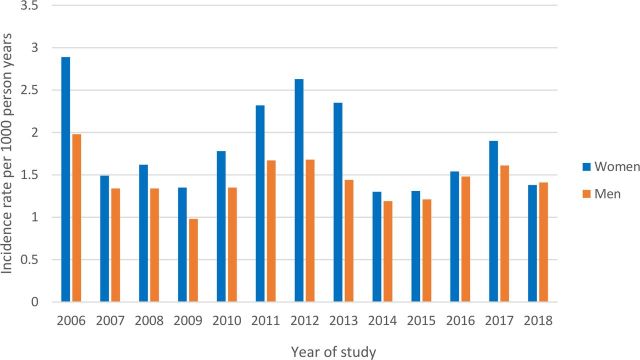
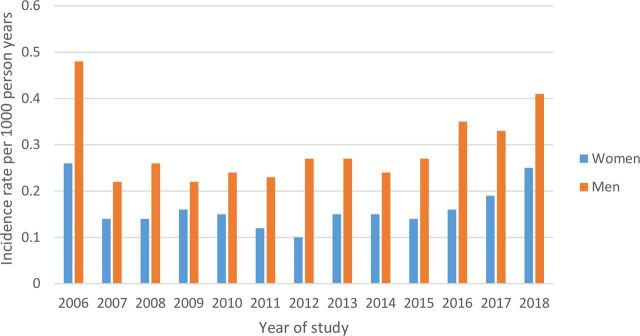
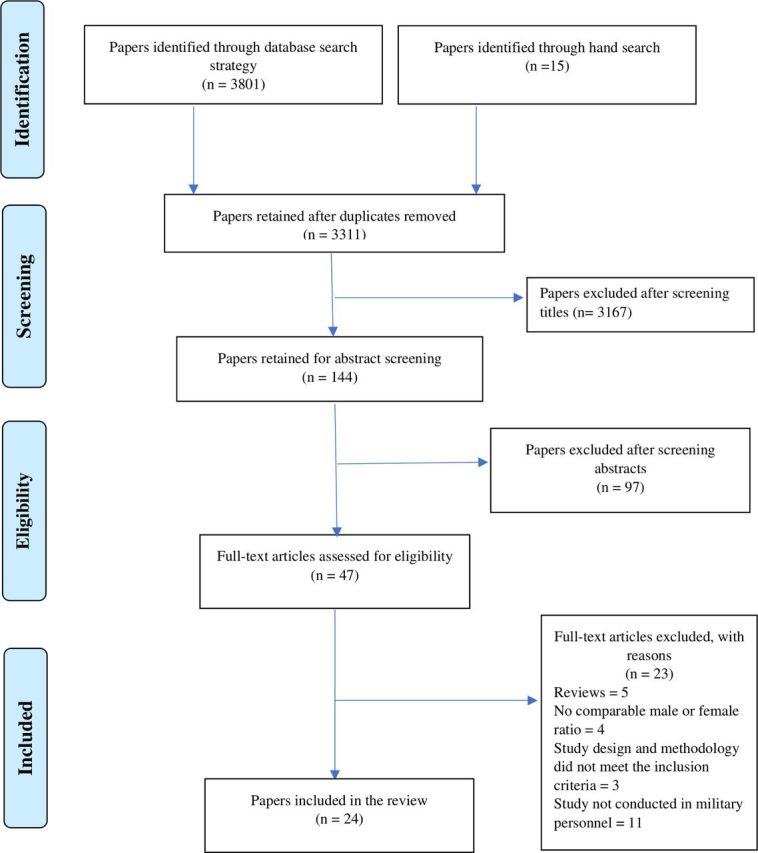
Twenty-four studies were included in the systematic review. The incidence of heat stroke in women ranged from 0.10 to 0.26 per 1000 person-years, while the incidence of heat stroke ranged from 0.22 to 0.48 per 1000 person-years in men. The incidence of other heat illnesses in women compared with men ranged from 1.30 to 2.89 per 1000 person-years versus 0.98 to 1.98 per 1000 person-years. The limited evidence suggests that women had a greater risk of exertional heat illness compared with men. Other gender-specific risk factors were slower run times and body mass index. Although there was a higher proportion of women who were heat intolerant compared with men, this finding needs to be interpreted with caution due to the limited evidence.

CONCLUSION

The findings of this review suggest that men experienced a slightly higher incidence of heat stroke than women in the armed forces. In addition, the limited available evidence suggests that a higher proportion of women were heat intolerant and being a female was associated with a greater risk of exertional heat illnesses. Given the limited evidence available, further research is required to investigate the influence of gender differences on heat intolerance and heat illness.

摘要

目的

本综述旨在描述与男性相比,女性在武装部队中所有与热相关的疾病的流行病学,并确定性别特异性的风险因素和耐热能力的差异。

设计

对多个数据库(MEDLINE、Emcare、CINAHL、PsycINFO、Informit 和 Scopus)进行了系统回顾,检索时间从数据库建立之初至 2019 年 4 月 1 日,使用系统评价和荟萃分析的首选报告项目进行。

纳入标准

所有调查和比较女性与男性在武装部队中热疾病和耐热能力的相关研究均纳入本综述。

结果

共纳入 24 项系统综述研究。女性中暑的发病率为 0.10 至 0.26 例/1000 人年,而男性中暑的发病率为 0.22 至 0.48 例/1000 人年。与男性相比,女性其他热疾病的发病率为 1.30 至 2.89 例/1000 人年,而男性为 0.98 至 1.98 例/1000 人年。有限的证据表明,与男性相比,女性患劳力性热疾病的风险更大。其他特定于性别的风险因素是跑步时间较慢和体重指数较高。尽管与男性相比,女性中有更高比例的人不耐热,但由于证据有限,这一发现需要谨慎解释。

结论

本综述的结果表明,在武装部队中,男性比女性经历的中暑发病率略高。此外,有限的可用证据表明,女性中有更高比例的人不耐热,并且女性的性别与患劳力性热疾病的风险增加相关。鉴于现有证据有限,需要进一步研究来调查性别差异对耐热能力和热疾病的影响。
https://cdn.ncbi.nlm.nih.gov/pmc/blobs/6b98/7245403/812aed0ca57b/bmjopen-2019-031825f03.jpg
https://cdn.ncbi.nlm.nih.gov/pmc/blobs/6b98/7245403/b459da28863d/bmjopen-2019-031825f01.jpg
https://cdn.ncbi.nlm.nih.gov/pmc/blobs/6b98/7245403/2bb2d1b72424/bmjopen-2019-031825f02.jpg
https://cdn.ncbi.nlm.nih.gov/pmc/blobs/6b98/7245403/812aed0ca57b/bmjopen-2019-031825f03.jpg
https://cdn.ncbi.nlm.nih.gov/pmc/blobs/6b98/7245403/b459da28863d/bmjopen-2019-031825f01.jpg
https://cdn.ncbi.nlm.nih.gov/pmc/blobs/6b98/7245403/2bb2d1b72424/bmjopen-2019-031825f02.jpg
https://cdn.ncbi.nlm.nih.gov/pmc/blobs/6b98/7245403/812aed0ca57b/bmjopen-2019-031825f03.jpg

相似文献

1
Systematic review of gender differences in the epidemiology and risk factors of exertional heat illness and heat tolerance in the armed forces.系统回顾军队中运动性热疾病和耐热性的流行病学和危险因素中的性别差异。
BMJ Open. 2020 Apr 6;10(4):e031825. doi: 10.1136/bmjopen-2019-031825.
2
Women and exertional heat illness: identification of gender specific risk factors.女性与运动性热疾病:特定性别的风险因素识别
US Army Med Dep J. 2015 Apr-Jun:58-66.
3
Epidemiology of Exertional Heat Illness in the Military: A Systematic Review of Observational Studies.军事运动性热疾病的流行病学:观察性研究的系统综述。
Int J Environ Res Public Health. 2020 Sep 25;17(19):7037. doi: 10.3390/ijerph17197037.
4
Heat exhaustion and heat stroke among active component members of the U.S. Armed Forces, 2019-2023.2019-2023 年美国武装部队现役成员中的热衰竭和热射病。
MSMR. 2024 Apr 20;31(4):3-8.
5
Heat Exhaustion and Heat Stroke Among Active Component Members of the U.S. Armed Forces, 2018-2022.2018-2022 年美国武装部队现役人员中的热衰竭和热射病。
MSMR. 2023 Apr 20;30(4):3-7.
6
Update: Heat illness, active component, U.S. Armed Forces, 2021.更新:热相关疾病,活性成分,美国武装部队,2021 年。
MSMR. 2022 Apr 1;29(4):8-14.
7
Exertional heat stroke in sport and the military: epidemiology and mitigation.运动和军事中的劳力性热射病:流行病学和缓解措施。
Exp Physiol. 2022 Oct;107(10):1111-1121. doi: 10.1113/EP090686. Epub 2022 Sep 14.
8
Update: Heat injuries, active component, U.S. Armed Forces, 2013.更新:热损伤、活性成分、美国武装部队,2013年。
MSMR. 2014 Mar;21(3):10-3.
9
Update: Heat illness, active component, U.S. Armed Forces, 2016.更新:中暑、活性成分、美国武装部队,2016年。
MSMR. 2017 Mar;24(3):9-13.
10
Risk of heat illness in men and women: A systematic review and meta-analysis.男性和女性患热病的风险:系统评价和荟萃分析。
Environ Res. 2019 Apr;171:24-35. doi: 10.1016/j.envres.2018.10.020. Epub 2018 Oct 25.

引用本文的文献

1
Guest editorial: Preparation for training in the heat season: key considerations for heat injury risk prevention and mitigation.客座社论:热季训练准备:预防和减轻热损伤风险的关键考虑因素
MSMR. 2025 Jul 20;32(7):16-19.
2
Wearable device monitoring of HIV health in the face of climate change and weather exposures: protocol for a mixed-methods study.面对气候变化和天气暴露时对艾滋病毒健康状况的可穿戴设备监测:一项混合方法研究的方案
BMJ Open. 2025 Jun 25;15(6):e092307. doi: 10.1136/bmjopen-2024-092307.
3
Optimizing female warfighter health and performance in environmental extremes.

本文引用的文献

1
Risk of heat illness in men and women: A systematic review and meta-analysis.男性和女性患热病的风险:系统评价和荟萃分析。
Environ Res. 2019 Apr;171:24-35. doi: 10.1016/j.envres.2018.10.020. Epub 2018 Oct 25.
2
Exertional Heat Stroke, the Return to Play Decision, and the Role of Heat Tolerance Testing: A Clinician's Dilemma.劳力性热射病、重返赛场的决策以及耐热性测试的作用:临床医生的困境
Curr Sports Med Rep. 2018 Jul;17(7):244-248. doi: 10.1249/JSR.0000000000000502.
3
Influence of menstrual phase and arid vs. humid heat stress on autonomic and behavioural thermoregulation during exercise in trained but unacclimated women.
在极端环境中优化女性作战人员的健康与表现。
MSMR. 2025 May 1;32(5):35-38.
4
Exertional heat illness: international military-oriented lessons learned and best practices for prevention and management.运动性热疾病:面向国际军事领域的经验教训及预防与管理的最佳实践
Front Physiol. 2025 Mar 5;16:1456984. doi: 10.3389/fphys.2025.1456984. eCollection 2025.
5
Regional cerebral pulsatile hemodynamics during isocapnic and poikilocapnic hyperthermia in young men.青年男性等碳酸血症和变碳酸血症性高热期间的局部脑搏动血流动力学
Physiol Rep. 2025 Feb;13(4):e70258. doi: 10.14814/phy2.70258.
6
Risk factors for adverse health in military and law enforcement personnel; an umbrella review.军事和执法人员不良健康风险因素:伞式综述。
BMC Public Health. 2024 Nov 13;24(1):3151. doi: 10.1186/s12889-024-20553-2.
7
Sex differences in biomarkers of end-organ damage following exertional heat stroke in humans.人类运动性热射病后靶器官损伤生物标志物的性别差异。
J Appl Physiol (1985). 2024 Nov 1;137(5):1434-1445. doi: 10.1152/japplphysiol.00463.2024. Epub 2024 Sep 19.
8
Impacts of heat exposure in utero on long-term health and social outcomes: a systematic review.胎儿期暴露于热环境对长期健康和社会结局的影响:系统评价。
BMC Pregnancy Childbirth. 2024 May 4;24(1):344. doi: 10.1186/s12884-024-06512-0.
9
Cognitive Function among Young Women's Football Players in the Summer Heat.夏季高温环境下年轻女子足球运动员的认知功能
Transl Sports Med. 2023 Nov 2;2023:5516439. doi: 10.1155/2023/5516439. eCollection 2023.
10
Exertional Heatstroke Survivors' Knowledge and Beliefs About Exertional Heatstroke Diagnosis, Treatment, and Return to Play.运动性中暑幸存者对运动性中暑诊断、治疗和重返运动的知识和信念。
J Athl Train. 2024 Nov 1;59(11):1063-1069. doi: 10.4085/1062-6050-0677.23.
月经周期以及干热与湿热应激对训练有素但未适应环境的女性运动期间自主神经和行为体温调节的影响。
J Physiol. 2017 May 1;595(9):2823-2837. doi: 10.1113/JP273176. Epub 2017 Jan 4.
4
Heat strain during military training activities: The dilemma of balancing force protection and operational capability.军事训练活动中的热应激:平衡部队保护与作战能力的困境。
Temperature (Austin). 2016 Feb 26;3(2):307-317. doi: 10.1080/23328940.2016.1156801. eCollection 2016 Apr-Jun.
5
Heat Stroke.中暑
Med J Armed Forces India. 2003 Apr;59(2):140-3. doi: 10.1016/S0377-1237(03)80062-X. Epub 2011 Jul 21.
6
Update: Heat injuries, active component, U.S. Army, Navy, Air Force, and Marine Corps, 2015.更新:热损伤、活性成分、美国陆军、海军、空军和海军陆战队,2015年
MSMR. 2016 Mar;23(3):16-9.
7
Operational Physical Performance and Fitness in Military Women: Physiological, Musculoskeletal Injury, and Optimized Physical Training Considerations for Successfully Integrating Women Into Combat-Centric Military Occupations.军事女性的作战体能表现与健康状况:生理、肌肉骨骼损伤以及将女性成功融入以战斗为中心的军事职业的优化体能训练考量
Mil Med. 2016 Jan;181(1 Suppl):50-62. doi: 10.7205/MILMED-D-15-00382.
8
Women and exertional heat illness: identification of gender specific risk factors.女性与运动性热疾病:特定性别的风险因素识别
US Army Med Dep J. 2015 Apr-Jun:58-66.
9
Extreme heat and occupational heat illnesses in South Australia, 2001-2010.2001 - 2010年南澳大利亚州的酷热与职业性中暑疾病
Occup Environ Med. 2015 Aug;72(8):580-6. doi: 10.1136/oemed-2014-102706. Epub 2015 Jun 16.
10
Heat tolerance testing: association between heat intolerance and anthropometric and fitness measurements.耐热性测试:不耐热与人体测量及体能测量之间的关联。
Mil Med. 2014 Nov;179(11):1339-46. doi: 10.7205/MILMED-D-14-00169.