Department of Anesthesia, First Affiliated Hospital, Zhejiang University School of Medicine, Hangzhou, China.
Department of Anesthesia, Changhai Hospital, Second Military Medical University, Shanghai, China.
Front Immunol. 2020 Mar 20;11:477. doi: 10.3389/fimmu.2020.00477. eCollection 2020.
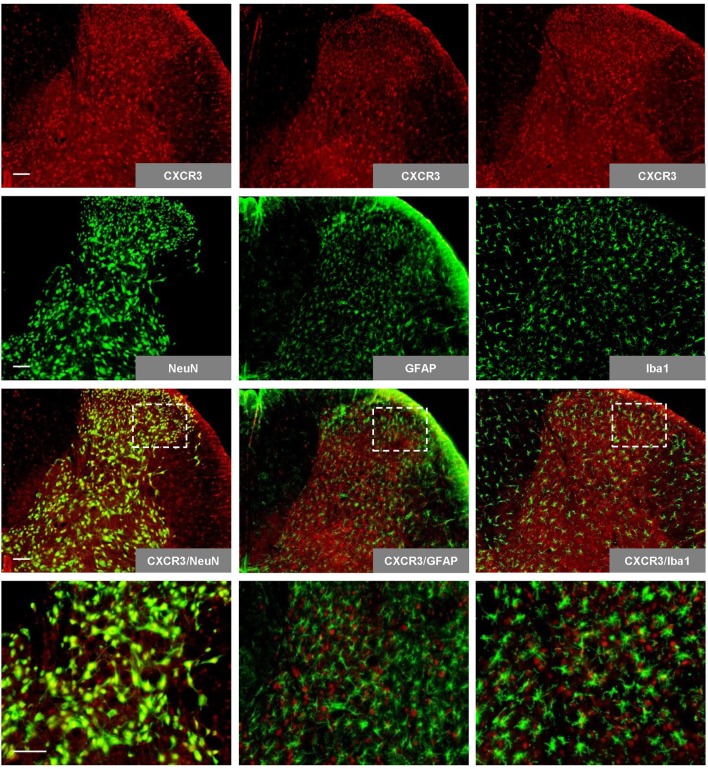
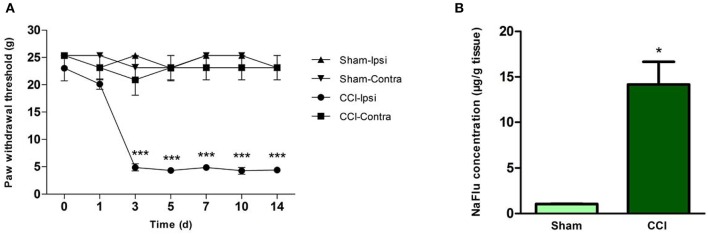
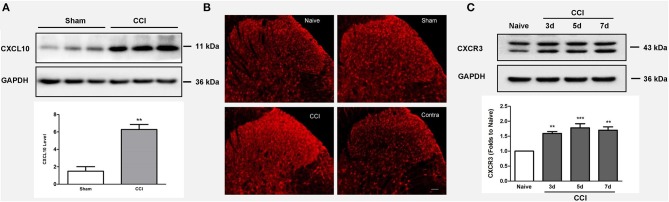
Neuropathic pain is among the most debilitating forms of chronic pain. Studies have suggested that chronic pain pathogenesis involves neuroimmune interactions and blood-spinal cord barrier (BSCB) disruption. However, the underlying mechanisms are poorly understood. We modeled neuropathic pain in rats by inducing chronic constriction injury (CCI) of the sciatic nerve and analyzed the effects on C-X-C motif chemokine 10 (CXCL10)/CXCR3 activation, BSCB permeability, and immune cell migration from the circulation into the spinal cord. We detected CXCR3 expression in spinal neurons and observed that CCI induced CXCL10/CXCR3 activation, BSCB disruption, and mechanical hyperalgesia. CCI-induced BSCB disruption enabled circulating T cells to migrate into the spinal parenchyma. Intrathecal administration of an anti-CXCL10 antibody not only attenuated CCI-induced hyperalgesia, but also reduced BSCB permeability, suggesting that CXCL10 acts as a key regulator of BSCB integrity. Moreover, T cell migration may play a critical role in the neuroimmune interactions involved in the pathogenesis of CCI-induced neuropathic pain. Our results highlight CXCL10 as a new potential drug target for the treatment of nerve injury-induced neuropathic pain.
神经病理性疼痛是最具致残性的慢性疼痛形式之一。研究表明,慢性疼痛的发病机制涉及神经免疫相互作用和血脊髓屏障(BSCB)的破坏。然而,其潜在机制尚不清楚。我们通过诱导大鼠坐骨神经慢性缩窄性损伤(CCI)来建立神经病理性疼痛模型,并分析其对 C-X-C 基序趋化因子 10(CXCL10)/CXCR3 激活、BSCB 通透性以及免疫细胞从循环向脊髓迁移的影响。我们检测到脊髓神经元中的 CXCR3 表达,并观察到 CCI 诱导了 CXCL10/CXCR3 的激活、BSCB 的破坏以及机械性痛觉过敏。CCI 诱导的 BSCB 破坏使循环中的 T 细胞能够迁移到脊髓实质中。鞘内给予抗 CXCL10 抗体不仅减弱了 CCI 诱导的痛觉过敏,还降低了 BSCB 的通透性,表明 CXCL10 是 BSCB 完整性的关键调节因子。此外,T 细胞的迁移可能在涉及 CCI 诱导的神经病理性疼痛发病机制的神经免疫相互作用中起关键作用。我们的研究结果强调了 CXCL10 作为一种治疗神经损伤诱导的神经病理性疼痛的新的潜在药物靶点。