Fundação Oswaldo Cruz, Escola Nacional de Saúde Pública Sergio Arouca, Programa de Pós-Graduação Stricto Sensu em Epidemiologia em Saúde Pública, Rio de Janeiro, RJ, Brasil.
Fundação Oswaldo Cruz, Escola Nacional de Saúde Pública Sergio Arouca, Departamento de Epidemiologia e Métodos Quantitativos, Rio de Janeiro, RJ, Brasil.
Rev Soc Bras Med Trop. 2020 Apr 3;53:e20190563. doi: 10.1590/0037-8682-0563-2019. eCollection 2020.
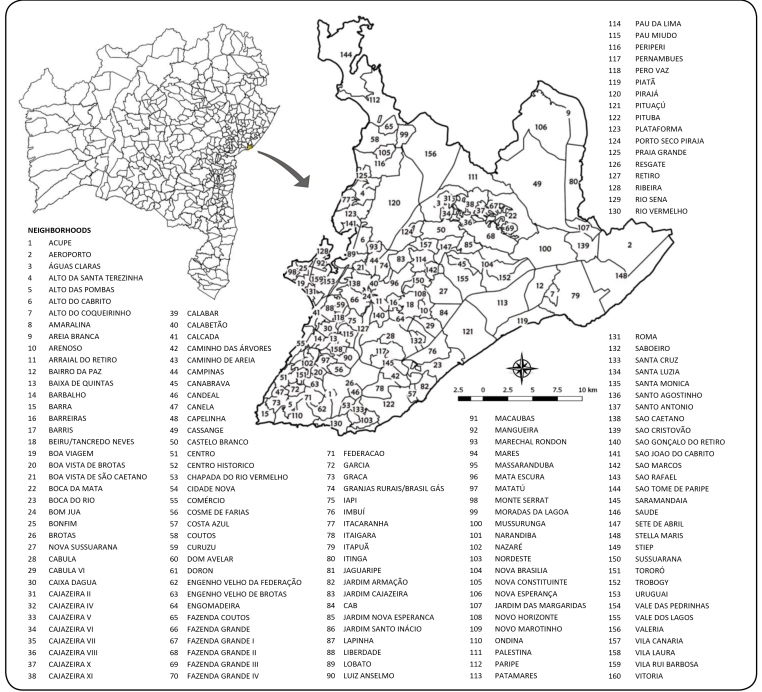
The recent emergence and rapid spread of Zika and Chikungunya fevers in Brazil, occurring simultaneously to a Dengue fever epidemic, together represent major challenges to public health authorities. This study aimed to identify and compare the 2015-2016 spatial diffusion pattern of Zika, Chikungunya, and Dengue epidemics in Salvador-Bahia.
We used two study designs comprising a cross-sectional-to-point pattern and an ecological analysis of lattice data. Residential addresses involving notified cases were geocoded. We used four spatial diffusion analysis techniques: (i) visual inspection of the sequential kernel and choropleth map, (ii) spatial correlogram analysis, (iii) spatial local autocorrelation (LISA) changes analysis and, (iv) nearest neighbor index (NNI) modeling.
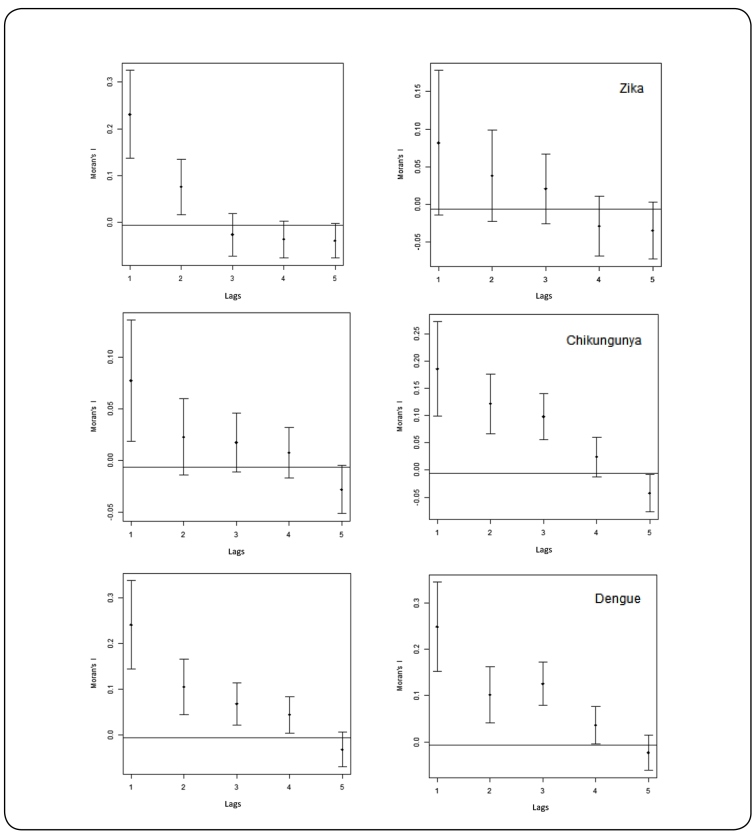
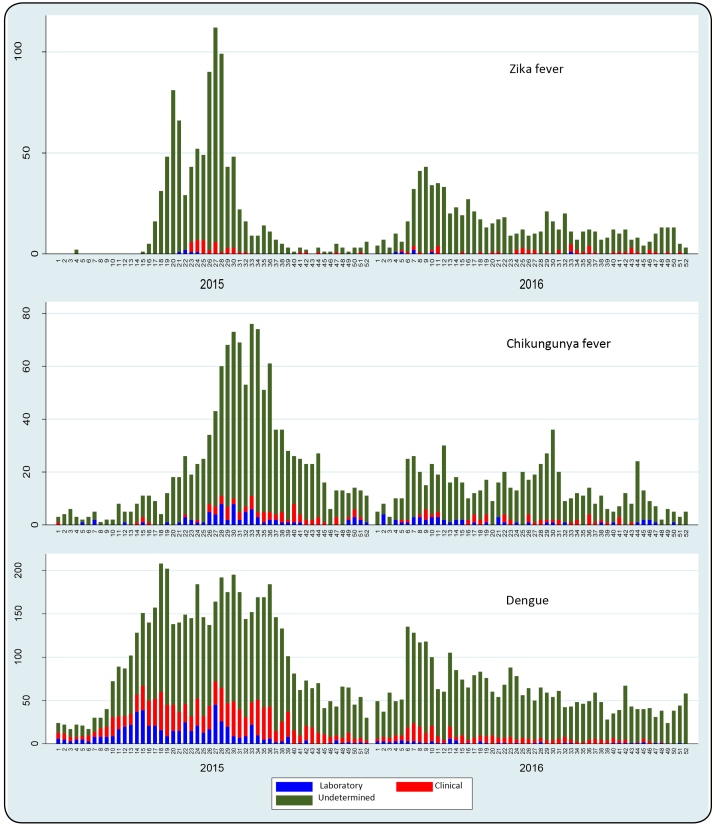
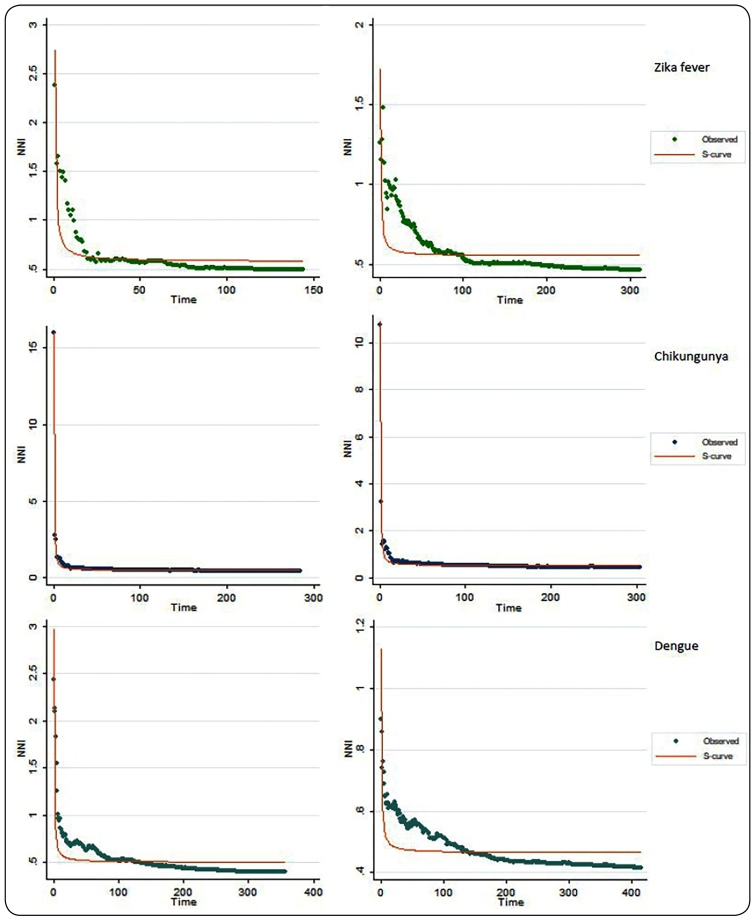
Kernel and choropleth maps indicated that arboviruses spread to neighboring areas near the first reported cases and occupied these new areas, suggesting a diffusion expansion pattern. A greater case density occurred in central and western areas. In 2015 and 2016, the NNI best-fit model had an S-curve compatible with an expansion pattern for Zika (R2 = 0.94; 0.95), Chikungunya (R2 = 0.99; 0.98) and Dengue (R2 = 0.93; 0.99) epidemics, respectively. Spatial correlograms indicated a decline in spatial lag autocorrelations for the three diseases (expansion pattern). Significant LISA changes suggested different diffusion patterns, although a small number of changes were detected.
These findings indicate diffusion expansion, a unique spatial diffusion pattern of Zika, Chikungunya, and Dengue epidemics in Salvador-Bahia, namely. Knowing how and where arboviruses spread in Salvador-Bahia can help improve subsequent specific epidemic control interventions.
寨卡和基孔肯雅热的近期出现和在巴西的快速传播,与登革热疫情同时发生,这对公共卫生当局构成了重大挑战。本研究旨在确定并比较萨尔瓦多-巴伊亚 2015-2016 年寨卡、基孔肯雅热和登革热疫情的空间扩散模式。
我们使用了两种研究设计,包括横断面-点模式和格网数据的生态分析。涉及报告病例的居住地址进行了地理编码。我们使用了四种空间扩散分析技术:(i)顺序核和专题图的视觉检查,(ii)空间相关图分析,(iii)空间局部自相关(LISA)变化分析,以及(iv)最近邻指数(NNI)建模。
核和专题图表明,虫媒病毒传播到第一个报告病例附近的邻近地区,并占领了这些新地区,表明存在扩散扩展模式。在 2015 年和 2016 年,NNI 最佳拟合模型与寨卡(R2=0.94;0.95)、基孔肯雅热(R2=0.99;0.98)和登革热(R2=0.93;0.99)疫情的扩张模式相兼容。空间相关图表明,三种疾病的空间滞后自相关呈下降趋势(扩张模式)。显著的 LISA 变化表明存在不同的扩散模式,尽管检测到的变化数量较少。
这些发现表明,在萨尔瓦多-巴伊亚,寨卡、基孔肯雅热和登革热疫情存在扩散扩展模式,这是一种独特的空间扩散模式。了解虫媒病毒在萨尔瓦多-巴伊亚的传播方式和传播范围,可以帮助改进随后的特定疫情控制干预措施。